Renting a car for a single day flips the usual insurance decision: the counter waiver costs the least it ever will, but so does every alternative. This guide covers one day rental car insurance the way a rental agent never will — which layers you already have for free, and when paying at the counter is the smart move.
Quick Answer
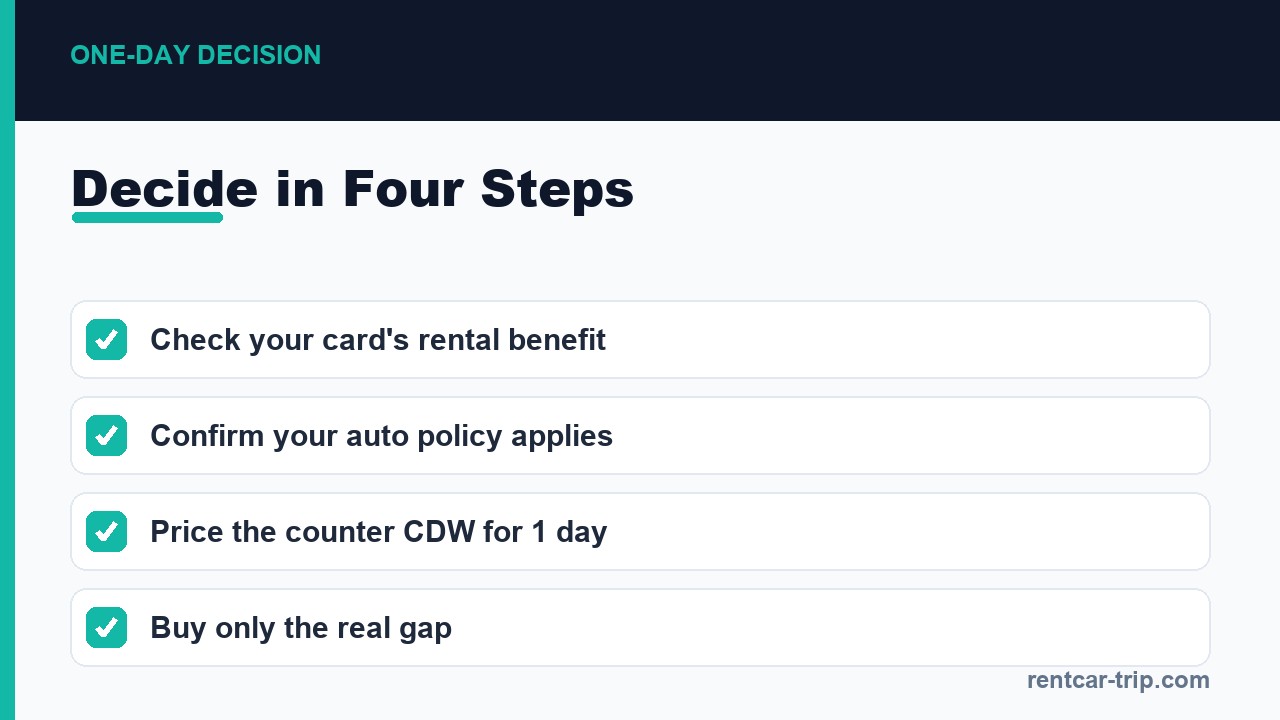
Usually, you do not need to buy anything at the counter for a one-day rental. The cheapest complete setup for most US renters is a credit card with rental collision coverage plus the liability limits on your existing auto policy — typically at no extra cost.
- Pay with a credit card that includes rental collision coverage and decline the counter damage waiver — that is the single biggest one-day saving.
- Your personal auto policy generally extends its coverage and deductibles to a rental used for personal driving, according to the Insurance Information Institute.
- If you carry no auto policy at all, a one-day counter package (damage waiver plus supplemental liability) is often a rational buy because the absolute cost is one day’s fee.
- Third-party standalone policies bought online before pickup usually undercut counter pricing, but most reimburse you after the fact rather than paying the rental company directly.
- Never drive with zero liability coverage — damage to the rental car is a capped risk, but injuring someone else is not.
Last Checked
This guide was last checked on July 12, 2026. Policies vary by company, location, and rental terms, so confirm your own agreement.
The One-Day Math: Why a Single Day Changes the Decision
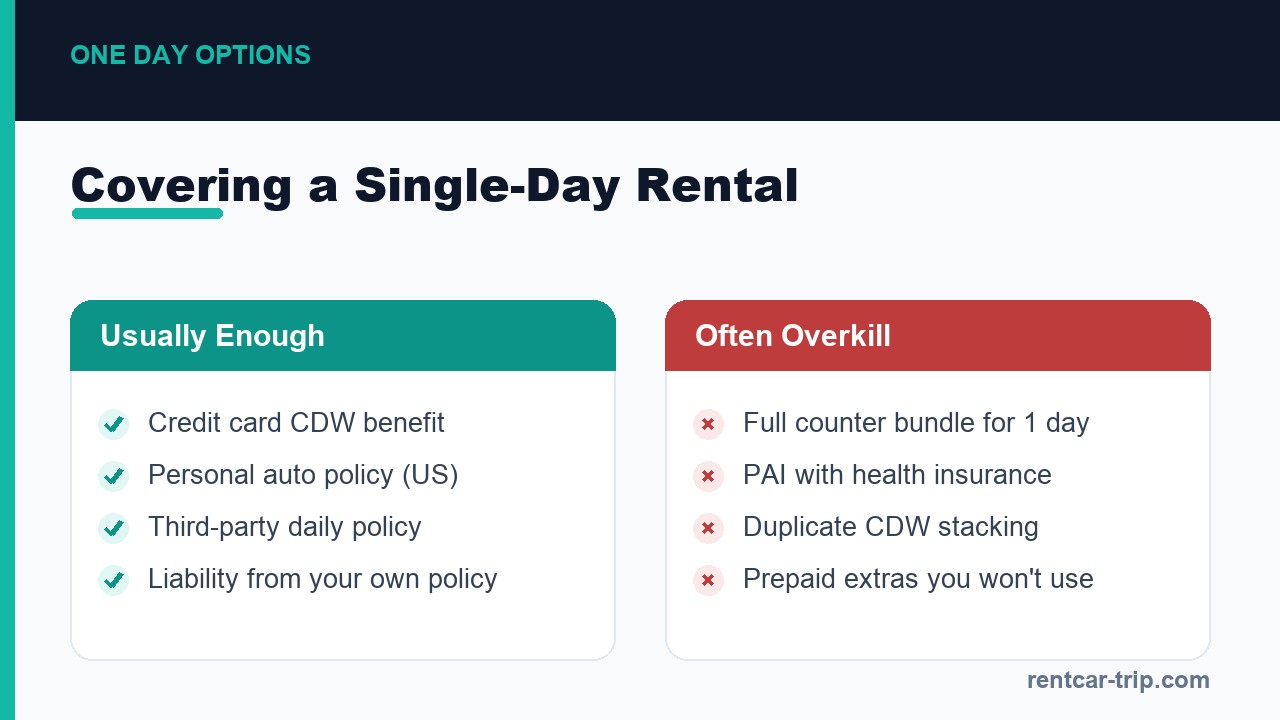
On a week-long rental, counter protection products can quietly double the bill, which is why most advice says decline them. A one-day rental compresses that logic: declining the per-day waiver saves one day’s fee, and buying it costs the lowest absolute price the product will ever have. That is why the right answer for a single day depends almost entirely on what coverage you already carry, not on the sticker price.
Two facts anchor the math. First, a counter damage waiver is not insurance; it is a contract in which the rental company agrees to waive its claim against you for damage or theft. Enterprise states this plainly in its US protection-products FAQ. Second, the waiver is voided by prohibited uses listed in the agreement — unauthorized drivers, off-road driving, DUI — so it is not an unconditional shield even after you pay.
| Option | One-day cost pattern | Best when | Key limitation |
|---|---|---|---|
| Counter damage waiver (CDW/LDW) | Flat per-day fee at pickup; varies widely by company and location | No card coverage, no personal policy, or you want a zero-hassle walk-away | Not insurance; voided by prohibited use; covers the car, not other people |
| Credit card rental coverage | Free when you pay with the card and decline the waiver | Almost every one-day rental where your card includes the benefit | Usually secondary; almost never includes liability |
| Personal auto policy | No added cost; your normal deductible applies | You carry collision and comprehensive on your own car | A claim can raise future premiums; deductible is out of pocket |
| Third-party standalone policy | Low flat daily premium bought online before pickup | You rent occasionally with neither card coverage nor a personal policy | Typically reimburses you later; the rental company may charge your card first |
| Supplemental liability (SLP/SLI) | Per-day counter fee; Enterprise cites an average of roughly $8 to $42 per day by location | You have no auto liability policy of your own | Covers claims against you, not damage to the rental itself |
Credit Cards and Your Own Policy: The Free Layer
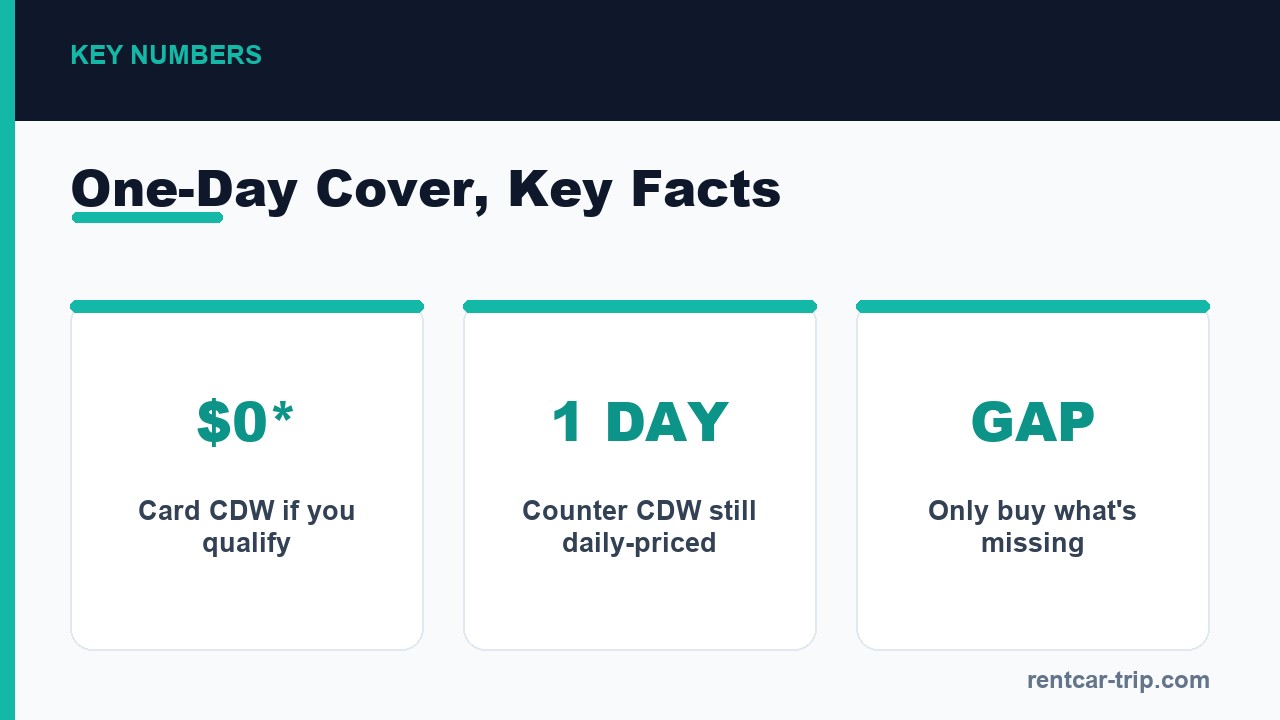
For a one-day rental, the cheapest complete coverage is usually a credit card with rental collision protection stacked on top of your own auto liability policy. Many US credit cards include a rental damage benefit, but the details are contract-specific: you generally must pay for the entire rental with that card, decline the company’s waiver, and be the primary renter. Read your card’s guide to benefits before you book.
Credit card rental coverage is almost always secondary, which means it pays only after your personal auto policy has paid first. If you carry collision on your own car, a secondary card benefit mostly picks up your deductible and some fees. Some premium travel cards offer primary rental coverage, which lets you skip your own insurer entirely — valuable, because even a small paid claim can follow you at renewal. The Insurance Information Institute recommends asking your card issuer for its coverage terms in writing before relying on the benefit.
One gap matters more than any other: credit cards cover damage to the rental car, not damage you do to other people. Liability must come from somewhere else — your own auto policy, the state-minimum protection rental companies provide where required, or supplemental liability at the counter. If you carry no auto policy, treat liability, not the damage waiver, as the one product worth paying for on a single day.
When Paying at the Counter Actually Makes Sense
Skipping every extra is the right call for most one-day renters, but not all. Buy the counter damage waiver, or a cheaper third-party equivalent, when any of these is true: you have no card coverage and no collision on your own policy; your deductible is high enough that a scraped bumper would cost more than the waiver; or you want the transaction closed the moment you drop the keys. The walk-away convenience of a waiver is genuinely worth something on a tight-turnaround day.
Buy supplemental liability when you have no auto policy, because liability claims — not fender scratches — are what generate six-figure losses. Skip personal accident insurance and personal effects coverage if you already have health insurance and renters or homeowners coverage; those counter products largely duplicate protection most people already carry.
Common Mistakes To Avoid
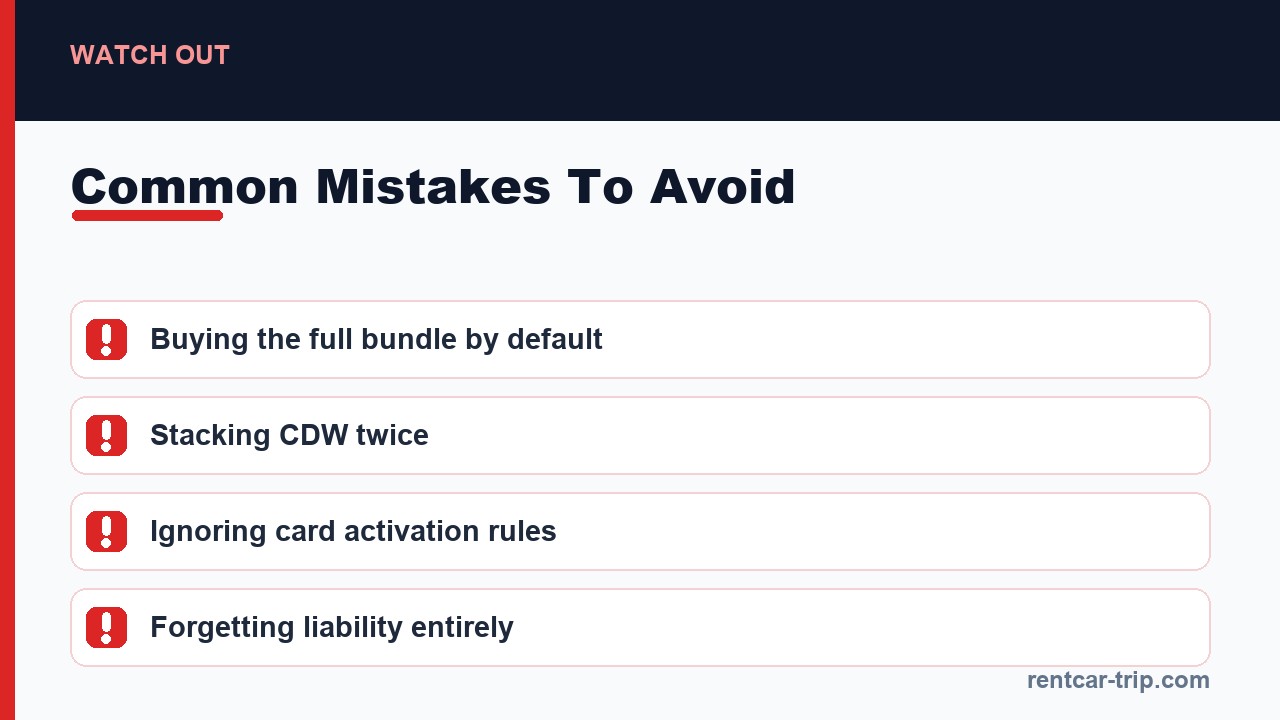
- Assuming a debit card carries rental coverage — the damage benefit is a credit card feature, and paying with debit usually forfeits it.
- Accepting the waiver “just in case” without checking your card’s benefits guide, which often makes the fee pure duplication.
- Declining everything with no personal auto policy, which leaves you bare on liability — the one risk with no upper limit.
- Letting a friend drive when only you are on the agreement; unauthorized drivers can void both the waiver and card coverage.
- Confusing the damage waiver with liability protection; they cover opposite directions of risk, and one does not substitute for the other.
Frequently Asked Questions
Can I buy rental car insurance for just one day?
Yes. Every counter protection product — damage waiver, supplemental liability, personal accident coverage — is priced and sold per rental day, so a one-day rental means one day’s fee. Third-party standalone policies sold online also price by the day, and a few sellers offer annual plans that can be cheaper for frequent renters.
Is my credit card enough coverage for a one-day rental?
Usually it is enough for damage to the car, but not for liability. Card benefits typically cover collision damage and theft when you pay with the card and decline the counter waiver. They almost never cover injuries or property damage you cause to others, so you still need liability from your own auto policy or another source.
Do I need extra insurance if I have full coverage on my own car?
Usually not for a personal-use rental. The Insurance Information Institute notes that your auto policy’s coverage and deductibles generally extend to a rental driven for recreation rather than business. The counter waiver’s remaining value is convenience: it spares you a claim on your own policy and a deductible if something happens.
How much does one day of coverage cost at the counter?
It varies widely by company, location, and car class, so treat any single number with suspicion. As one verified reference point, Enterprise’s US FAQ lists its supplemental liability protection at an average of roughly $8 to $42 per day depending on location. Damage waiver pricing is similarly location-driven; airport branches often quote the high end.
What happens if I decline everything and damage the car?
You are contractually responsible for the damage, plus fees the agreement allows, such as loss of use and administrative charges. You would then claim against your personal auto policy, your credit card benefit, or a standalone policy you bought. Keep photos from pickup and return — they are your best evidence if the bill looks inflated.
Does one-day coverage work the same for Turo and other peer-to-peer rentals?
Often it does not. Many credit card rental benefits and some personal auto policies exclude peer-to-peer platforms, and Triple-I notes that insurance offered by car sharing programs is not standardized. For a one-day Turo trip, the platform’s own protection plans are frequently the only option that clearly applies, so read the exclusions first.
Official and Primary Sources Used
- FTC Consumer Advice: Renting a Car – supports comparing total cost including optional per-day add-ons.
- Insurance Information Institute: Rental Car Insurance – supports personal-policy extension to rentals and secondary credit card coverage.
- Enterprise Rent-A-Car: Car Rental Insurance and Protection Products (US) – supports the damage waiver being optional and not insurance, and the supplemental liability daily price range.
- FTC Consumer Alert: Renting a Car – Factoring in the Fees – supports how optional daily items and fees inflate the advertised rental price.