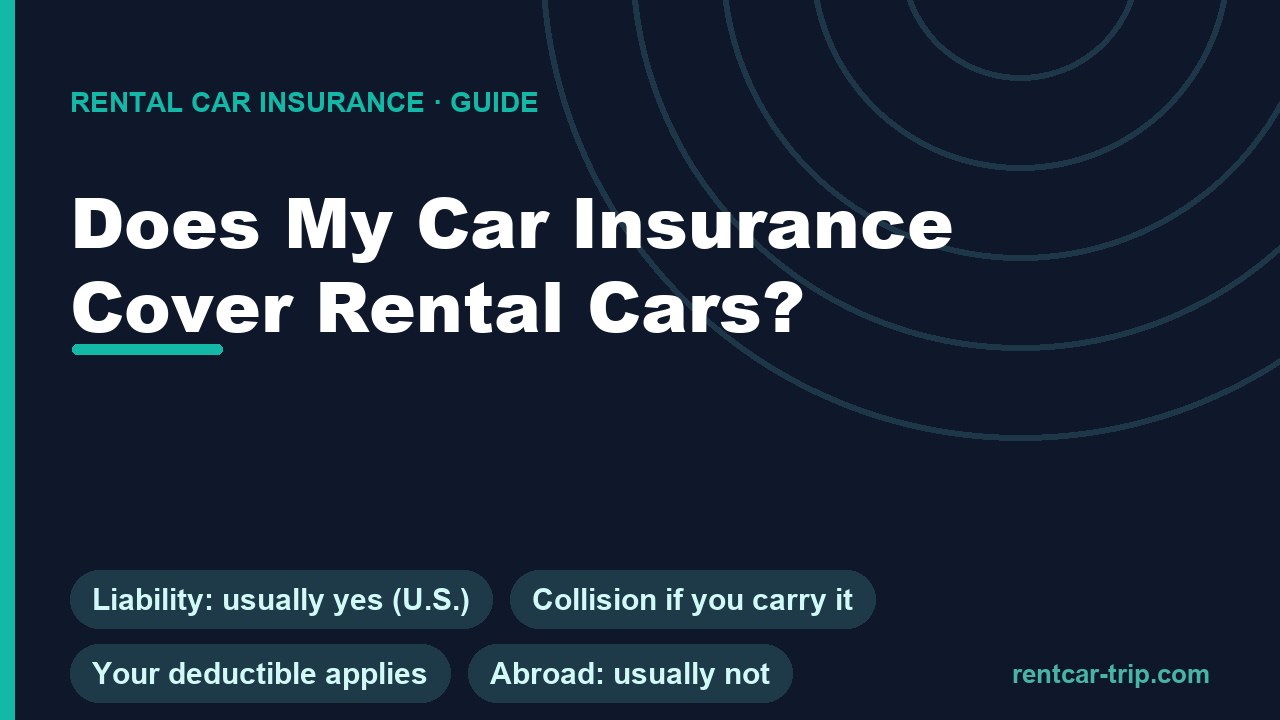
You are at the rental counter, the agent is offering a stack of waivers, and you are wondering whether you already pay for this back home. The honest answer to does my car insurance cover rental cars is “usually yes inside the United States, but only the coverages you already carry, and rarely abroad.” This guide shows you exactly what transfers, what does not, and how to confirm it before you sign.
Quick Answer
Usually yes for domestic rentals, because most U.S. personal auto policies extend your existing liability, collision, and comprehensive coverage (and the same deductibles) to a rental car you use for personal travel. It typically does not extend outside the U.S., and it never adds coverage you already dropped.
- Your liability coverage almost always follows you into a U.S. rental car for personal use.
- Collision and comprehensive transfer only if you carry them on your own car, and your deductible still applies.
- Coverage usually stops at the U.S. border; Mexico, and often other countries, require separate insurance.
- Business use, exotic vehicles, and large trucks or vans are commonly excluded from personal policy coverage.
- Rental-specific costs like loss of use, diminished value, and admin fees may not be fully paid by your policy.
Last Checked
This guide was last checked on June 28, 2026. Coverage varies by policy, card, provider, country, and rental terms, so confirm your own documents.
How Your Personal Auto Policy Treats A Rental Car
In most cases, a U.S. personal auto policy treats a rental car much like a “temporary substitute” for your own vehicle. The Insurance Information Institute explains that whatever auto coverage and deductibles you carry on your own car generally apply when you rent, as long as you are using the rental for personal travel rather than business. That means the protection is real, but it is also a mirror of what you already own.
The key word is “extend.” Your policy does not create brand-new coverage for the rental; it stretches your current coverage over to it. So if you carry only state-minimum liability and dropped collision and comprehensive to save money, the rental car inherits exactly that gap. The FTC makes the same point: you may already be covered by your own auto policy, but you should check your policy and call your insurer if you are unsure.
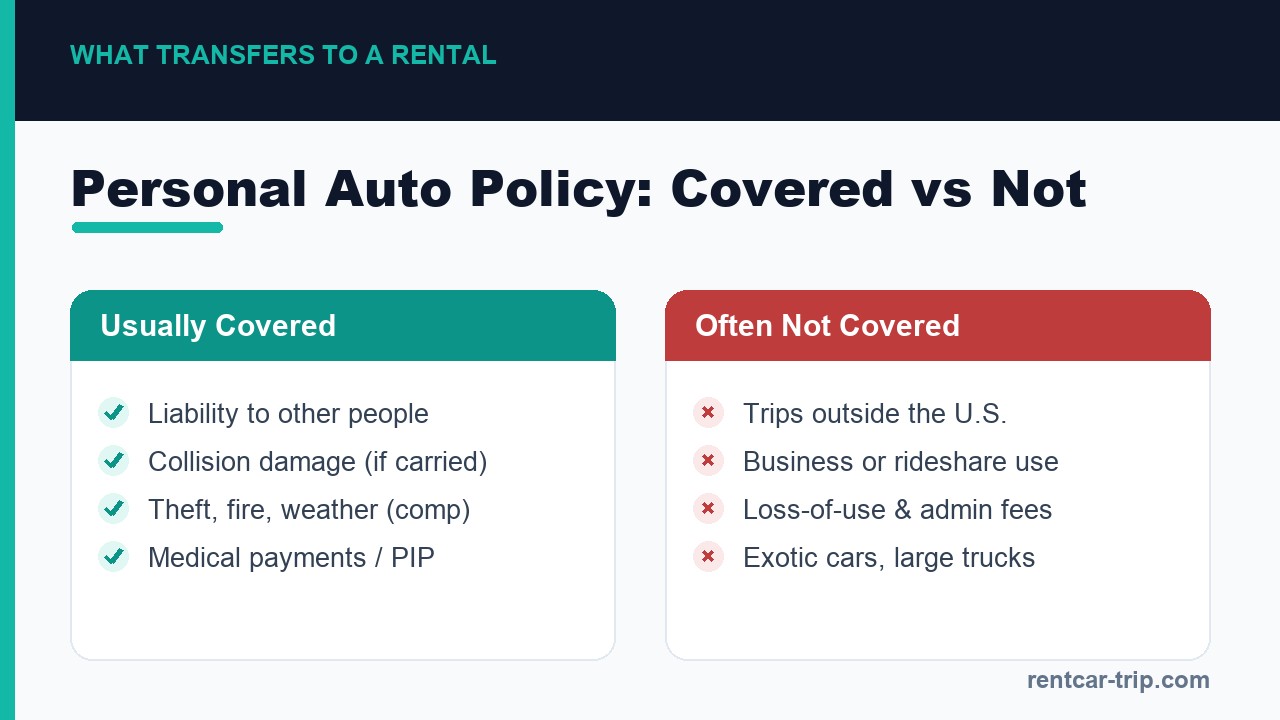
Three coverage types usually transfer. Liability pays for injuries and damage you cause to other people and their property. Collision pays to repair or replace the rental after a crash, minus your deductible. Comprehensive pays for theft, fire, vandalism, hail, and similar non-crash damage, also minus your deductible. Medical payments or personal injury protection often follow as well, depending on your state and policy.
What Your Policy Pays For Versus What It Often Skips
Personal auto coverage is strong on the basics and weak on the rental-specific extras. Rental companies charge fees that a standard policy was never designed to handle, which is where many travelers get a surprise bill. The table below shows the typical pattern; your own contract is the final word.
| Item | Personal Auto Policy (Typical) | Notes |
|---|---|---|
| Liability (injury/damage to others) | Usually covered | Up to your policy limits; personal use only. |
| Collision damage to the rental | Covered if you carry collision | Your deductible applies. |
| Theft / vandalism / weather | Covered if you carry comprehensive | Your deductible applies. |
| Your medical costs | Often covered (MedPay/PIP) | Varies by state and policy. |
| Loss of use (rental’s lost income) | Often limited or excluded | A common gap a CDW/LDW closes. |
| Diminished value & admin fees | Frequently not fully paid | Read the rental damage policy. |
| Use outside the U.S. | Usually not covered | Mexico needs separate insurance. |
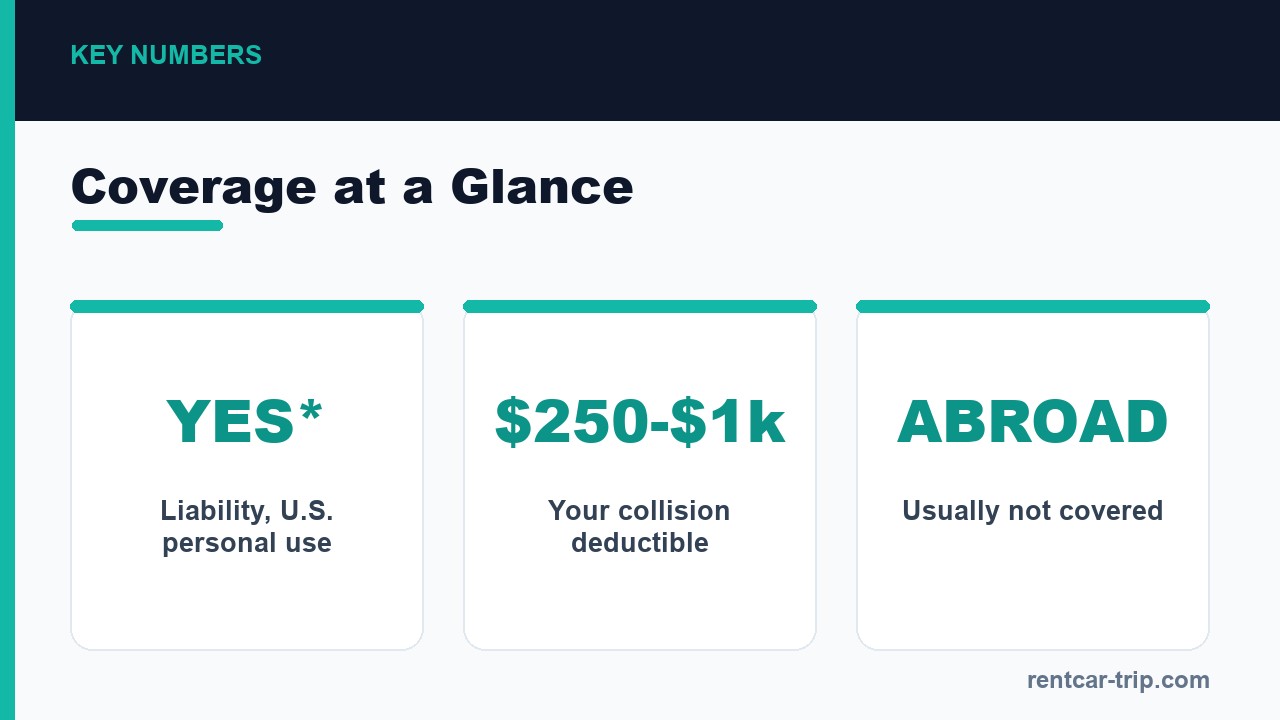
This is why the counter waiver still has a job to do. A collision or loss damage waiver (CDW/LDW) is not insurance; it is the rental company agreeing not to charge you for damage, and it often covers loss-of-use and fees that your policy resists. Your deductible is also worth a hard look: if your collision deductible is high, a single dented bumper could cost more out of pocket than a few days of waiver.
Your credit card can fill part of the remaining gap. Most card rental benefits are secondary in the U.S., meaning they pay after your personal policy and frequently reimburse your deductible rather than acting first. To use a card benefit you almost always must decline the rental company’s own damage waiver and pay with that card.
Domestic Versus Abroad: The Border Changes Everything
Inside the United States, the default assumption of “my policy follows me” usually holds. Cross a border and that assumption collapses. Most U.S. personal auto policies provide little or no coverage outside the country, and some explicitly exclude foreign rentals entirely. Mexico is the clearest example: U.S. liability coverage is generally not recognized there, and Mexican law requires separate, locally valid liability insurance to drive legally.
Other countries vary widely. In many destinations, basic liability is bundled into the rental rate by law, while collision-type damage is handled through a waiver with a high excess (the foreign term for deductible). Credit card damage benefits sometimes work abroad, but they exclude specific countries and vehicle types, so the card’s exclusion list matters as much as the benefit itself. Before any international trip, confirm coverage in writing from your insurer, your card issuer, and the rental company.
Common Mistakes To Avoid
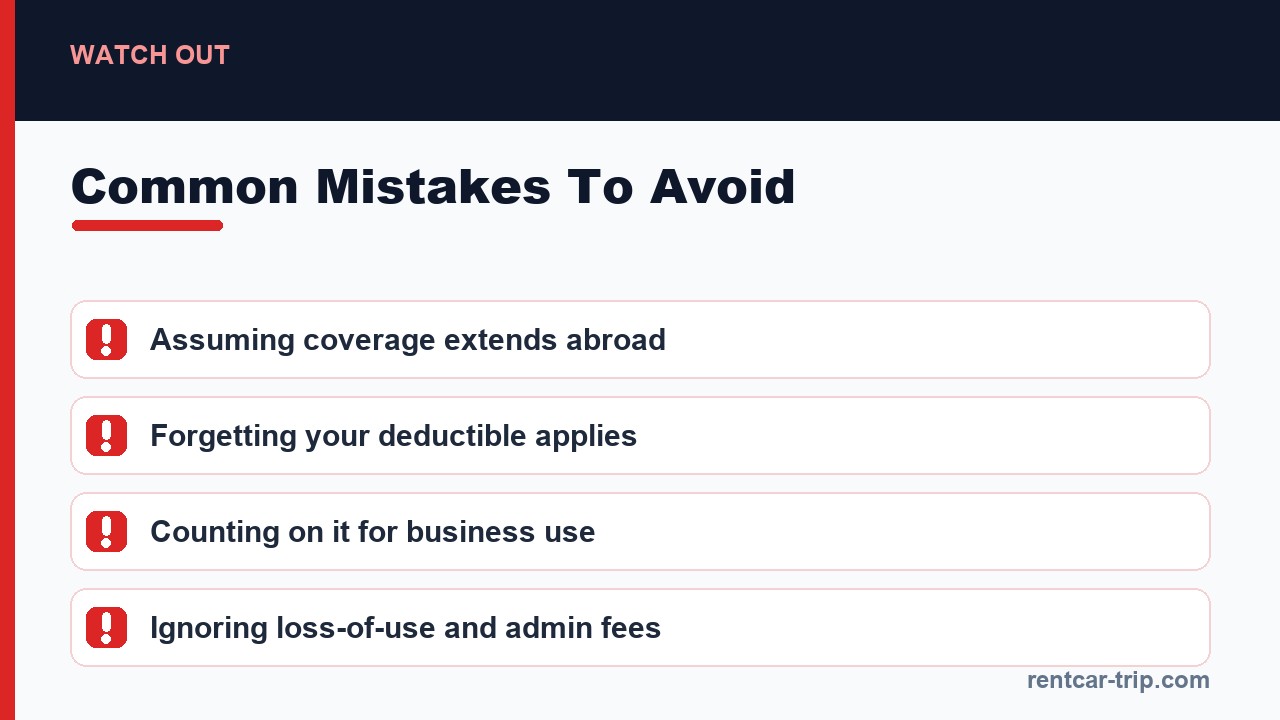
- Assuming “full coverage” means full rental coverage. If you dropped collision or comprehensive on your own car, the rental inherits that gap.
- Forgetting the deductible. Your policy may pay for rental damage, but you still owe your deductible out of pocket.
- Renting for business on a personal policy. Business or commercial use is a common exclusion that can void the extension entirely.
- Treating a card benefit as primary. Most U.S. card coverage is secondary and only reimburses what your policy leaves behind.
- Skipping the international check. Driving a foreign rental on a U.S. policy can leave you uninsured, especially in Mexico.
- Ignoring loss of use and fees. These rental-specific charges are exactly what a waiver covers and your policy may not.
How Each Personal Auto Coverage Type Applies to a U.S. Rental
Your personal auto policy is not one switch that is either “on” or “off” for a rental car. Each individual coverage type extends differently, applies its own limit or deductible, and carries its own exclusions. The table below maps the four coverages that make up a standard U.S. auto policy against a rented passenger vehicle used for personal travel. The core principle comes straight from the Insurance Information Institute: “whatever auto insurance and deductibles you have on your own car would apply when you rent a car (providing you are using the rental car for recreation and not for business).”
| Coverage type on your policy | Does it generally extend to a U.S. rental? | Limit & deductible that apply | Key exclusions & gaps to check |
|---|---|---|---|
| Bodily-injury & property-damage liability | Typically yes for a personal-use rental of a standard vehicle, as long as you carry liability on your own policy. | Your existing per-person and per-accident limits apply; liability has no deductible. The III notes rental companies must provide the state-required minimum liability, which “often does not provide enough protection,” so your own policy commonly sits on top of that minimum, though state law and the rental contract can change whether it is primary or excess. | Business or for-hire (rideshare/delivery) use is a common exclusion; state-minimum limits may be too low; liability never pays for damage to the rental car itself. |
| Collision | Only if you already carry collision on at least one vehicle on your policy. The III warns that if you dropped it to save money, “you may not be covered if your rental car is stolen or damaged.” | Your own collision deductible typically carries over to the rental; the policy pays repair cost above that deductible. | Loss-of-use, administrative, and diminished-value fees the rental company bills are often not paid unless your policy or a rider covers them (the III lists these as extras to verify); exotic, antique, and larger trucks/cargo vans are often excluded; driving on restricted roads, DUI, or an unauthorized/unlisted driver can void the coverage. |
| Comprehensive (other-than-collision: theft, vandalism, weather, glass) | Only if you carry comprehensive on your own policy; the same “if you dropped it, you may not be covered” warning applies. | Your comprehensive deductible applies; pays up to the vehicle’s actual cash value. | Personal belongings stolen from the car are not covered by auto comprehensive; the III states those losses fall to your homeowners or renters insurance (“not your car insurance”), which generally covers belongings damaged or stolen out of a vehicle. Specialty vehicles are commonly excluded. |
| Medical payments (MedPay) or Personal Injury Protection (PIP) | Generally follows you into a rental you are driving, in the states and amounts you carry it (PIP is required in some no-fault states, MedPay is optional in others). | Your existing MedPay/PIP limit applies and coordinates with your health insurance; these limits are usually modest. | A rental counter “personal accident insurance” upsell often duplicates what your MedPay/PIP plus health coverage already provide; PIP/MedPay typically does not follow you abroad. |
Two limits cut across every row. First, geography: most personal auto policies extend only within the United States (and usually Canada), so a rental in Mexico or overseas generally needs separate, locally valid insurance regardless of what your home policy says. Second, vehicle class: coverage is written for standard passenger cars, vans, and pickups, so exotics, motorcycles, and heavier moving/box trucks are frequently outside the policy. As of July 2026, treat these as starting points and verify the current terms and your specific limits with your provider before you rent.
How to Confirm Rental Coverage With Your Insurer: A Specific Checklist
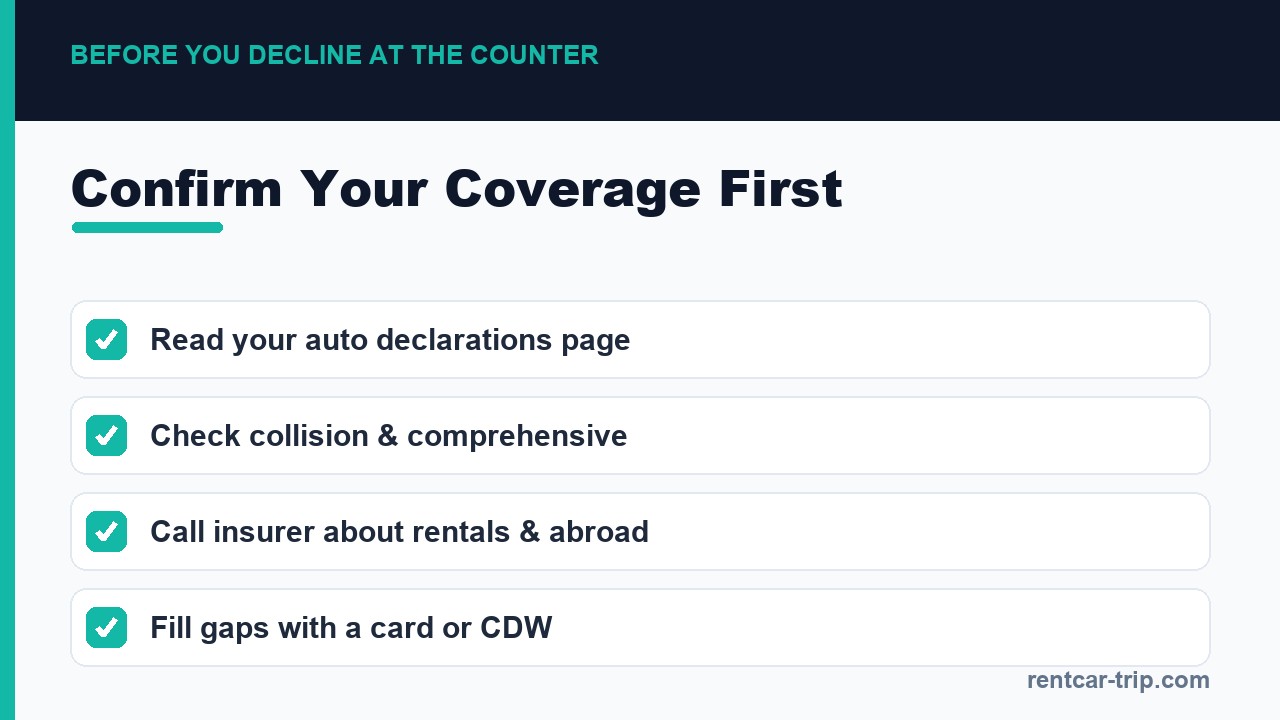
Generic advice says “call your insurer.” The problem is that most people ask “am I covered?” and accept a vague yes. Ask instead about the exact points that create coverage gaps, using your policy declarations page in front of you. Work through this list and get the answers in writing (an emailed confirmation or a claim-reference note), because the FTC’s guidance is explicit that you may already be covered by your own car or homeowner’s insurance and should check your policies before you pay for anything at the counter.
- On your declarations page, confirm that both collision and comprehensive are actually listed on at least one vehicle. Per the III, if you dropped these coverages, damage to or theft of the rental may not be covered.
- Ask which deductible applies to a rental claim. Confirm the dollar figure, since your own deductible typically carries over to the rented car.
- Ask whether your liability is primary or excess in your state for a rental, and read back your per-person, per-accident, and property-damage limits so you know if they are high enough (the III cautions that the rental company’s state-minimum liability often is not).
- State the trip’s geography explicitly (for example “U.S. only,” “into Canada,” or “Mexico”) and confirm the policy’s territorial limits for that route.
- If any part of the trip is work-related, ask directly about the business-use exclusion, and separately check whether an employer policy covers you, as the FTC notes business travelers sometimes are.
- Name the vehicle class you plan to rent (economy car, full-size van, pickup, or anything larger or specialty) and confirm it is not an excluded vehicle type.
- Ask specifically whether your policy pays loss-of-use, administrative, and diminished-value fees, or whether you need a rider, since the III lists these as extras to check, so you know the size of any gap before deciding on counter coverage.
- Ask the maximum rental duration your policy covers if the trip runs long, and confirm every intended driver is eligible under your policy.
- If you plan to rely on a credit card benefit instead, remember the FTC’s point that you generally must pay with that card and decline the rental company’s collision waiver to be eligible; the FTC also warns such a waiver will not pay for injuries to you or damage to your personal property, and a card’s collision benefit is typically secondary and does not cover your liability for injury or damage to others.
As of July 2026, insurers and card issuers change these terms periodically, so verify the current details with your provider and card benefits administrator each time rather than relying on a past answer.
Sources verified for this section: iii.org, consumer.ftc.gov
Frequently Asked Questions
Does my car insurance cover a rental car if I have full coverage?
Generally yes, for personal use inside the U.S. “Full coverage” usually means you carry liability, collision, and comprehensive, and those typically extend to a rental along with your deductibles. It still will not pay coverages you do not carry, and it usually will not cover business use or driving outside the country.
Will I still owe a deductible if my insurance covers the rental?
Yes. When your collision or comprehensive coverage pays for rental damage, your normal deductible applies just as it would on your own car. If your deductible is high, a small repair may cost more than declining the waiver saved you. A credit card benefit can sometimes reimburse that deductible afterward.
Does my U.S. auto insurance cover rental cars in other countries?
Usually not. Most U.S. personal auto policies provide little or no coverage abroad, and many exclude it outright. Mexico in particular requires separate Mexican liability insurance to drive legally. Always confirm international coverage with your insurer and buy local or card-based protection where your policy stops.
Is the rental counter CDW or LDW the same as my insurance?
No. A collision damage waiver or loss damage waiver is not insurance; it is the rental company waiving its right to charge you for damage. It often covers loss of use and administrative fees that your auto policy resists, and it has no deductible, which is why some renters buy it even with good coverage.
Does my insurance cover other drivers of the rental car?
Often only if they are listed on both your policy and the rental agreement. Coverage for additional drivers depends on your policy’s permissive-use rules and the rental contract, and an unlisted driver can void coverage entirely. Add every driver to the rental agreement and confirm with your insurer before handing over the keys.
How do I find out exactly what my policy covers?
Read your declarations page and call your insurer with the rental dates, destination, and vehicle type. Ask specifically about collision, comprehensive, deductibles, business use, and foreign travel. Get the answer in writing if you can, then compare it to the rental company’s damage policy so you know which gaps remain before you decline any waiver.
Official and Primary Sources Used
- Source – FTC consumer advice confirming you may already be covered by your own auto policy and explaining CDW/LDW limits and the need to decline the counter waiver to use a credit card benefit.
- Source – Insurance Information Institute on how your existing coverage and deductibles extend to a rental for personal (non-business) use.
- Source – Insurance Information Institute defining the core auto coverage types: liability, collision, and comprehensive.
- Source – Visa Auto Rental Collision Damage Waiver terms showing card coverage is secondary for personal rentals and requires declining the rental company’s CDW/LDW.