do you need rental car insurance can look simple in search results, but the real decision happens in the quote details, counter terms, and return receipt. The pressure moment happens at the counter, but the best answer is decided before you leave home. Rental car coverage depends on your auto policy, credit card, trip location, business purpose, and risk tolerance.
Quick Answer
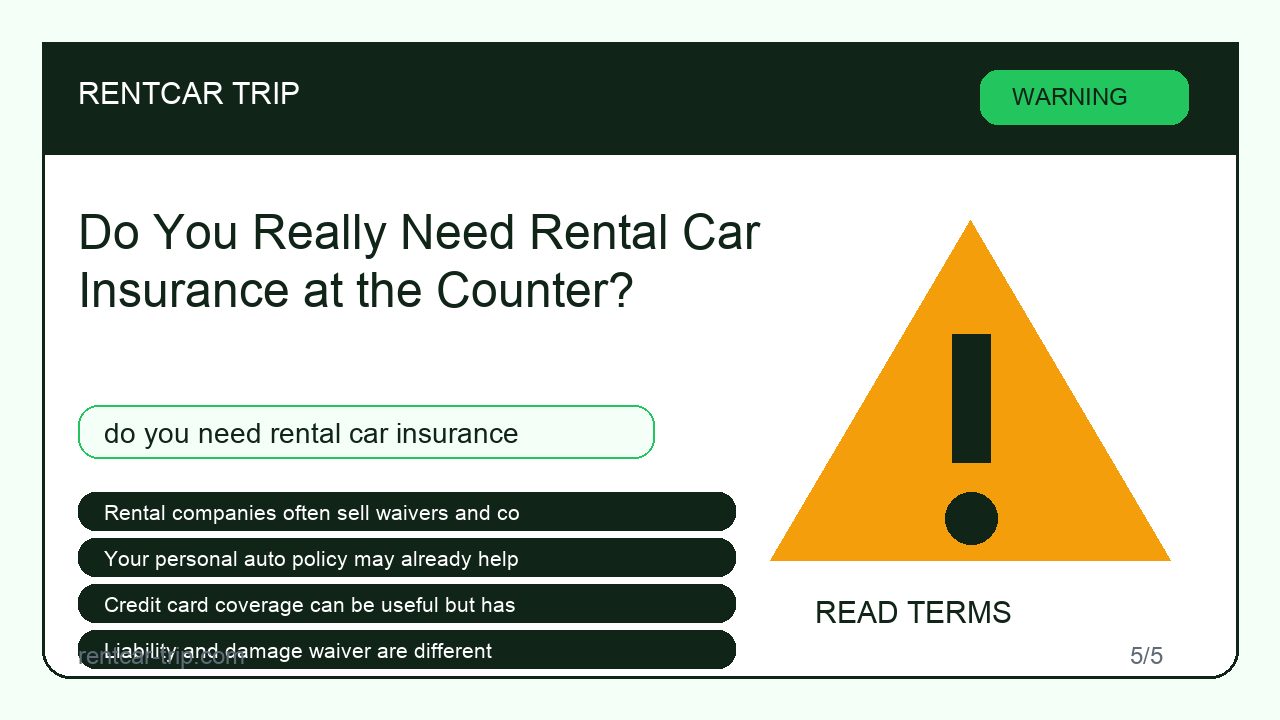
No, not always — counter coverage like CDW is often optional, so check first whether your personal auto policy or credit card already covers this rental, then buy at the counter only for the gaps they leave (liability, international trips, theft/damage waivers). Decide this before pickup so you’re not choosing under pressure at the desk.
- Map your existing coverage first: a personal auto policy may already help on some domestic rentals but commonly leaves international ones as a gap, and credit card coverage usually only reimburses damage/theft, is often secondary, and may not apply if you pay by debit card.
- Don’t confuse CDW (damage to the rental car) with liability (damage to others or their property) — they’re different protections, so ask the counter agent whether a waiver covers damage, liability, or both.
- Going abroad is the moment to be cautious: check the destination’s rules, the rental terms, and whether your domestic coverage applies before declining anything at the counter.
- Ask the deposit/hold question up front — how much is held and when it’s released — and confirm what happens with early/late return, returning below the fuel level, or toll roads.
- Buying at the counter is mainly worth it for convenience and a simpler claim path, or to fill a real gap; otherwise duplicate coverage just adds a daily cost.
Final Check Date
This guide was last checked on June 16, 2026. Rental car rules change by location, company, vehicle class, payment card, and season, so use this as a decision checklist and confirm the final terms in your own reservation.
Why This Rental Car Topic Gets Expensive Fast
The price card shown at the start of a booking flow is usually only one layer of the rental. A traveler still has to account for location-based charges, taxes, coverage choices, fuel policy, toll products, equipment, driver rules, and deposit holds.
The pattern is predictable: the earlier you separate mandatory charges from optional products, the less pressure you feel at pickup. That is especially important at airports, after long flights, or when family luggage makes it hard to pause and read every line.
Do You Really Need Rental Car Insurance at the Counter?: Cost and Decision Table
| Coverage source | May help with | Common gap |
|---|---|---|
| Personal auto policy | Liability and damage in some domestic rentals | International rentals |
| Credit card | Damage or theft waiver reimbursement | Liability, exclusions, secondary status |
| Rental counter option | Convenience and simpler claim path | Daily cost |
Step-by-Step Booking Checklist
- Call your auto insurer or read your policy before the trip.
- Check whether your credit card coverage is primary or secondary.
- Separate damage to the rental car from liability to other people or property.
- Read exclusions for country, vehicle type, rental length, and business use.
- Decide before the counter so pressure does not make the decision for you.
What To Check Before You Click Reserve
Use the quote page like a contract preview. Look for the final estimated total, mileage rule, fuel policy, cancellation language, payment card rules, coverage products, and location-specific fees. If a page shows only the base rate, keep clicking until you see taxes and fees.
For airport rentals, compare the convenience of landing and going straight to pickup against any concession, recovery, or facility charges. For city pickup, add the cost of reaching the branch and returning to the airport or station later.
Common Mistakes To Avoid
- Thinking every credit card covers every rental.
- Confusing CDW with liability insurance.
- Declining coverage abroad without checking local requirements.
- Forgetting that debit card bookings may not trigger card coverage.
Counter Script: Questions Worth Asking
- Is this item mandatory at this location, or optional?
- Does this waiver cover damage to the rental car, liability to others, or both?
- What happens if I return early, late, below fuel level, or through a toll road?
- How much is the deposit hold, and when is it released?
- Can I get the return receipt before leaving the lot?
Try the interactive tool
Rental Car Insurance Decision Tool
Answer four questions to see which coverage you likely already have and what, if anything, is worth buying at the counter. This is guidance, not a policy ruling.
Educational estimate only. Coverage depends on your exact policy, card benefits guide, and the rental agreement. Confirm damage AND liability coverage with your insurer and card issuer before you decline anything at the counter.
Counter add-ons compared: what each one actually covers (and what it doesn’t)
The rental desk usually offers four separate products, and they are easy to blur together. Neither the FTC nor the Insurance Information Institute (Triple-I) publishes set prices, because terms, limits, and pricing are not uniform across rental companies and states—so read your own rental agreement carefully. The daily figures below are typical amounts reported by consumer-finance sources as of mid-2026; your real price varies by rental company, vehicle class, pickup state, and season.
| Counter product | What it typically covers | What it does NOT cover | Typical price per day (varies) | Who most likely already has this |
|---|---|---|---|---|
| Collision / Loss Damage Waiver (CDW / LDW) | Technically a waiver, not insurance (Triple-I): the company waives its right to bill you for damage to, or theft of, the rental vehicle. An LDW often also covers “loss of use,” towing, and administrative fees. | Any injuries to you, or damage to your personal property (FTC). It does not cover liability to others, and it can be voided by speeding, driving on unpaved roads, or intoxicated driving (Triple-I). | About $15–$30/day; often higher for premium or luxury vehicles | Drivers who carry comprehensive and collision on their own auto policy may already be covered; many credit cards include a rental-damage benefit (usually secondary, sometimes only the deductible). |
| Supplemental Liability Insurance (SLI) | Raises third-party liability protection—injury or damage you cause to other people or property—above the state-minimum limit the rental company must include; limits typically range from about $300,000 to $1 million, depending on the company and state. | Damage to the rental car itself, your own injuries, or your belongings. | About $10–$20/day | Drivers whose personal auto policy carries higher liability limits may already be “adequately covered” (Triple-I); a personal umbrella policy can extend limits further. |
| Personal Accident Insurance (PAI) | Medical and ambulance bills—and typically an accidental-death benefit—for the driver and passengers injured in a crash. | Vehicle damage, liability to others, or theft of belongings. | About $5–$9/day | Anyone with health insurance, and drivers whose auto policy includes Personal Injury Protection (PIP) or MedPay, will likely have overlapping coverage (Triple-I); life insurance may duplicate the death benefit. |
| Personal Effects Coverage (PEC) | Theft of personal belongings from the rental car (sometimes sold bundled with PAI). | The vehicle, liability, or injuries; it also typically applies per-item and total caps. | About $1–$6/day | Homeowners or renters insurance generally covers belongings stolen from a vehicle (FTC and Triple-I), usually subject to your policy deductible. |
Two nuances worth checking: some states cap the daily amount a company may charge for a damage waiver—for example, New York limits it to $9/day (or $12/day for a vehicle with an MSRP above $30,000) under General Business Law § 396-z, and California caps it at $25/day for the five smallest vehicle classes, adjusted annually for inflation, under Civil Code § 1939.09—so counter prices are not the same everywhere; and to rely on a credit-card CDW you generally must decline the rental company’s own waiver at the counter (FTC). As of July 2026, verify current terms, limits, exclusions, and prices with the provider before you rely on any figure here.
Typical counter cost vs. cheaper places the same protection may already live
Buying every add-on at the desk is usually the most expensive route. The snapshot below pairs each product’s typical per-day range with a rough one-week estimate, and the first place to check for coverage you may already carry. Ranges are typical and vary by company, vehicle, and state; the full-bundle price is often discounted below the sum of the individual products.
| Coverage | Typical per day (varies) | Rough 7-day cost | Lower-cost source to check first |
|---|---|---|---|
| CDW / LDW | $15–$30 | ~$105–$210 | Comprehensive + collision on your auto policy; a credit-card rental benefit (decline the counter CDW to qualify) |
| Supplemental Liability (SLI) | $10–$20 | ~$70–$140 | Higher liability limits on your auto policy or a personal umbrella policy |
| Personal Accident (PAI) | $5–$9 | ~$35–$63 | Your health insurance; PIP or MedPay on your auto policy |
| Personal Effects (PEC) | $1–$6 | ~$7–$42 | Homeowners or renters insurance |
| Full bundle (all four) | $40–$60 | ~$280–$420 | Standalone third-party rental policies are frequently sold for less |
Because the exact terms, limits, and exclusions vary from company to company and state to state, the wording of your own agreement decides what is and isn’t covered—so compare it against what your own auto, health, homeowners/renters insurance, and credit card already provide before you pay counter rates. As of July 2026, confirm current pricing and coverage directly with the rental company and your own insurer or card issuer.
Sources verified for this section: iii.org, consumer.ftc.gov, moneygeek.com, wallethub.com, nerdwallet.com, nysenate.gov, codes.findlaw.com
Frequently Asked Questions
Is rental car insurance required?
Some coverage may be required by law or contract, but many counter products are optional. Requirements vary by location.
What is CDW?
Collision damage waiver is usually a waiver of responsibility for rental car damage, subject to terms and exclusions.
Does my credit card cover rental cars?
Only if your card includes it and you follow the card's rules, including payment and vehicle restrictions.
Should I buy coverage abroad?
Check destination rules, rental terms, and whether your domestic coverage applies before declining.
Official and Primary Sources Used
- FTC Consumer Advice: Renting a Car – Coverage options, insurance checks, fees, inspections, and final bill review.
- U.S. State Department: Driving and Transportation Safety Abroad – License, insurance, local traffic laws, and road safety abroad.