CDW vs LDW vs liability rental car can look simple in search results, but the real decision happens in the quote details, counter terms, and return receipt. The counter script can sound like one product, but CDW, LDW, supplemental liability, personal accident coverage, and personal effects coverage answer different problems.
Quick Answer
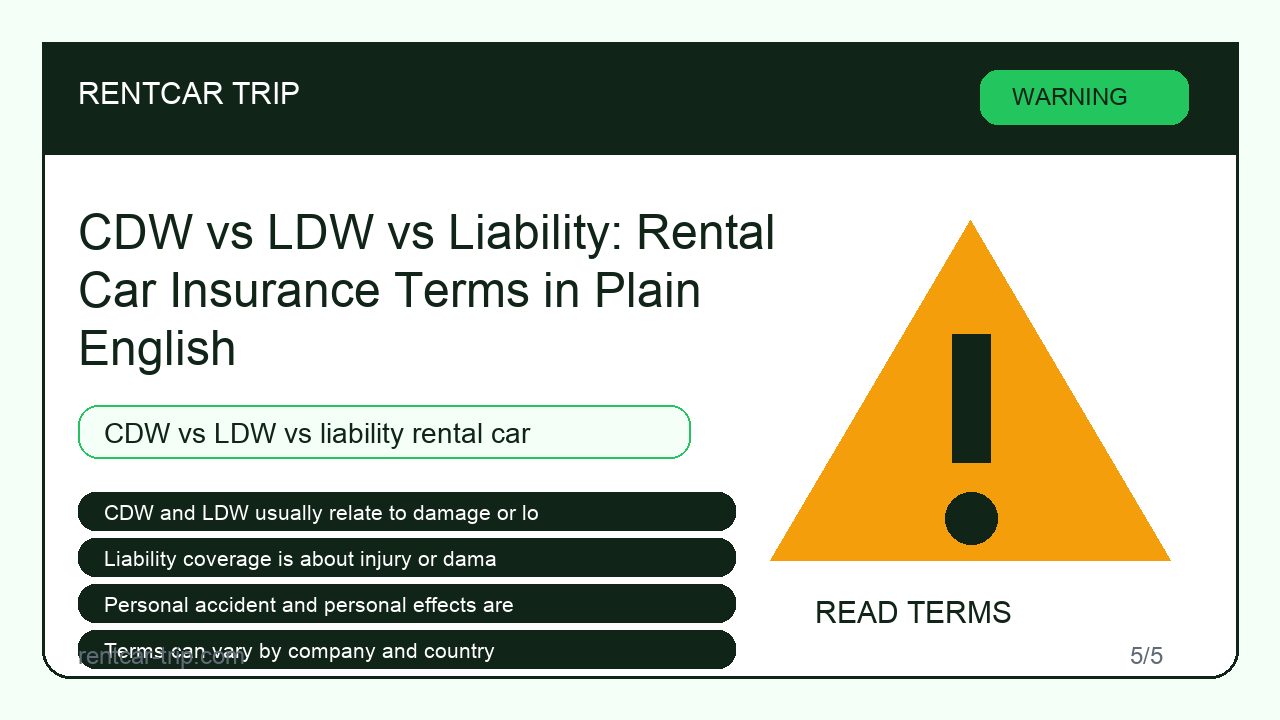
CDW and LDW are damage waivers that protect the rental car itself: CDW typically covers collision damage to the car, and LDW usually extends that to loss or theft (though the exact split varies by company and region). Liability/SLI is a completely separate product that covers injury or property damage you cause to other people. Buy a damage waiver to protect the car and a liability product to protect against third-party claims; they are not interchangeable, so never assume one covers the other.
- CDW is usually a waiver, not a traditional insurance policy, and it addresses collision damage to the rental vehicle, not anything you owe to other drivers.
- LDW goes beyond CDW by covering loss or theft of the car, but exact terms vary by rental company and location, so confirm what ‘loss’ includes before you rely on it.
- Liability/SLI (and PAI/PEC) are separate: SLI covers third-party claims, PAI/PEC are personal/medical add-ons, and none of them double as a damage waiver for the car.
- Check your existing personal auto policy and your credit card’s ‘rental car damage waiver’ benefit before declining counter coverage, since these may already cover the vehicle.
- Watch the common exclusions that waivers often carve out, such as tires, glass, roof, undercarriage, keys, off-road driving, and unauthorized drivers, and write your coverage decisions down before pickup to resist counter pressure.
Final Check Date
This guide was last checked on June 16, 2026. Rental car rules change by location, company, vehicle class, payment card, and season, so use this as a decision checklist and confirm the final terms in your own reservation.
Why This Rental Car Topic Gets Expensive Fast
The price card shown at the start of a booking flow is usually only one layer of the rental. A traveler still has to account for location-based charges, taxes, coverage choices, fuel policy, toll products, equipment, driver rules, and deposit holds.
The pattern is predictable: the earlier you separate mandatory charges from optional products, the less pressure you feel at pickup. That is especially important at airports, after long flights, or when family luggage makes it hard to pause and read every line.
CDW vs LDW vs Liability: Rental Car Insurance Terms in Plain English: Cost and Decision Table
| Product | Main question | Not the same as |
|---|---|---|
| CDW | Who pays for collision damage to the rental car? | Liability to others |
| LDW | Who pays if the rental car is lost or stolen? | Medical coverage |
| SLI | Do you want extra liability protection? | Damage waiver |
| PAI/PEC | Do you want accident or belongings coverage? | Auto damage coverage |
Step-by-Step Booking Checklist
- Ask which product covers the rental vehicle itself.
- Ask which product covers third-party liability.
- Check whether your personal auto policy extends to rentals.
- Check your card benefit for rental car damage waiver language.
- Write your decision on a note before pickup so you do not decide under pressure.
What To Check Before You Click Reserve
Use the quote page like a contract preview. Look for the final estimated total, mileage rule, fuel policy, cancellation language, payment card rules, coverage products, and location-specific fees. If a page shows only the base rate, keep clicking until you see taxes and fees.
For airport rentals, compare the convenience of landing and going straight to pickup against any concession, recovery, or facility charges. For city pickup, add the cost of reaching the branch and returning to the airport or station later.
Common Mistakes To Avoid
- Treating liability and damage waiver as the same thing.
- Buying every box because the terms sound official.
- Declining everything without checking the destination.
- Ignoring exclusions for tires, glass, roof, undercarriage, or keys.
Counter Script: Questions Worth Asking
- Is this item mandatory at this location, or optional?
- Does this waiver cover damage to the rental car, liability to others, or both?
- What happens if I return early, late, below fuel level, or through a toll road?
- How much is the deposit hold, and when is it released?
- Can I get the return receipt before leaving the lot?
CDW, LDW, Liability, PAI, and PEC: What Each Product Actually Covers
Rental-counter add-ons sound interchangeable, but each one answers a different question and carries a different legal nature. The most important distinction is at the top of the table: a Collision Damage Waiver (CDW) or Loss Damage Waiver (LDW) is not insurance. It is a contractual waiver in which the rental company gives up its right to bill you for damage to or theft of its car. All four major U.S. brands say so in their own terms — Avis, Budget, Enterprise, and Hertz each describe their damage waiver as optional and not an insurance policy. CDW is the older, narrower term (collision); LDW is broader and typically adds theft and loss-of-use. The other products in the table — supplemental liability, personal accident, and personal effects — generally are backed by real insurance policies underwritten by third-party insurers (for example, Enterprise’s SLP is underwritten by Zurich American Insurance Company, and Budget’s SLI by Empire Fire and Marine Insurance Company or ACE American Insurance Company depending on the state).
| Product | Waiver or insurance? | What it typically covers | What it does NOT cover |
|---|---|---|---|
| CDW / LDW (damage waiver) | Contractual waiver, not insurance | Damage to, or theft of, the rental vehicle itself when the car is used per the rental agreement | Third-party injury or property damage; your own injuries; your belongings. Commonly excludes lost/stolen keys, towing or tire service unless accident-related, and is typically voided by “prohibited use” (off-road, unauthorized driver, driving under the influence) |
| Supplemental / Additional Liability (SLI, ALI, SLP, LIS) | Insurance (excess/supplemental) | Third-party bodily-injury and property-damage claims made against you, above the state-minimum liability included with the rental, up to the plan’s stated limit | Damage to the rental car itself; your own injuries; your personal property. Typically excludes intentional acts, prohibited use, and punitive damages |
| Personal Accident Insurance (PAI) | Insurance | Accidental medical expenses, and accidental death/dismemberment benefits, for the driver and passengers in the rental | Vehicle damage; third-party liability; theft of belongings. May duplicate your health or life insurance, which is usually primary |
| Personal Effects Coverage (PEC) | Insurance | Theft of or damage to your personal belongings during the rental period, up to per-person and aggregate caps | The vehicle; liability; your injuries. Often excludes “mysterious disappearance,” motorcycles/boats, and high-value items above the cap; may duplicate homeowner’s/renter’s insurance |
Because CDW/LDW is a waiver rather than an insurance contract, buying it does not put a claim on your personal auto policy — but it also means the “coverage” ends the moment you break a term of the rental agreement. Read the exclusion list, not just the price.
What Each Major Brand Calls Its Damage Waiver and Liability Product
The same underlying products carry different brand names, which makes counter comparisons confusing. The table below maps the exact product names each major U.S. brand uses on its own protection-products pages. Note that the damage-waiver column is always a waiver (not insurance), while the liability column is a genuine excess-liability insurance product. Stated liability limits vary by state and change over time — several brands cut their supplemental-liability caps from the $1 million range to the figures below — so treat the numbers as current U.S. values to verify at booking.
| Brand | Damage-waiver product (waiver, not insurance) | Liability product (supplemental insurance) | Typical stated liability limit (U.S.) | Personal accident / effects product |
|---|---|---|---|---|
| Avis | Loss Damage Waiver (LDW) | Additional Liability Insurance (ALI) | Up to a $500,000 combined single limit, depending on jurisdiction | Personal Accident Insurance (PAI); Personal Effects Insurance (PEP) |
| Budget | Loss Damage Waiver (LDW) | Supplemental Liability Insurance (SLI) | Up to $500,000 (limit reduced from $1 million effective January 1, 2025) | Personal Accident and Effects (PAE), sold as one product |
| Enterprise | Damage Waiver (DW) | Supplemental Liability Protection (SLP) | Up to $300,000 excess third-party coverage (up to $1,000,000 for Enterprise Truck Rental) | Personal Accident Insurance (PAI); Personal Effects Coverage (PEC) |
| Hertz | Loss Damage Waiver (LDW) | Liability Insurance Supplement (LIS) | Up to $300,000 (plus uninsured/underinsured motorist up to $100,000; higher limits in some states, e.g. up to $2 million in CA and FL) | Personal Accident Insurance & Personal Effects Coverage (PAI/PEC), often bundled |
Two practical takeaways: first, “LDW” at Avis, Budget, and Hertz and “DW” at Enterprise all mean the same thing — a damage waiver on the car, not liability protection for people or property you might hit. Second, the liability add-on is where the names diverge most (ALI, SLI, SLP, LIS), yet each does the same job: raising your third-party liability above the bare state minimum that comes with the rental. As of July 2026, verify current product names, limits, exclusions, and state-specific rules directly on each brand’s protection-products page before you rent, because coverage terms and prices change and vary by location.
Sources verified for this section: avis.com, avis.com, avis.com, budget.com, budget.com, budget.com, enterprise.com, hertz.com, hertz.com, hertz.com
Frequently Asked Questions
Is CDW insurance?
It is often a waiver, not a traditional insurance policy. Read the rental agreement wording.
Is LDW better than CDW?
It depends on the company definition. LDW may include loss or theft, but terms vary.
Do I need liability coverage?
Check your existing policy and the rental location's legal requirements before deciding.
What exclusions matter most?
Tires, windshield, roof, undercarriage, keys, off-road driving, and unauthorized drivers are common areas to review.
Official and Primary Sources Used
- FTC Consumer Advice: Renting a Car – Coverage options, insurance checks, fees, inspections, and final bill review.
- U.S. State Department: Driving and Transportation Safety Abroad – License, insurance, local traffic laws, and road safety abroad.
Related RentCar Trip Guides
- Do You Really Need Rental Car Insurance at the Counter?
- Credit Card Rental Car Insurance: Primary vs Secondary Explained
- Rental Car Insurance Abroad: What U.S. Travelers Should Check First
- Supplemental Liability Insurance (SLI): Do You Need It?
- Personal Accident Insurance (PAI) for Rental Cars: Worth It?
- Rental Car Loss of Use Fee: What It Is and How to Dispute It
- Rental Car Diminished Value: Can a Rental Company Charge You?