When you reserve a car, you face two very different ways to cover damage to the vehicle: buy a standalone policy online before your trip, or accept the waiver the agent offers at the desk. Third party rental car insurance is usually cheaper per day but pays you back after a claim, while the counter waiver costs more but often settles damage on the spot with no out-of-pocket fight. Which one wins depends on cost, the claims process, and what you already carry.
Quick Answer
Choose third-party rental coverage when you want the lowest price and you can handle a pay-now, get-reimbursed-later claim; choose the counter waiver when you want zero hassle at return and protection of your own auto policy. Third-party policies are typically reimbursement-based, while counter CDW/LDW is the only option that erases your liability to the rental company instantly.
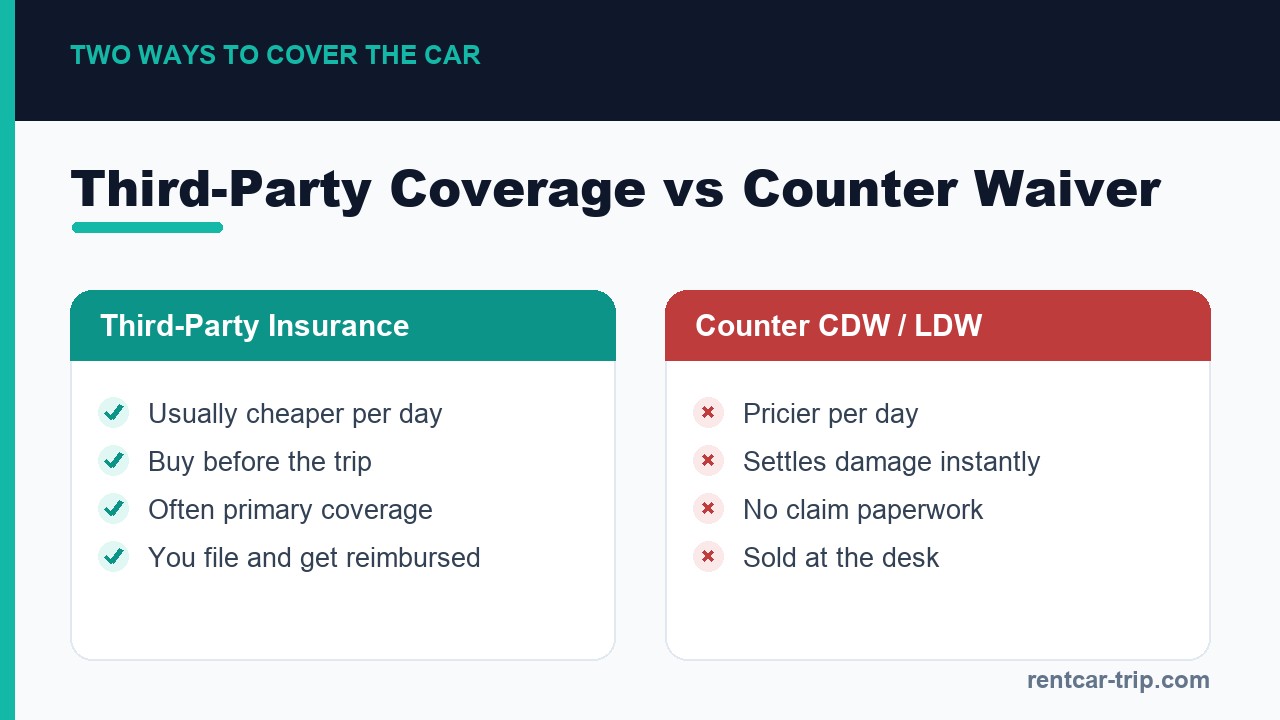
- Third-party rental damage coverage is usually far cheaper per day than the counter’s CDW/LDW.
- The counter waiver settles vehicle damage immediately; you generally walk away owing nothing in the U.S.
- Most third-party policies pay you back after you file a claim, so you may front the repair bill first.
- Neither product covers liability to other people or their property unless you add it separately.
- Third-party policies often exclude luxury cars, vans, and trucks, and may not work outside the U.S. and Canada.
Last Checked
This guide was last checked on June 28, 2026. Coverage varies by policy, card, provider, country, and rental terms, so confirm your own documents.
What Each Option Actually Is
The two products work in fundamentally different ways, which is why their price and claims experience diverge so sharply. The counter collision damage waiver (CDW), also called a loss damage waiver (LDW), is not technically insurance. As the Insurance Information Institute explains, it is a contractual waiver that relieves you of financial responsibility if the rental car is damaged or stolen, rather than a policy that pays a claim. Accept it, and the rental company agrees not to bill you for covered vehicle damage.
Third party rental car insurance is a true insurance policy sold by a travel-insurance-style provider, such as a standalone rental-car damage product or a rider inside a broader travel plan. You buy it before your trip, decline the counter waiver, and the provider covers physical damage and theft of the rental up to a stated limit. Because it is real insurance, it operates on a claim-and-reimbursement model rather than an instant waiver. This is the same secondary, reimbursement-style structure most credit cards use, which is why card and third-party coverage often feel similar at claim time.
One distinction matters more than any other: the counter waiver is primary against the rental company by design, while most third-party and card coverage sits behind your own insurance or asks you to pay first. Understanding that order of payment is the key to choosing well.
Cost, Coverage, and Claims Compared
The counter waiver is almost always the most expensive line on your rental contract, while third-party coverage trades a lower price for more limits and a slower claim. The table below shows the typical trade-offs. Treat the dollar figures as general ranges that vary by location, vehicle, and provider, and always verify against your own quote.
| Factor | Counter CDW/LDW | Third-Party Rental Coverage |
|---|---|---|
| Typical daily cost | Higher; often the priciest add-on at the desk | Usually much lower per day |
| How it pays | Waives the charge instantly at return | Reimburses you after a claim is filed |
| Out-of-pocket at return | Often none in the U.S. | You may pay the repair bill first |
| Vehicle damage and theft | Covered (read exclusions) | Covered up to a policy limit |
| Loss of use, towing, admin fees | Frequently included | Often excluded or capped |
| Liability to others | Not covered | Not covered |
| Vehicle and country limits | Few; tied to the rental | May exclude luxury cars, vans, trucks; may not cover outside U.S./Canada |
| Effect on your auto policy | No claim on your policy | No claim on your auto policy if the third-party plan pays |
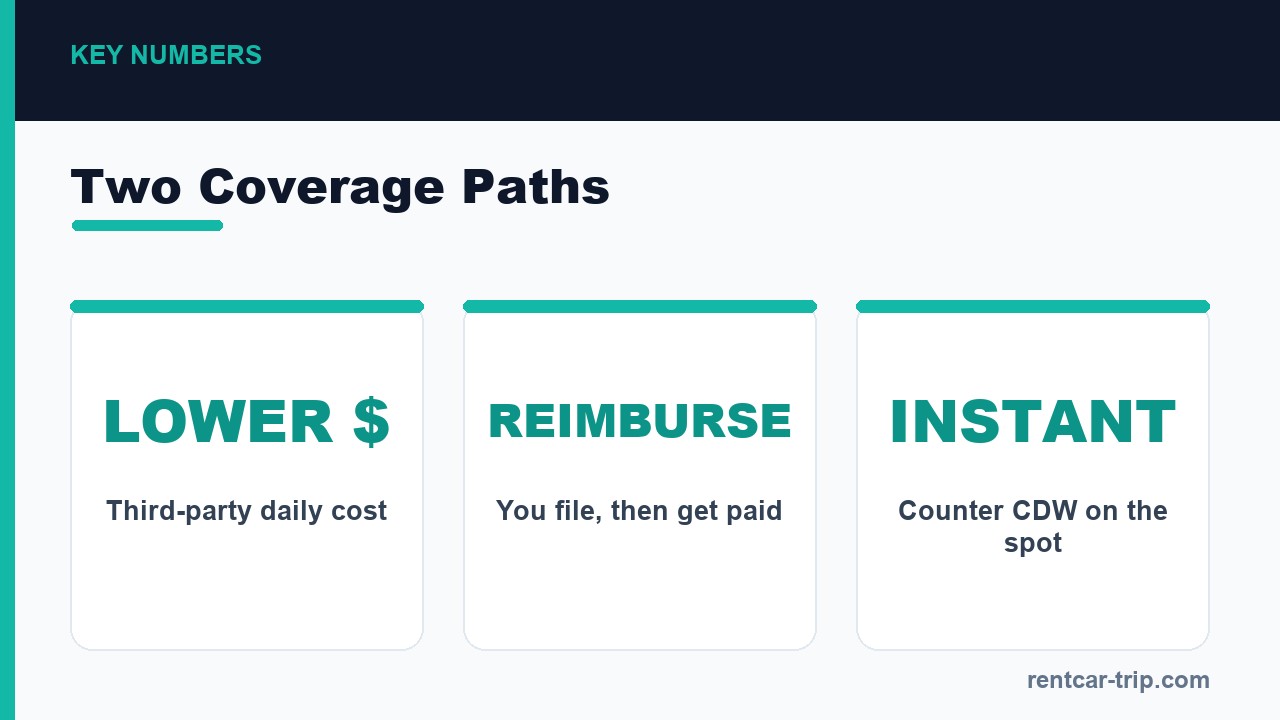
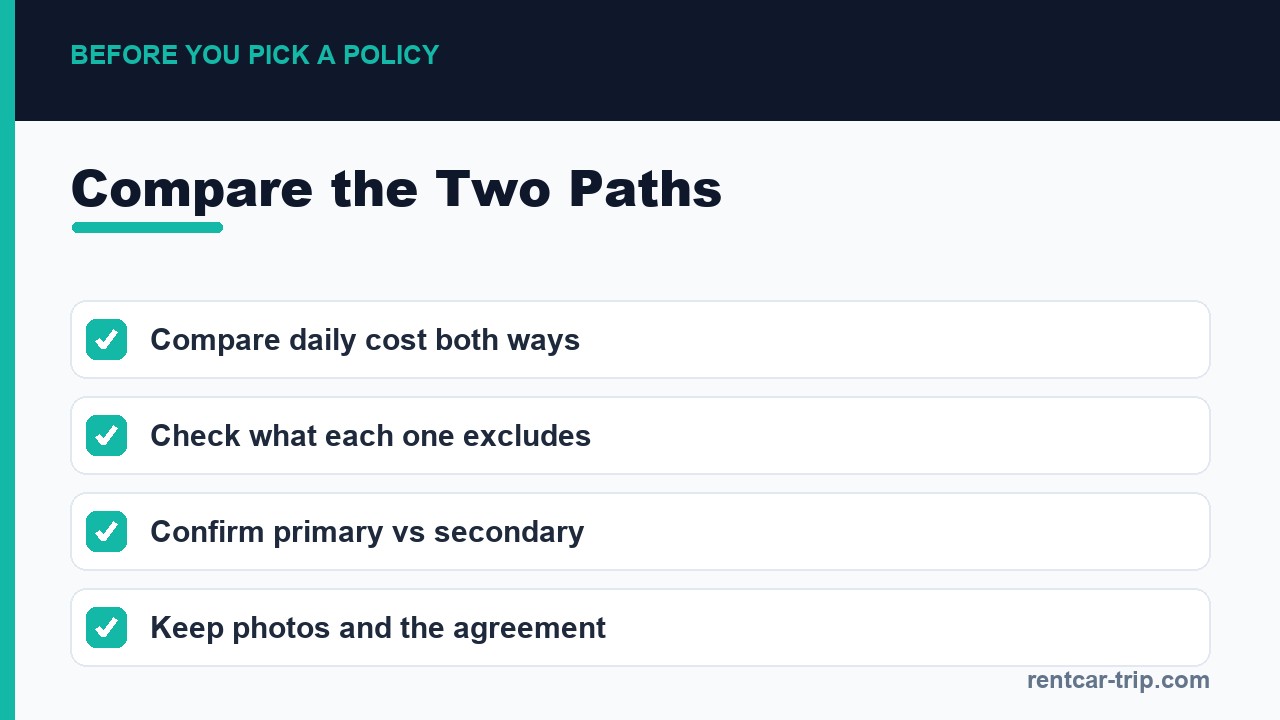
The claims experience is where the gap is widest. With the counter waiver, you hand back a damaged car and typically owe nothing, and the FTC notes the waiver guarantees the rental company will pay for damage to the car. With third-party coverage, the rental company may charge or pre-authorize your card for the damage, and you then submit photos, the rental agreement, the repair invoice, and the police report to recover the money. The counter waiver protects your cash flow; the third-party policy protects your wallet over many rentals.
Primary vs. Secondary: Who Pays First
The single most useful question is not “Am I covered?” but “Who pays first, and who argues about the bill?” The counter waiver answers first against the rental company, so there is rarely a second claim to manage. Most third-party rental coverage and most credit-card benefits are secondary, meaning they pay after any other applicable insurance, often your personal auto policy.
Secondary coverage still has real value. Even when it is secondary to your auto insurance, a third-party policy can reimburse the deductible and other gaps so the claim never lands on your personal policy and your premiums stay flat. That is a meaningful advantage if you want to avoid a surcharge at renewal. Primary-style protection, however, removes the step of involving your own insurer for vehicle damage, which is why it is the better fit for travelers with no personal auto policy or those who simply want fewer moving parts. Note that “primary” does not always mean zero out-of-pocket; the rental company may still charge your card first depending on the process.
Common Mistakes To Avoid
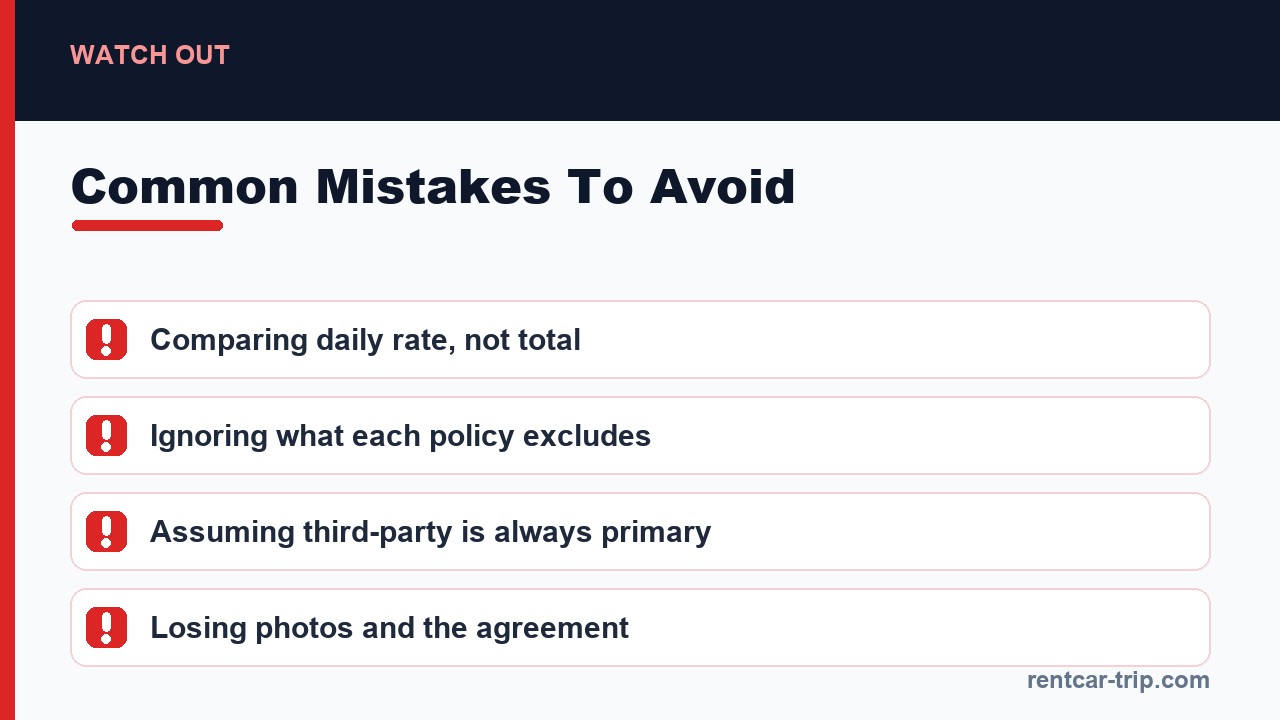
- Buying both. Third-party and credit-card coverage usually require you to decline the counter waiver. Accept the waiver and you may void the coverage you already paid for.
- Assuming you are covered for liability. Neither the counter waiver nor third-party damage coverage pays for injuries to others or damage to their property. You need separate liability protection.
- Ignoring vehicle and country exclusions. Many third-party policies will not cover luxury cars, vans, trucks, or rentals outside the U.S. and Canada. Confirm your exact vehicle and destination qualify.
- Forgetting loss-of-use and fees. Counter waivers often include loss of use, towing, and admin fees; third-party plans may cap or exclude them, leaving you exposed.
- Skipping pickup and return photos. Timestamped photos from every angle are your strongest evidence in any damage dispute, no matter which coverage you carry.
- Not reading the policy before the desk. Verify eligibility and limits in writing before you decline anything at the counter.
Named Standalone Providers vs. the Counter Waiver: A Real Comparison
The general “third-party coverage” category hides big differences between the actual companies selling it. The table below compares four widely used standalone products — Allianz Global Assistance’s OneTrip Rental Car Protector, Bonzah, RentalCover.com’s Damage & Theft Cover, and Sure — against the rental counter’s CDW/LDW. Every figure is taken from each provider’s own pages; treat all prices as “typical” starting points because they vary by state, vehicle, and trip and change over time.
| Product | Typical daily cost model | Primary or secondary | What it typically covers | Third-party liability? | Settlement model |
|---|---|---|---|---|---|
| Rental counter CDW/LDW | Usually the highest per-day cost; varies by rental company, vehicle, and location | Primary to the rental company | Waives your responsibility for damage/theft of the rented vehicle (terms vary) | No (liability sold separately as SLI/LIS) | On-the-spot: nothing to pay out of pocket at return in the U.S. if the waiver applies |
| Allianz OneTrip Rental Car Protector | Typically about $13 per calendar day (varies by state) | Primary | Repair/replace the car up to $75,000 plus reasonable loss-of-use; collision, theft, vandalism, weather damage | No — explicitly not liability insurance | Pay-then-claim: report the loss to Allianz and the rental company, then file for reimbursement (marketed as no-deductible primary coverage); not settled at the counter |
| Bonzah CDW | Typically about $26.95 per 24-hour period on its main site | Primary | Collision damage to the rental vehicle up to $35,000, less a stated deductible (e.g., $1,000); notable exclusions apply | No in the base CDW — separate liability policies (SLI/RCLI) are offered | Pay-then-claim: report loss (typically within 30 days), third-party adjuster reviews |
| RentalCover.com Damage & Theft Cover | Marketed as roughly half the counter price; varies by rental and dates | Reimbursement product covering the rental company’s excess/charges | Excess/deductible plus bodywork, theft, vandalism, tires, windscreen, headlights, keys, towing and loss-of-use, up to policy limit | No in the damage cover — Supplemental Liability (SLI) offered as an add-on for U.S./Canada | Pay-then-claim: you pay the rental company, then claim (provider states it pays 98% of claims within 3 days); may liaise directly on large claims |
| Sure (underwritten by Chubb) | Tiered plans starting as low as about $6 per day (varies by state) | Primary | Physical damage/loss to the car up to $100,000; higher tiers add tire damage, personal property, lost keys (up to about $250) and wrong-fuel repairs | No — covers the rental car only, not third-party injury or property | Pay-then-claim: submit a claim online after the rental |
Two patterns stand out. First, cost does not track coverage in a simple way: Sure and Allianz advertise the highest vehicle limits ($100,000 and $75,000) yet sit at the low end of the daily price range, while Bonzah’s base CDW is cheaper than the counter but carries a deductible and tighter exclusions. Second, every standalone option here is a pay-then-claim product — the opposite of the counter waiver, where a covered driver in the U.S. typically walks away owing nothing at return.
The Liability Gap and Where Add-Ons Fill It
The single most common misread of standalone rental coverage is assuming it protects you if you injure someone or damage their property. It generally does not — these are vehicle-damage products, not liability insurance. The table shows how each provider handles that gap, which usually still relies on your personal auto policy or a separately purchased liability product.
| Product | Base product covers third-party liability? | Separate liability option? | Notable availability/eligibility notes |
|---|---|---|---|
| Allianz OneTrip Rental Car Protector | No | Not offered with this product (use personal auto or counter SLI) | Excludes certain jurisdictions and rentals beyond a set duration; vehicle-value and other exclusions apply |
| Bonzah | No (in the CDW) | Yes — separate SLI/RCLI liability policies | Coverage generally not available for rentals originating in New York, Michigan, or Pennsylvania |
| RentalCover.com | No (in Damage & Theft Cover) | Yes — Supplemental Liability (SLI) add-on for U.S./Canada (U.S. rentals except New York) | Reimbursement-based; requirements and covered items vary by policy |
| Sure | No | Not included — Sure is not a liability replacement | Not available to residents of New York, Massachusetts, South Carolina, Virginia, or Washington |
As of July 2026, verify current terms. Prices, coverage limits, deductibles, exclusions, and state availability change frequently and differ by state and plan; the figures above are provider-stated “typical” values, not quotes for your trip. Confirm the exact limit, deductible, liability handling, and eligibility on each provider’s official page and policy documents (and your rental agreement) before you decline the counter waiver.
Sources verified for this section: allianztravelinsurance.com, allianztravelinsurance.com, bonzah.com, bonzah.com, rentalcover.com, rentalcover.com, rentalcover.com, insurance.sureapp.com, sureapp.com, blog.autoslash.com
Frequently Asked Questions
Is third-party rental car insurance cheaper than the counter waiver?
Usually yes. Standalone third-party rental damage coverage typically costs much less per day than the rental company’s CDW/LDW, which is often the priciest add-on at the desk. The trade-off is a reimbursement-based claim and more exclusions, so confirm the daily price and limits against your specific rental quote before deciding.
Does third-party coverage pay the rental company directly?
Usually not. Most third-party policies reimburse you after you file a claim, so the rental company may charge or hold your card for the damage first. You then submit documentation and wait for repayment. The counter waiver, by contrast, settles the charge instantly, which is its main practical advantage at return.
Will either option cover liability if I injure someone?
No. Both the counter CDW/LDW and third-party rental damage coverage protect only the rental vehicle, not your liability to other people or their property. The FTC confirms a waiver will not pay for injuries to others. You need separate liability coverage, often through the rental company, an add-on, or your own auto policy.
Can I use third-party coverage outside the United States?
Sometimes, but check carefully. Many standalone rental policies cover only the U.S. and Canada, and some countries require you to take the rental company’s coverage regardless. Read the geographic terms before you travel, and confirm the destination is included; otherwise the counter waiver or a travel-specific plan may be your only valid option.
Does using third-party coverage raise my auto insurance rates?
Generally no. If the third-party policy pays the claim, the damage never lands on your personal auto policy, so your premiums should not rise at renewal. That protection of your driving record is a key reason travelers choose standalone coverage over filing on their own auto insurance, even when their policy could technically respond.
Should I ever take the counter waiver instead?
Yes, when convenience matters most. If you want zero out-of-pocket at return, broad coverage of loss-of-use and towing fees, and no claim paperwork, the counter waiver delivers that despite the higher price. It is also wise for luxury vehicles or destinations your third-party policy excludes. Match the choice to your trip and risk tolerance.
Official and Primary Sources Used
- Source – FTC guidance that CDW/LDW waivers cover the car but not injuries to others, and that credit-card CDW requires declining the rental’s coverage.
- Source – Insurance Information Institute explanation that a loss damage waiver is not technically insurance and that card coverage is typically secondary.
- Source – New York Department of Financial Services FAQ on collision damage waivers and how rental coverage works for consumers.