The rental counter agent offers a few extra dollars a day for “personal accident” coverage, and most travelers have no idea what it actually pays. Personal accident insurance rental car coverage (PAI) is a small accidental-injury and death policy bolted onto your rental, and for many U.S. drivers it duplicates protection they already carry.
Quick Answer
Usually no, PAI is not worth it for most U.S. travelers, because its medical and death benefits typically overlap with your existing health insurance, auto personal injury protection (PIP), or a separate accidental-death policy. It can make sense if you have thin health coverage, are traveling with passengers, or want a simple injury payout that does not depend on proving fault.
- PAI pays accidental-injury and accidental-death benefits to you and your passengers, not for car damage or other people’s injuries.
- Coverage limits are often modest, so a serious injury can blow past them quickly.
- Your health plan and auto PIP usually already cover the same medical bills.
- PAI is frequently bundled with Personal Effects Coverage (PEC), which can overlap with homeowners or renters insurance.
- Decide before you reach the counter, after checking what your current policies already pay.
Last Checked
This guide was last checked on June 28, 2026. Coverage varies by policy, card, provider, country, and rental terms, so confirm your own documents.
What PAI Actually Covers (and What It Does Not)
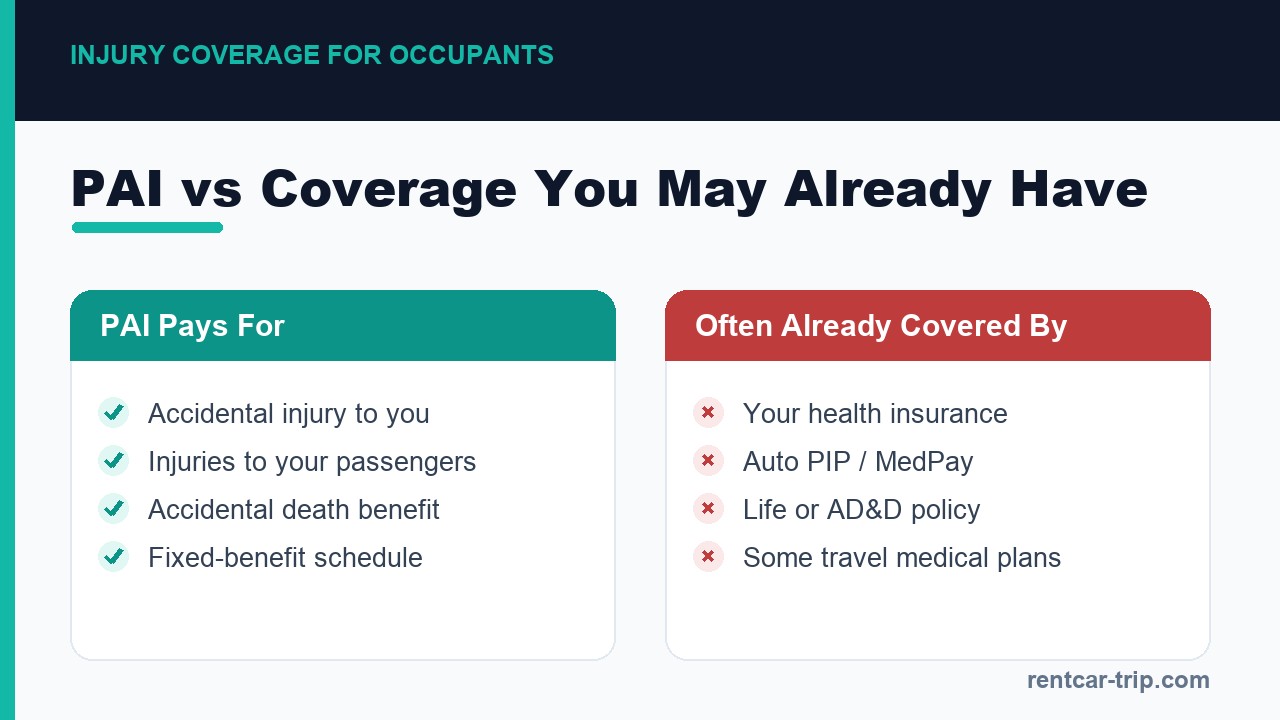
Personal Accident Insurance is a personal-injury product, not a vehicle product. It is designed to pay a benefit if you or your passengers are hurt or killed in an accident in the rental car, regardless of who caused the crash. It does nothing for the car itself, for the other driver, or for your luggage.
This is the single most important distinction to understand: PAI protects people inside your car, while collision and liability coverage protect property and third parties. Buying PAI does not satisfy any state liability requirement, and it will not pay to repair a dented bumper. Below is how the common rental counter products divide up.
| Coverage | What it pays for | What it does NOT pay for |
|---|---|---|
| Personal Accident Insurance (PAI) | Accidental medical, ambulance, and accidental death/dismemberment benefits for you and your passengers | Rental car damage, other people’s injuries or property, your belongings |
| Personal Effects Coverage (PEC) | Theft of personal belongings from the rental car | Injuries, vehicle damage, liability to others |
| CDW / LDW | Damage to or theft of the rental vehicle itself | Your injuries, third-party injuries, your belongings |
| Liability (SLI) | Injuries and property damage you cause to other people | Your own injuries, your rental car, your belongings |
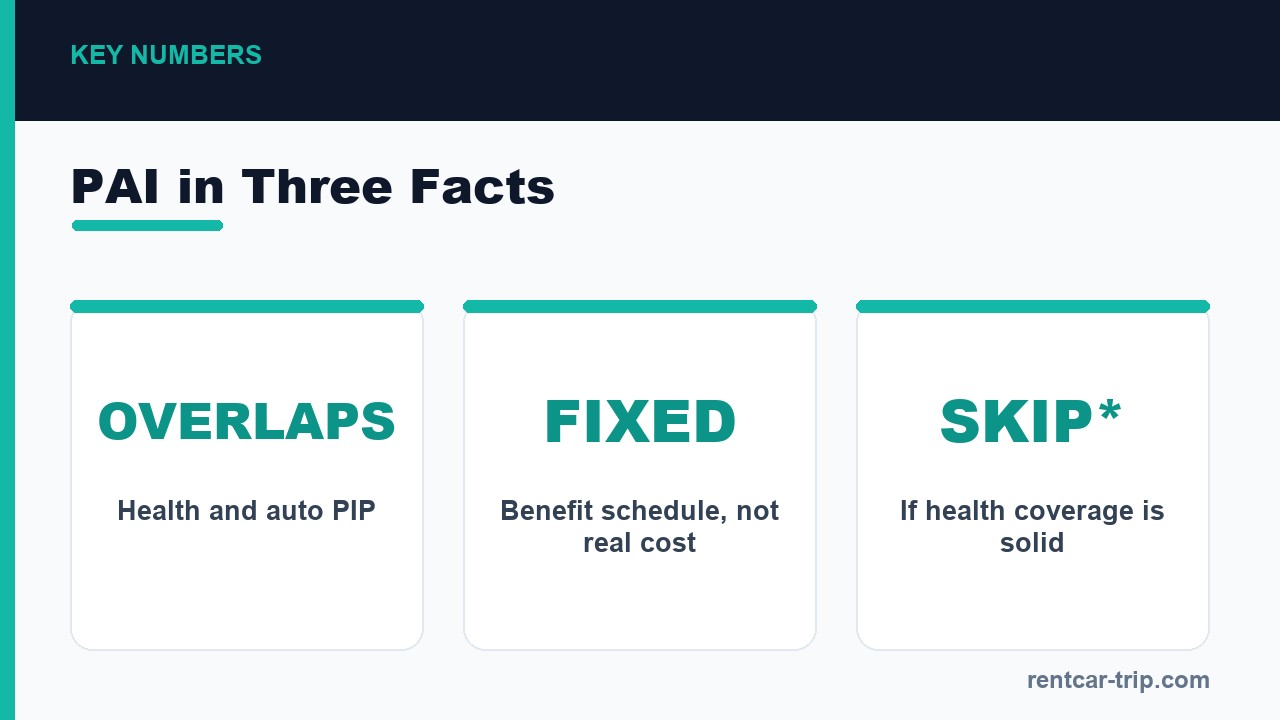
PAI usually pays on a fixed-benefit schedule, meaning a set dollar amount per category rather than your actual costs. Limits vary widely by provider, and they are often modest, so a long hospital stay or a serious injury can exceed the PAI ceiling well before your bills are paid. Always read the benefit schedule before assuming PAI is a real safety net.
Where PAI Overlaps With Coverage You Already Have
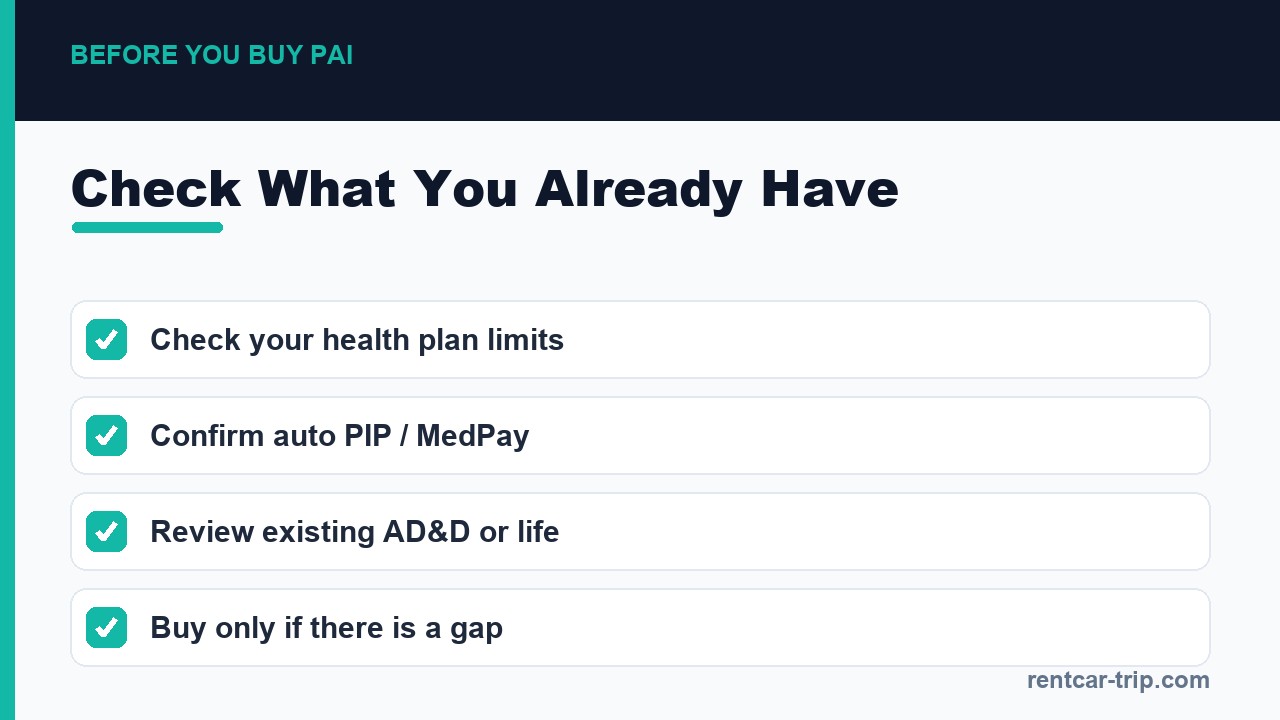
The reason most experts wave off PAI is overlap. The medical bills PAI is built to handle are the same bills your health insurance and auto policy are designed to absorb. The Insurance Information Institute specifically advises drivers to weigh their health insurance and the personal injury protection on their auto policy before buying PAI, because those will likely cover the same medical expenses.
Here is the practical overlap map for a typical U.S. traveler:
- Health insurance: Your medical plan generally covers injuries from a car accident, often with higher limits than PAI offers.
- Auto PIP or MedPay: If your personal auto policy includes personal injury protection or medical payments, that coverage frequently extends to you in a rental car.
- Life or AD&D insurance: An existing accidental death and dismemberment policy through your employer or a standalone plan already provides a death benefit, usually far larger than PAI’s.
- Travel insurance: Many travel medical plans cover accident-related injuries, though some exclude motor-vehicle incidents, so check the fine print.
If you carry solid health insurance plus auto PIP, PAI is most likely paying you twice for the same risk. The FTC makes the broader point plainly: coverage offered at the rental counter may duplicate insurance you already have through your auto and homeowner’s policies, so you should check before you buy. Duplicate coverage does not stack into a bigger payout in the way buyers often imagine, and the second policy frequently coordinates as secondary rather than adding meaningful value.
When PAI Might Actually Be Worth Buying
PAI is not always a waste. There are specific, identifiable gaps where it earns its keep. The deciding question is never “is PAI good?” but “do I have a real coverage gap that PAI fills?”
Consider PAI if one of these describes you. You are traveling with passengers who are not covered by your own health or auto policies. You carry a high-deductible health plan and want first-dollar accident benefits. You have weak or no health insurance, or you are a visitor whose home coverage does not apply in the United States. Your travel insurance specifically excludes motor-vehicle medical costs. In any of these cases, the modest daily fee can buy a genuine layer of protection rather than a redundant one.
Common Mistakes To Avoid
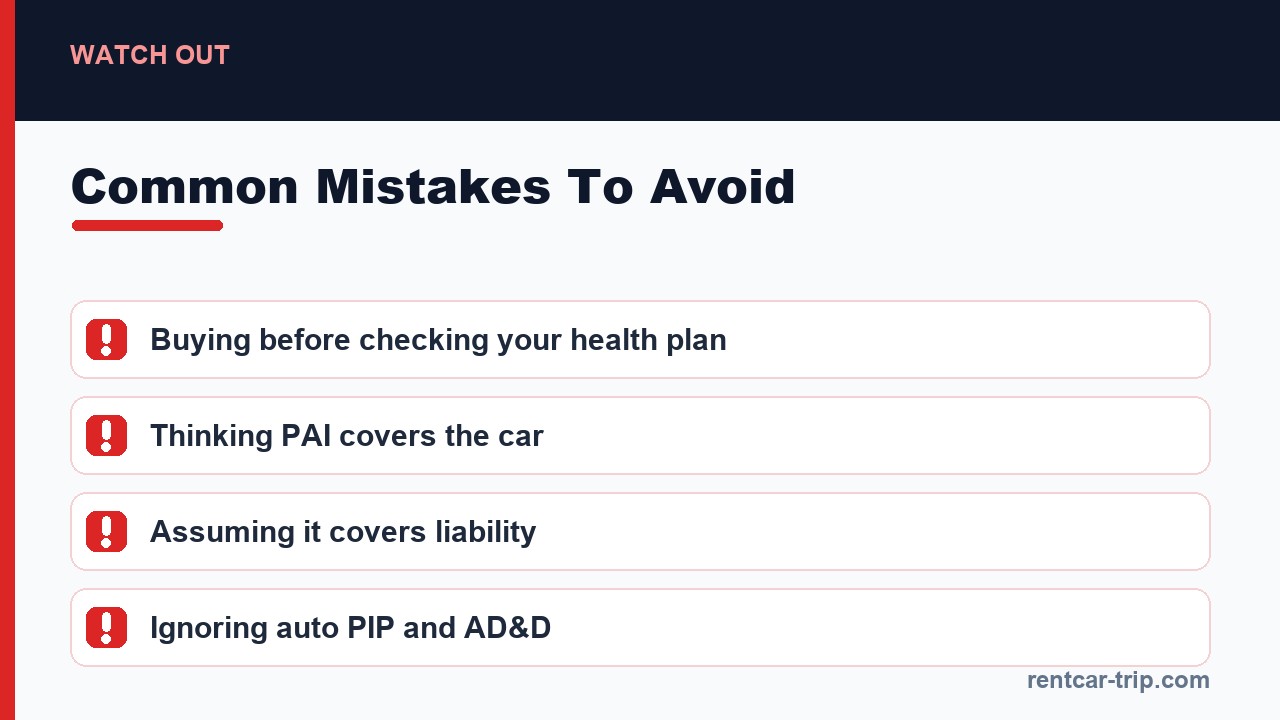
- Assuming PAI covers the car. It does not, you still need CDW/LDW or another waiver for vehicle damage.
- Thinking PAI satisfies liability. It protects you and your passengers, not the people you might injure, so it is not liability coverage.
- Buying it without checking your health plan. Your existing medical coverage usually applies to car-accident injuries already.
- Ignoring auto PIP and AD&D you already pay for. These often duplicate PAI’s exact benefits.
- Deciding under pressure at the counter. Map your coverage at home, where you can read your policies calmly.
- Overlooking who is covered. Some PAI policies cover only the renter and authorized drivers, not every passenger, so confirm the scope.
What Personal Accident Insurance Actually Pays: Fixed-Benefit Schedules at the Major Brands
PAI is a fixed-benefit accident policy, not open-ended reimbursement of your actual bills. It pays set amounts from a published schedule for each covered loss, the renter is usually insured for several times more than each passenger, and the medical portion is capped low relative to real US hospital costs. The two largest rental groups publish their schedules, and the numbers below come straight from their official protection pages.
| Benefit | Standard tier (Avis PAI / Budget Personal Accident and Effects) | Plus tier |
|---|---|---|
| Accidental death and dismemberment — renter | up to $175,000 | up to $250,000 |
| Accidental death and dismemberment — each passenger | up to $25,000 | up to $125,000 |
| Accident medical expenses | up to $10,000 | up to $15,000 |
| Hospital benefit | $500 per day, up to 30 days | $500 per day, up to 30 days |
| Personal effects (bundled in Budget’s Personal Accident and Effects) | $1,000 per item; $3,000 per rental | $1,000 per item; $3,000 per rental |
| Maximum coverage period | 30 consecutive days | 30 consecutive days |
These figures reflect Avis PAI and Budget’s Personal Accident and Effects product, both part of Avis Budget Group, so their core schedules match. Limits vary by state: renter accidental-death coverage is higher in New York (typically $200,000) and lower in New Hampshire (typically $50,000), the hospital benefit is not offered in New York, and New York caps personal effects at $2,000. Avis lists PAI pricing starting around $7 per day, and notes that Avis PAI is issued by ACE American Insurance Company, a Chubb-group insurer. Separately, the Enterprise, Alamo, and National family sells a comparable Personal Accident Insurance / Personal Effects package — underwritten in the US by Empire Fire and Marine Insurance Company (a different insurer from the one behind Avis) — that pays accidental death, accident medical expense, and ambulance benefits to the renter and passengers. That group’s US benefit schedule is not published on an openly accessible page, and Enterprise’s own material advises renters to review personal policies that may duplicate the coverage PAI provides, so confirm the exact renter and passenger amounts on your rental agreement or at the counter. As of July 2026, verify current terms and state-specific limits on each brand’s official protection page, as schedules and underwriters can change.
What the Insurance Information Institute Says About PAI Overlap
The Insurance Information Institute (III) describes rental-counter personal accident insurance as coverage for the driver and passengers for medical and ambulance bills
after a crash — the same medical and ambulance costs your health insurance and your auto policy’s medical payments (MedPay) or personal injury protection (PIP) are typically built to pay. III’s guidance is explicit that whether PAI is worth buying depends on your health insurance and the PIP provided by your auto policy, which it says will likely already cover those medical expenses.
Because PAI pays a fixed schedule regardless of fault and in addition to any other insurance you hold, its accidental-death and dismemberment benefits can likewise overlap life or AD&D coverage you already own. That is why III frames PAI as a duplication question rather than a coverage gap: check your health limits, your auto medical/PIP limits, and your life or AD&D limits first, then decide whether the rental brand’s low fixed benefits add anything. As of July 2026, verify current terms with each insurer and rental brand before relying on any single figure here.
Sources verified for this section: avis.com, budget.com, iii.org, enterprise.com, avis.com
Frequently Asked Questions
Is personal accident insurance the same as liability coverage?
No. PAI pays accidental-injury and death benefits to you and your passengers, while liability coverage pays for injuries and property damage you cause to other people. They protect opposite parties. PAI never satisfies a state’s mandatory liability requirement, so you cannot use it in place of the liability protection a rental requires.
Does my health insurance already cover rental car accident injuries?
Usually yes. Most U.S. health plans treat car-accident injuries like any other covered medical event, often with limits far higher than PAI’s fixed schedule. Confirm your deductible and whether your network applies where you are traveling. If your health coverage is strong, PAI typically becomes redundant for medical bills.
What does PAI not cover?
PAI does not cover damage to the rental car, injuries or property damage to other people, or theft of your personal belongings. Those need CDW/LDW, liability coverage, and Personal Effects Coverage respectively. PAI is strictly a personal-injury and accidental-death benefit for occupants of your rental vehicle, and nothing more.
Is PAI worth it if I have AD&D or life insurance?
Probably not. If you already carry accidental death and dismemberment coverage through an employer or a standalone policy, PAI largely duplicates that death benefit, usually at a lower limit. Check your existing AD&D amount first. When your current coverage is higher, PAI adds little value beyond minor medical benefits you may also already have.
Does credit card rental coverage include PAI?
Generally no. Credit card rental benefits typically focus on damage to the car (a CDW-type benefit), not personal injury or accidental death. Card coverage rarely replaces PAI, but it also means you should not assume your card fills this gap. Read your card’s benefit guide to confirm exactly what is and is not included.
Should travelers from outside the U.S. buy PAI?
It can make more sense for them. Visitors whose home health insurance does not apply in the United States, or whose travel policy excludes motor-vehicle medical costs, may face a real coverage gap that PAI fills. The deciding factor is whether your travel medical insurance already covers car-accident injuries with adequate limits.
Official and Primary Sources Used
- FTC: Renting a Car – Consumer guidance that rental counter coverage may duplicate your auto and homeowner’s policies and that you should check existing coverage first.
- Insurance Information Institute: Rental Car Insurance – Explanation that PAI overlaps with health insurance and auto PIP, and that PEC overlaps with homeowners or renters insurance.