Plain-English guide for renters facing a post-damage bill, focused on what you can actually dispute.
If you damaged a rental car and got hit with an extra line item for the days it sat in the shop, you ran into a rental car loss of use fee. This charge is often legitimate, but it is also one of the most commonly inflated and poorly documented fees on a damage claim. Knowing how it is calculated and what proof the company may need gives you real leverage to push back.
Quick Answer
A loss of use fee is what a rental company charges to recover the income it says it lost while a car you damaged was being repaired and could not be rented out. It can be valid, but you can often dispute it if the company cannot document the repair days, or, where your insurer or credit card benefit requires it, cannot produce a fleet utilization log showing the car would actually have been rented.
- It is typically billed as a daily rate times the number of repair days, not always the full retail rental price.
- Many credit card and auto insurance policies reimburse loss of use, but often only with a fleet utilization log as proof.
- Inflated charges usually come from padded repair days or full-retail daily rates the company never actually earns.
- Always get the claim in writing and verify your rental agreement, card benefits, and state rules before paying.
Last Checked
This guide was last checked on June 29, 2026. Charges and dispute rights vary by company, state, and rental terms, so confirm your own agreement.
What a Loss of Use Fee Actually Is
Loss of use is the rental company’s claim for lost rental income while a damaged vehicle sits out of service for repair. The logic is that every day the car is in the body shop is a day the company could otherwise have rented it, so they bill the responsible renter for that lost revenue. This is separate from the physical repairs, the deductible, towing, and any administrative or diminished value fees that may appear on the same claim.
Whether a loss of use charge holds up is genuinely contested. Some states, reportedly including New York and Wisconsin, restrict or bar these charges, while courts in states such as Colorado and Texas have upheld them. Rental claims managers often argue the fee is owed any time a damaged car is off the lot, while insurers and card benefit administrators frequently demand proof of actual lost income before they reimburse. Because the law and the reimbursement rules differ, confirm the rules in your state and read your own coverage terms rather than assuming the charge is either automatic or unenforceable.
If you declined the Loss Damage Waiver (LDW) at the counter, you are generally on the hook for these charges; if you accepted LDW, it often waives loss of use along with the repair cost. Check your agreement language carefully, because LDW terms differ by brand and location.
How Companies Calculate the Charge
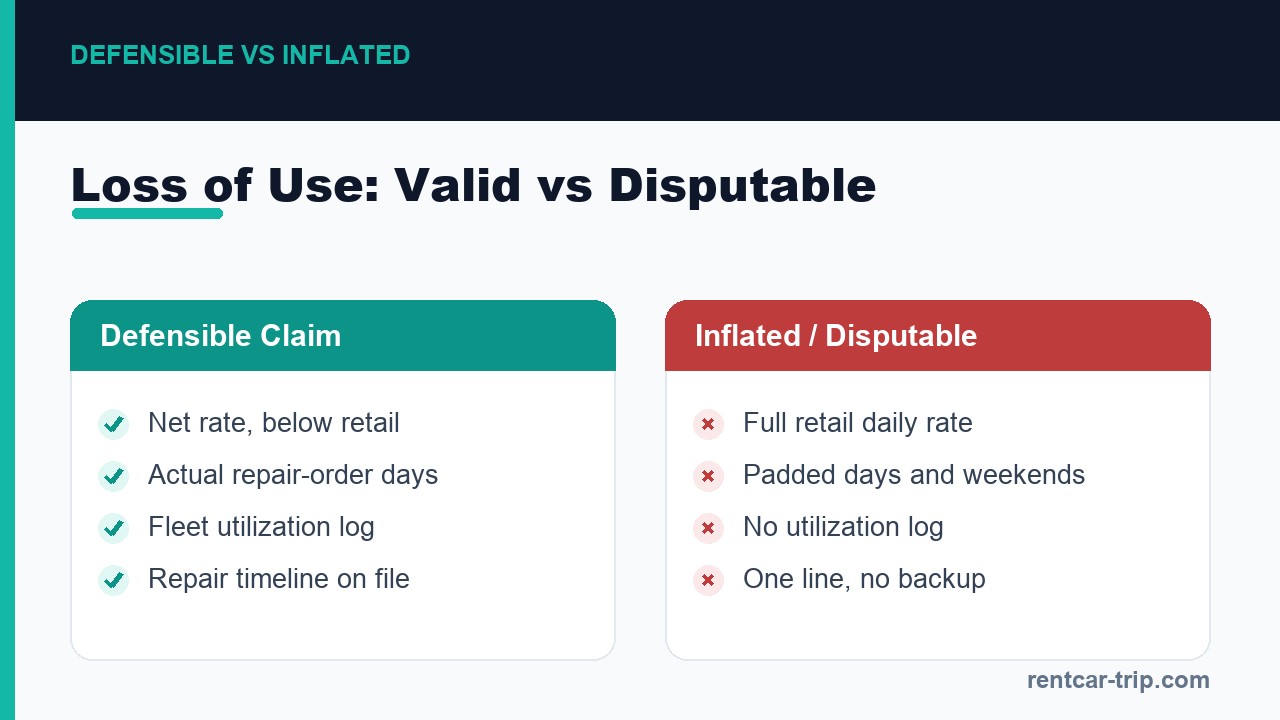
The math is simple on its face: a daily rate times the number of repair days. The dispute almost always lives inside those two numbers. Card and insurer benefit programs often expect a daily rate tied to fleet utilization, while an inflated claim may use the full retail daily rate for every repair day, including days the shop never even touched the car.
| Component | Defensible claim | Inflated claim |
|---|---|---|
| Daily rate | Net rate reflecting fleet utilization, often below retail | Full retail daily rate, peak-season pricing |
| Repair days | Actual days in the shop per the repair order | Padded days, including weekends with no work |
| Proof on file | Utilization log plus repair timeline | A single invoice line with no backup |
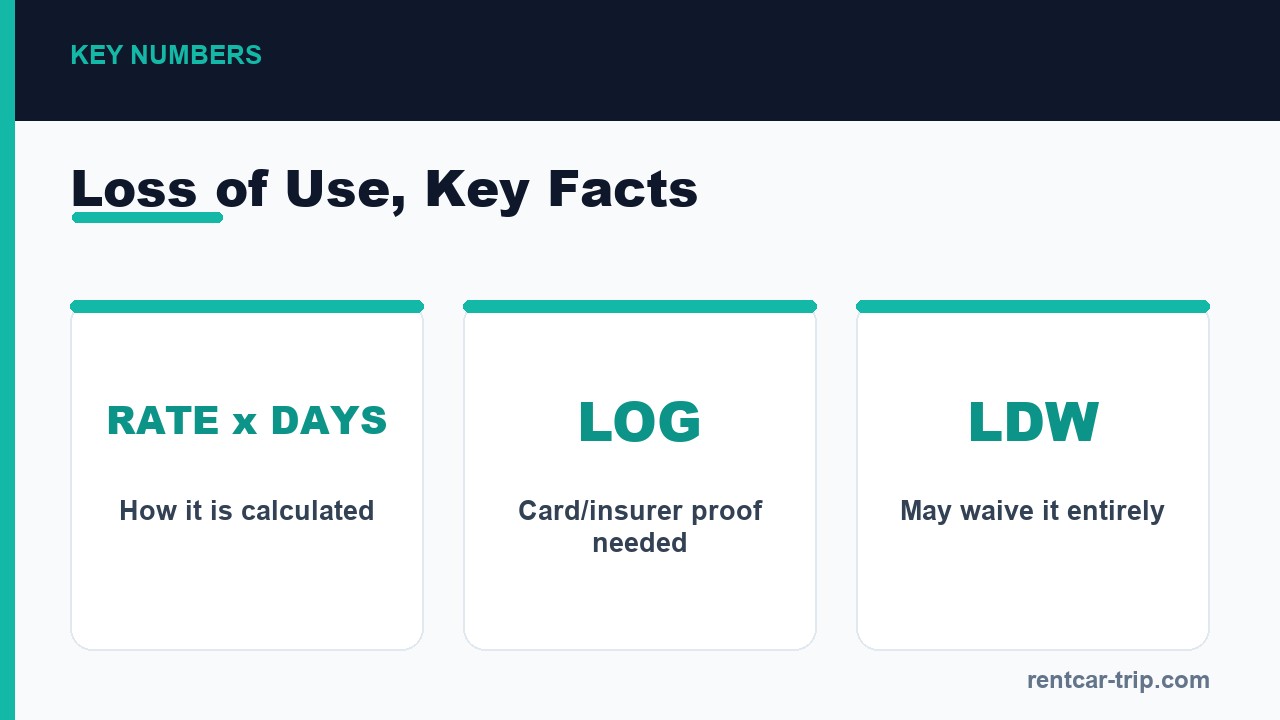
The single most important supporting document for many claims is the fleet utilization log. Major card programs such as Visa and Mastercard require a location- and class-specific fleet utilization log before they will pay loss of use, and many auto insurers ask for the same. If a company refuses to produce one, your insurer or card benefits administrator is likely to reject or reduce the charge. Keep one caveat in mind: a missing log is a reimbursement obstacle, not a guaranteed legal escape, since some courts have upheld loss of use charges without it.
Who Pays It: Card and Insurance Coverage
Loss of use is frequently covered, but the protection is conditional. Your personal auto policy’s collision coverage may reimburse it, though some policies exclude or cap it. A credit card with rental collision benefits (the kind you trigger by paying with the card and declining the counter LDW) often covers loss of use, but card programs are strict: they typically require the fleet utilization log and will deny the line item if the rental company cannot supply one.
| Payer | Covers loss of use? | Common condition |
|---|---|---|
| Counter LDW / CDW | Often yes (waives it) | Purchased and not voided by a policy breach |
| Personal auto collision | Sometimes | Varies by policy; may be capped or excluded |
| Credit card collision benefit | Often yes | Requires utilization log; declined LDW; paid with the card |
| Out of pocket | Only if nothing above applies | You can still dispute the amount |
Because card benefits are secondary in most cases, file with your auto insurer first unless your card benefit is primary. Whoever pays, the company still has to justify the number. A coverage source paying the bill does not mean the charge was correctly calculated, and your insurer has its own incentive to challenge a padded claim.
How to Dispute an Inflated Loss of Use Fee
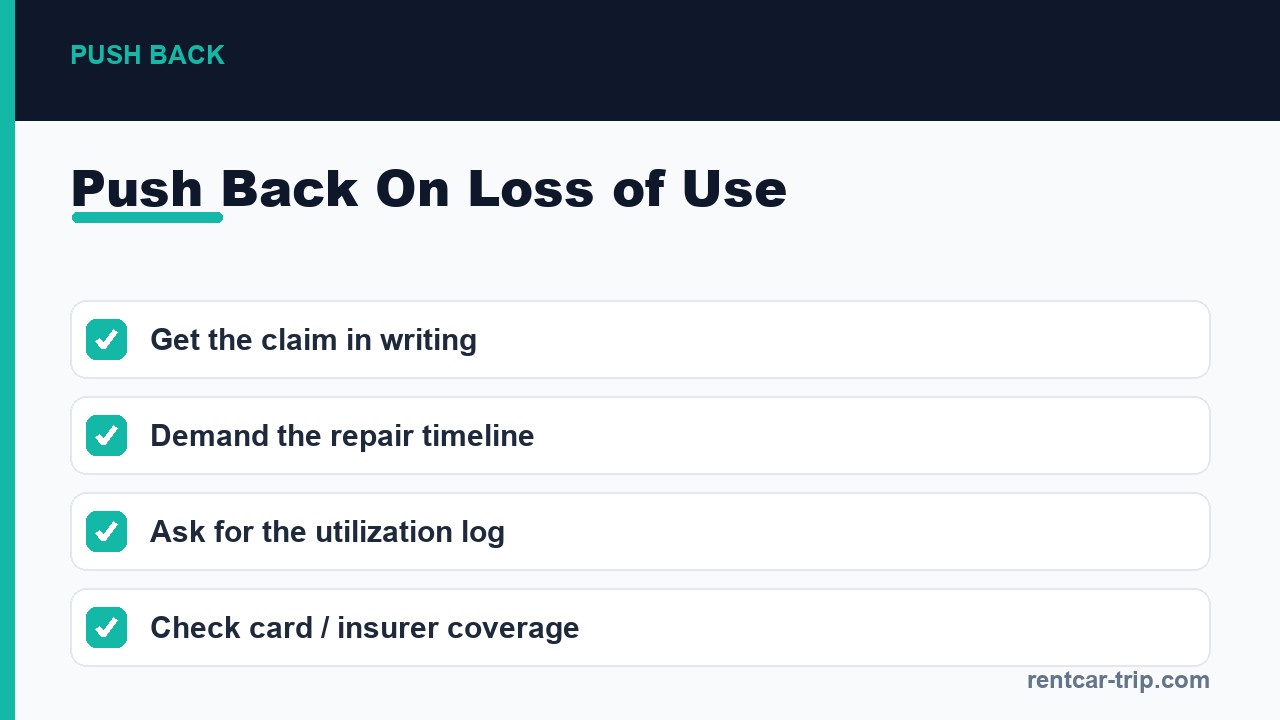
Start by requesting everything in writing. Ask the rental company for an itemized claim, the full repair order with dates, and, if your insurer or card benefit requires it, the fleet utilization log for the vehicle class during the repair period. A short, firm written request often gets the number reduced before any formal dispute.
- Request the utilization log if your coverage needs it. Without it, the daily rate is often unsupported for reimbursement.
- Match repair days to the repair order. Challenge any billed day the shop was not actively working on the car.
- Loop in your insurer or card benefits administrator early. They negotiate these claims routinely and may take over the dispute.
- Keep your own evidence. Your pickup and return photos and the signed agreement anchor what damage you actually caused.
- Escalate if needed. A complaint to your state Attorney General or Department of Insurance is a legitimate next step.
Common Mistakes To Avoid
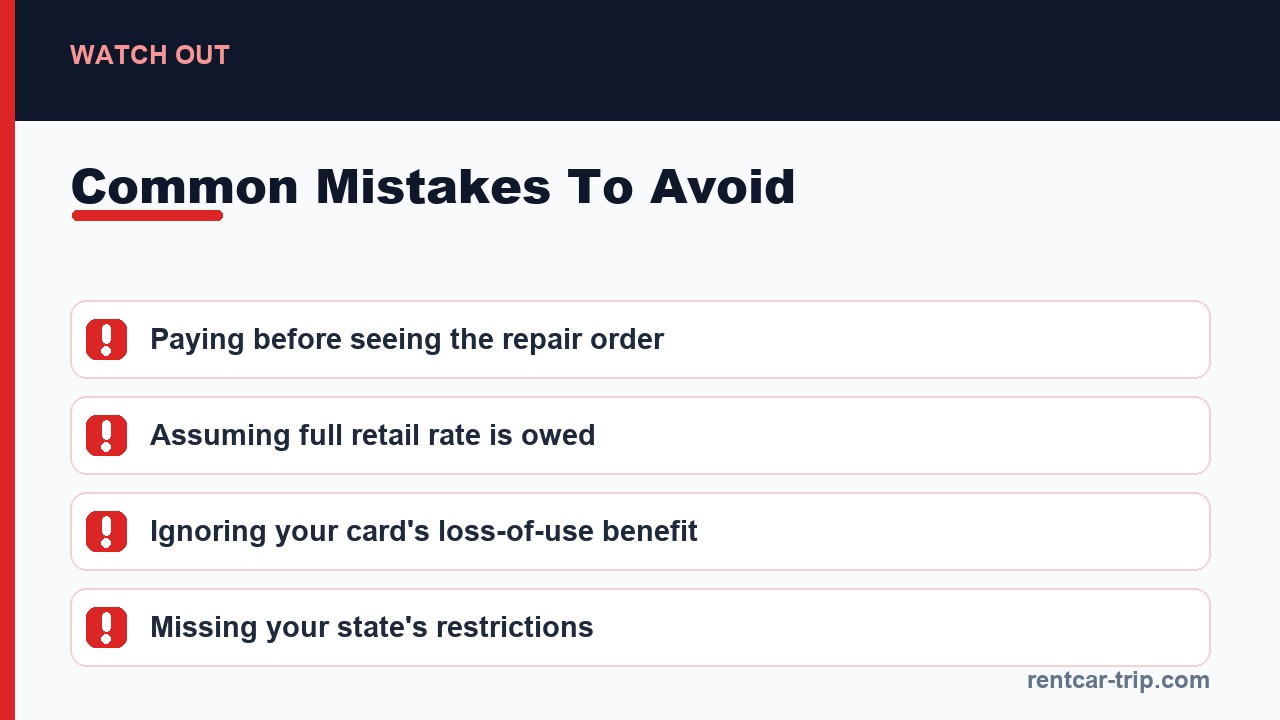
- Paying the invoice immediately. Once you pay, leverage drops sharply. Verify the math first.
- Accepting a single line item as proof. A number on a letter is a claim, not documentation. Ask for the backup.
- Forgetting to file with your card or insurer. Many renters pay out of pocket for a fee a benefit would have covered.
- Assuming loss of use is always valid. It depends on your state and your coverage terms, so check first.
- Throwing away your rental photos and agreement. Those documents are your strongest evidence in any dispute.
- Ignoring the deadline. Card benefit claims have filing windows; missing them can void otherwise valid coverage.
How Visa, Mastercard, and American Express Handle Loss of Use
Not all card rental benefits treat loss of use the same way. Each network’s benefit terms answer three separate questions: does the benefit reimburse loss of use at all, is the coverage primary or secondary, and what proof does the administrator demand before it pays. The proof requirement is where the networks differ most: only Mastercard’s terms specifically name the “fleet utilization log,” while Visa and American Express require the charge to be documented and “substantiated” without naming that exact record. The table below reflects each network’s own published benefit terms.
| Card network / benefit | Reimburses loss of use? | Primary or secondary | Proof required for loss of use |
|---|---|---|---|
| Visa — Auto Rental Collision Damage Waiver | Yes. Covers “valid loss-of-use charges imposed and substantiated by the auto rental company,” alongside administrative fees and reasonable and customary towing charges. | The cited Visa Infinite guide states the benefit “acts as primary coverage.” Coverage is primary on many Visa Infinite and Signature cards but secondary on some standard cards, and it varies by card tier and issuing bank. | The charge must be “substantiated by the auto rental company.” Visa’s guide does not name a specific log, but the Benefit Administrator “may request any other documentation” needed to substantiate the claim. |
| Mastercard — MasterRental Coverage | Yes. Covers “reasonable loss of use charges imposed by the vehicle rental company for the period of time the rental vehicle is out of service.” | Paid “on a secondary basis” on the consumer MasterRental guide cited here. Some World and World Elite tiers differ; varies by issuer. | Charges “must be substantiated by a location and class-specific fleet utilization log,” and “You must secure this log from the rental agency.” The cited consumer guide also caps loss of use at “$500 per incident”; the cap and terms vary by card tier and issuer. |
| American Express — Car Rental Loss and Damage Insurance (complimentary) | Yes, in the current complimentary benefit: “Reasonable and Customary charges … such as Loss of Rental Vehicle Use … provided they are supported with verifiable documentation.” Note: some Amex-network cards issued by other banks sit under a different underwriter and exclude it — one “Worldwide Car Rental Loss & Damage Insurance” certificate lists “Loss of use of the Rented Automobile” among its exclusions, so check your specific certificate. | Secondary (“Yes, it is secondary to any other coverage”). Amex’s optional paid Premium Car Rental Protection is a separate product that provides primary coverage. | The charge must be “Reasonable and Customary” and “supported with verifiable documentation.” The current guide does not name a fleet utilization log specifically. |
Two practical takeaways follow from this. First, a fleet utilization log is not just good leverage in a dispute — under Mastercard it is a stated condition of payment, and obtaining it is explicitly the cardholder’s job, not the rental company’s. Second, because Visa and Amex ask for “substantiation” or “verifiable documentation” rather than naming the log, that same utilization record is still the strongest evidence to submit, even where the terms do not require it by name.
As of July 2026, verify current terms with the provider. Benefit guides are revised periodically and differ by card tier and issuing bank, so confirm the exact language for your specific card before relying on it. Sources: Visa Auto Rental Collision Damage Waiver (Infinite) terms; Mastercard MasterRental Guide to Benefits; American Express Car Rental Loss and Damage Insurance benefit guide (PDF) and its terms page; and, for the exclusion example, a Worldwide Car Rental Loss & Damage Insurance certificate.
How the Daily Loss-of-Use Amount Is Typically Calculated
At its simplest, loss of use is a daily rate multiplied by the number of days the vehicle is out of service — Mastercard describes it as covering “the period of time the rental vehicle is out of service.” The disputes almost always come down to two variables: which daily rate is applied, and how many days are counted. The choice of rate is where the fleet utilization log earns its keep, because it distinguishes a “retail” figure from a genuinely lost one.
| Rate basis | What it means | Why it matters to you |
|---|---|---|
| Retail / contract rate | The full published or contracted daily rental price, applied to each out-of-service day. Some rental agreements state loss of use is charged this way regardless of fleet utilization. | Tends to produce the highest bill. Whether it holds up can depend on state law and the specific contract wording. |
| Utilization-adjusted (net) rate | The average daily rate reduced to reflect that not every car rents every day — typically the average daily rate scaled by the location’s fleet utilization rate for that vehicle class. | Reflects revenue the company would actually have earned. A location- and class-specific utilization log is the document that supports this figure, and it is the exact record Mastercard requires. |
As an illustration only: if a class of car averages a $50 daily rate but that location rents such cars roughly 80% of the time, a utilization-adjusted approach implies closer to $40 of genuinely lost revenue per idle day rather than the full $50. These figures are hypothetical and vary widely by location, class, and season — the point is simply that a low utilization rate undercuts a full-retail claim. The number of days can inflate a bill just as much as the rate, since some agreements count each partial repair day as a full day and add administrative or weekend days, so always match the days charged against the repair shop’s dated records.
As of July 2026, verify current terms with the provider. How a specific rental company computes loss of use, and how a court would treat it, vary by contract and by state, so request the daily-rate basis and the fleet utilization log in writing before accepting any figure.
Sources verified for this section: usa.visa.com, apcifcu.org, campusfederal.org, americanexpress.com, americanexpress.com, americanexpress.com
Frequently Asked Questions
Is a loss of use fee legal?
Often, yes. Loss of use charges are generally enforceable when you caused the damage and declined a waiver, but it depends on your state. A few states reportedly restrict them, while courts in others have upheld them. Confirm your state’s rules before assuming the charge is either automatic or void.
How much is a typical loss of use fee?
It varies widely because it equals a daily rate multiplied by repair days. A defensible daily rate often reflects fleet utilization and can be below the retail rental price, while repair windows run from a few days to several weeks. There is no fixed amount, so always demand an itemized breakdown.
Does my credit card cover loss of use?
Many credit cards with rental collision benefits do, but only under specific conditions. You generally must have paid with the card, declined the counter LDW, and filed within the deadline. Major card programs such as Visa and Mastercard also require the rental company’s fleet utilization log as proof and will deny the charge without it. Check your card’s benefits guide.
What is a fleet utilization log and why does it matter?
A fleet utilization log shows what percentage of similar vehicles were actually rented during the repair period. Insurers and card administrators routinely require it to prove the company genuinely lost income. Without one, a loss of use charge is often reduced or denied for reimbursement, though that does not by itself erase what the rental company says you owe.
Can I refuse to pay a loss of use fee?
You can dispute it, but simply refusing to pay can lead to collections or damage to your record. The smarter route is to challenge the amount in writing, demand documentation, and route the claim through your insurer or card benefit. If the company cannot support the charge, that gap is the basis for a formal dispute.
Does LDW or CDW cover loss of use?
Often yes. A Loss Damage Waiver or Collision Damage Waiver purchased at the counter frequently waives loss of use along with the repair cost, but not always. Coverage language varies by brand and location, and a policy breach such as unauthorized driving can void it. Read your specific agreement to confirm what is included.
Official and Primary Sources Used
- FTC: Renting a Car – guidance on rental car fees and what to verify before you pay.
- Insurance Information Institute: Rental car insurance – explains how LDW can waive loss of use, towing, and administrative fees.
- Insurance Information Institute: Understanding your insurance deductibles – how deductibles work alongside collision claims.
- FTC consumer alert: Renting a car, factoring in the fees – factoring rental fees into the true cost.