When you damage a rental, the number that decides your real cost is the rental car insurance deductible — the amount you pay out of pocket before any coverage starts paying. The same accident can cost you zero, a few hundred dollars, or thousands, depending entirely on which protection layer you used and what its deductible is. This guide shows how deductibles work across the counter waiver, your credit card, and your personal auto policy.
Quick Answer
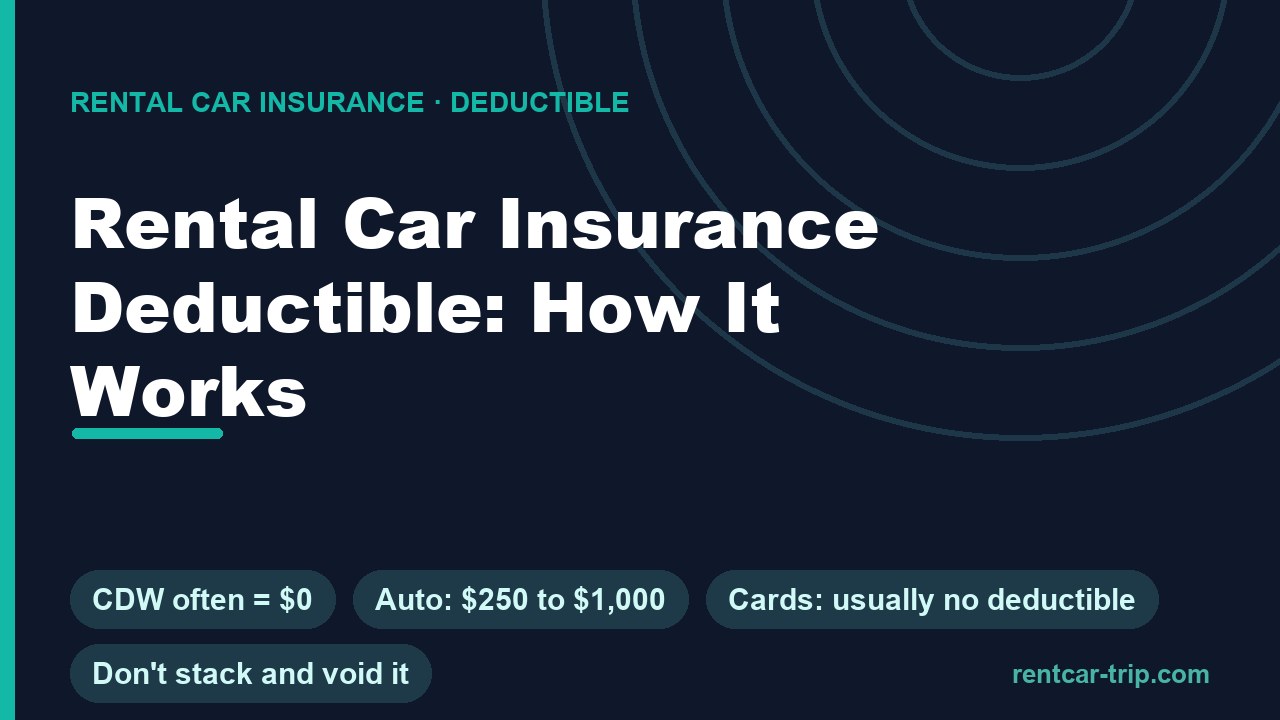
A rental car insurance deductible is the portion of repair or theft costs you pay yourself before coverage kicks in. The counter waiver (CDW/LDW) usually reduces it to zero, your personal auto policy applies its own existing deductible, and credit card coverage often reimburses what those leave behind — but only if you decline the rental company’s waiver.
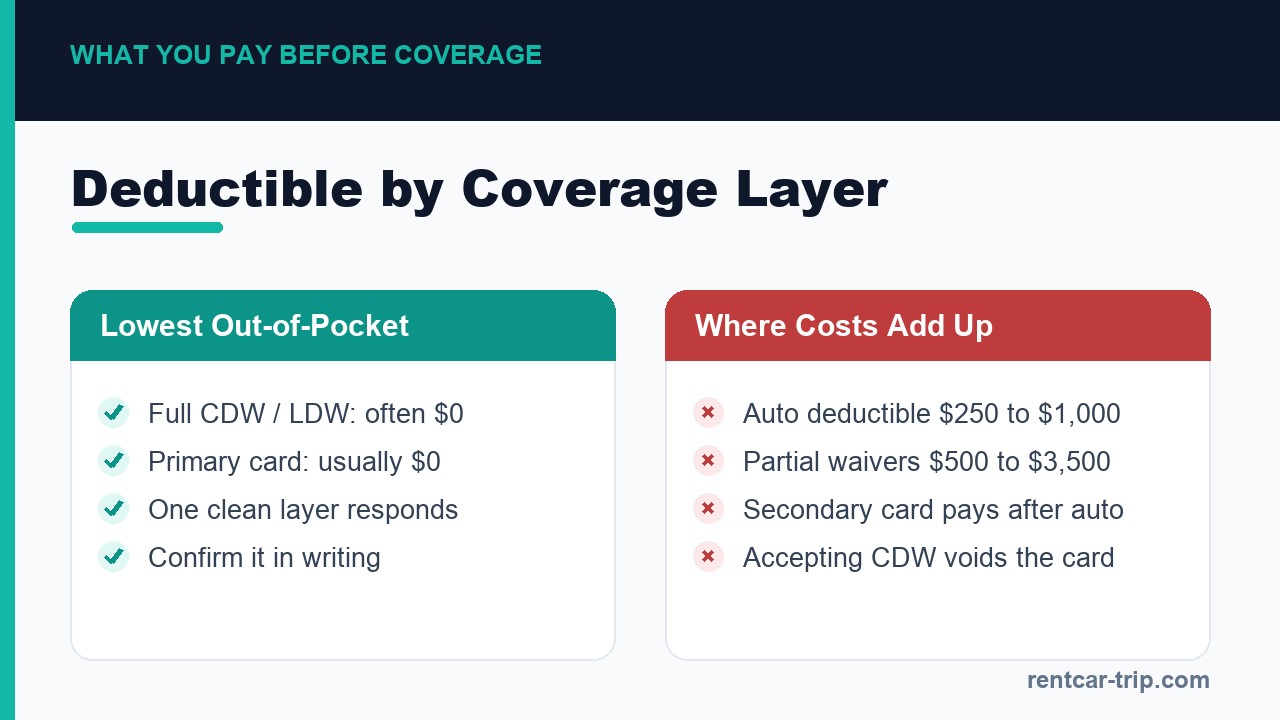
- CDW/LDW typically waives the deductible entirely, so you owe nothing for covered damage.
- Your personal auto collision deductible (often $250–$1,000) carries over to rentals in the U.S.
- Credit card coverage commonly has no deductible itself but is usually secondary in the U.S.
- Accepting the counter waiver usually voids your credit card benefit, including its deductible help.
- Always confirm the exact deductible in writing before you sign or hand back the keys.
Last Checked
This guide was last checked on June 28, 2026. Coverage varies by policy, card, provider, country, and rental terms, so confirm your own documents.
What a Rental Car Deductible Actually Is
A deductible is a cost-sharing line. If a covered repair is $4,000 and your deductible is $500, you pay $500 and coverage pays the rest. The confusion with rentals is that you usually have several overlapping protections, and each one has its own deductible rule. Knowing which one responds first tells you what you will actually pay.
The rental company’s Collision Damage Waiver (CDW) or Loss Damage Waiver (LDW) is not technically insurance — it is a contract that waives the company’s right to charge you for damage or theft. The Insurance Information Institute notes the waiver is “designed to relieve or ‘waive’ renters of financial responsibility.” A full waiver typically drops your deductible to zero, which is why it feels like the simplest option even though it is often the most expensive per day.
Your personal auto policy works differently. Its collision and comprehensive deductibles follow you to a U.S. rental car, so a $1,000 collision deductible on your own car is the same $1,000 you would owe on the rental. Credit card coverage is a third layer with its own rules, described below.
How Each Coverage Type Treats the Deductible
The table below shows what each layer generally does with the deductible. Treat the dollar figures as common ranges, not guarantees — your exact numbers live in your rental contract, declarations page, and card benefits guide.
| Coverage Layer | Typical Deductible | What It Pays | What It Does Not Pay |
|---|---|---|---|
| CDW / LDW (counter waiver) | Often $0 (full waiver); partial waivers may keep $500–$3,500 | Damage to and theft of the rental car; sometimes loss-of-use and towing fees | Liability to other people or property; your own injuries |
| Personal auto policy | Your existing collision/comprehensive deductible, often $250–$1,000 | Rental damage up to your limits, mirroring your own-car coverage in the U.S. | Coverage abroad in most cases; loss-of-use varies by insurer |
| Credit card (secondary, U.S.) | Usually $0 on the card, but pays after your auto policy | Reimburses your auto deductible and uncovered damage fees | Liability; excluded vehicles and countries; long rentals |
| Credit card (primary) | Usually $0; pays without involving your auto insurer | Rental damage and theft up to the card’s cap, no auto claim needed | Liability; injuries; excluded vehicle classes and locations |
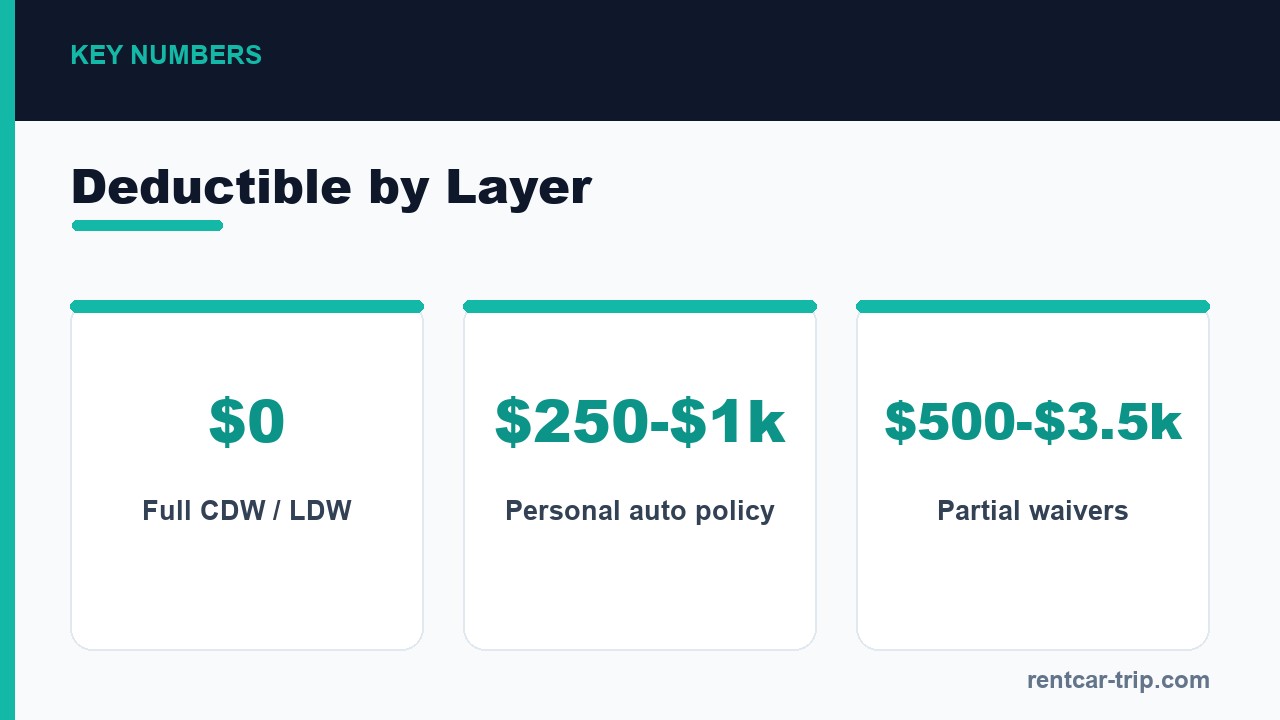
The single most important rule is the interaction between layers. Accepting the rental company’s CDW usually cancels your credit card’s damage benefit entirely. If you buy a partial waiver that leaves a $1,000 deductible, your card will generally not cover that deductible, because the card benefit was voided the moment you accepted the counter coverage.
Lowering Your Out-of-Pocket Risk
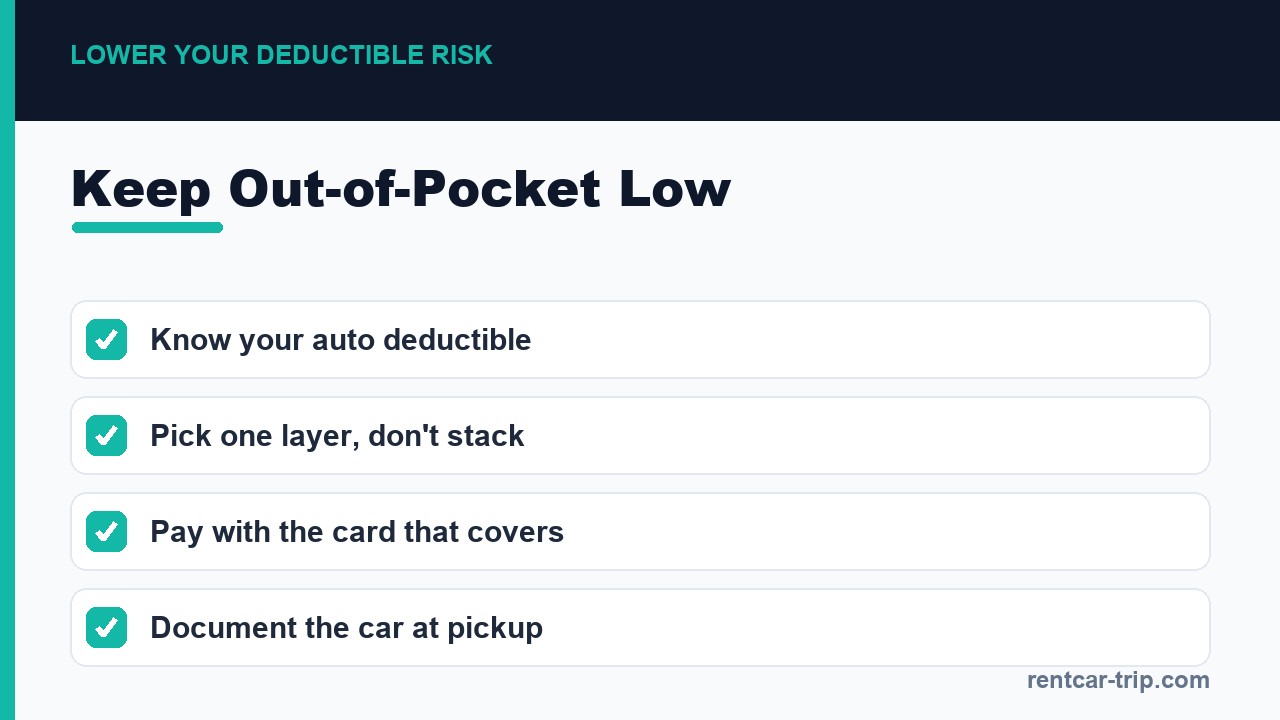
The goal is not to stack the most coverage — it is to make sure one clean layer responds with the lowest deductible at the lowest cost. Most U.S. credit card rental benefits are secondary, meaning they pay only after your personal auto insurance does, though some premium cards offer primary coverage that skips your insurer. The III confirms credit card coverage is “usually secondary” and varies sharply by card.
If your personal auto deductible is high — say $2,500 — a counter waiver at roughly $20–$45 per day can be cheaper than absorbing that deductible on a claim. If you have a primary-coverage credit card and no liability concern, declining the waiver and letting the card respond often costs nothing and carries no deductible. The right answer depends on your specific numbers, so price both paths before you decide.
Common Mistakes To Avoid
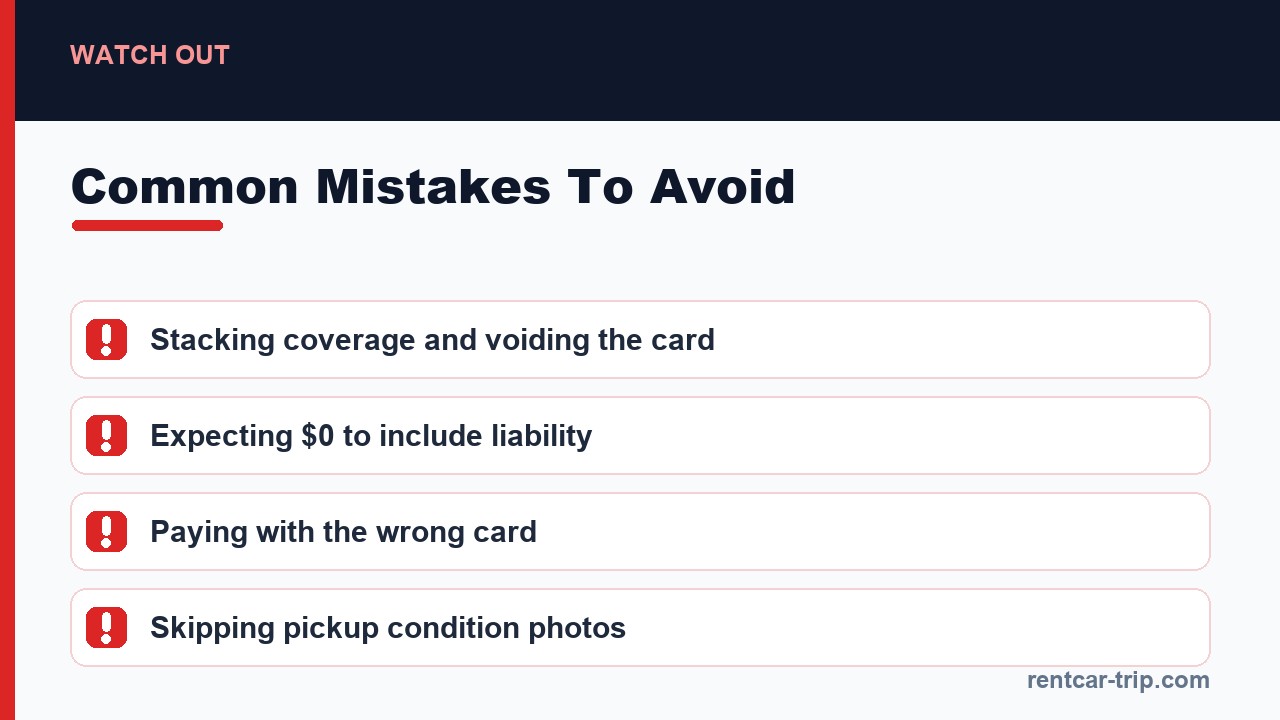
- Assuming “zero deductible” on the waiver also means liability is covered — it almost never is.
- Buying the counter CDW and expecting your credit card to still pay the deductible; accepting the waiver usually voids the card.
- Paying for the rental with a different card than the one that carries the coverage, which can disqualify the benefit.
- Forgetting that credit card coverage is usually secondary in the U.S., so your auto deductible still applies first.
- Relying on card coverage for excluded vehicles (luxury, trucks, vans), long rentals over ~30 days, or excluded countries.
- Failing to document the car’s condition, which can leave you disputing damage charges with no proof.
Typical Deductibles by Coverage Layer: The Actual Dollar Ranges
Generic guides often lump every “personal insurance” deductible into one number, but the Insurance Information Institute (III) actually publishes different typical ranges for collision versus comprehensive claims. That distinction matters, because a rental scrape or windshield chip can land on either side. The table below separates the layers and pins the personal-auto rows to the III’s stated ranges rather than a single blended figure. Treat these as typical starting points; your own policy declarations page and rental agreement are the only authoritative sources for your numbers.
| Coverage layer | Typical deductible | What it means in practice | Primary source |
|---|---|---|---|
| Full rental CDW/LDW (accepted at the counter) | Usually $0 | When the full waiver is accepted and its conditions are met, the rental company generally agrees to waive its right to charge you for covered damage. A CDW/LDW is a waiver rather than insurance; the FTC notes it will not pay for injuries to you or damage to your personal property. | FTC, “Renting a Car” |
| Partial / reduced-rate waiver | A stated per-incident deductible remains (varies by company) | Cheaper counter option that leaves you responsible up to a disclosed amount. The exact figure is set by the rental company and printed in the rental agreement, so confirm it before signing. | Rental agreement (varies by provider) |
| Personal auto — collision | $250–$1,000 | Per the III, collision coverage is “generally sold with a deductible of $250 to $1,000.” A higher deductible lowers your premium but raises your out-of-pocket share on a rental collision claim. | Insurance Information Institute, “Auto Insurance Basics” |
| Personal auto — comprehensive | $100–$300 | The III states comprehensive is “usually sold with a $100 to $300 deductible.” This is the layer that typically responds to theft, vandalism, fire, hail, or a cracked windshield rather than a collision. | Insurance Information Institute, “Auto Insurance Basics” |
| Personal auto — liability | No deductible | The III notes deductibles generally apply to property damage, not to the liability portion of an auto policy, so liability itself carries no deductible — but it pays for damage you cause to others, not to the rental car itself. | Insurance Information Institute, “Understanding Your Insurance Deductibles” |
| Credit card rental benefit | Usually no separate deductible | Card benefits typically add no deductible of their own. When the benefit is secondary, it generally reimburses the deductible you owe on your personal auto claim; when primary, it may pay covered damage directly. The FTC notes you usually must decline the rental company’s coverage to be eligible. | FTC + card benefits guide |
Two hedges worth keeping in mind: figures vary by insurer, card network, state, and rental company, and coverage adoption is not universal — the III reports roughly 77% of insured drivers buy collision and about 80% buy comprehensive (based on a Triple-I analysis of 2023 NAIC data), so some renters have no personal collision/comprehensive layer to fall back on at all. If you are in that group, a credit card’s rental benefit or the counter waiver may be your only protection.
How the Deductible Actually Gets Charged
The deductible is subtracted from what the policy pays, not added on top. In the III’s own illustration, a $500 deductible on a $10,000 insured loss means the insurer issues a claims check for $9,500 and you effectively absorb the first $500. In a rental context, that deductible is where a secondary credit card benefit usually steps in — after your auto insurer settles, the card benefit can reimburse the deductible you were left owing, subject to the card’s terms and claim window. If you have no personal collision/comprehensive coverage, there is no auto-policy deductible to reimburse, so a primary-type benefit or a full counter waiver becomes the deciding layer instead.
As of July 2026, verify current terms. Deductible ranges, waiver conditions, and card benefit rules change; confirm the exact numbers against your policy declarations page, your card’s benefits guide, and the signed rental agreement before you rely on any figure above.
Sources verified for this section: iii.org, iii.org, iii.org, iii.org, consumer.ftc.gov
Frequently Asked Questions
Does CDW have a deductible?
A full CDW or LDW typically has no deductible, waiving your financial responsibility for covered damage or theft to zero. However, some discounted or “partial” waivers keep a deductible of several hundred to a few thousand dollars. Read the waiver terms at the counter so you know whether you are buying full or partial protection.
Does my personal auto deductible apply to a rental car?
Yes, in the United States your existing collision and comprehensive deductibles generally carry over to a rental. If your collision deductible is $500, that is what you would owe on a covered rental claim. Personal auto policies usually do not extend abroad, so confirm coverage before renting outside the country.
Do credit cards charge a deductible for rental coverage?
Most credit card rental benefits have no deductible of their own. The catch is that U.S. cards are usually secondary, meaning they reimburse what your auto policy does not cover, including your auto deductible. Primary-coverage cards pay first without involving your insurer. Check your card’s benefits guide to confirm which type you hold.
If I have full CDW, do I still owe anything after an accident?
With a valid full waiver, you typically owe nothing for damage to or theft of the rental car. The waiver can become void, however, if you violate the rental agreement — for example, speeding, driving under the influence, off-roading, or letting an unlisted driver use the car. Liability for others is never covered by the waiver.
Why did the rental company charge my card a large amount?
When damage occurs, rental companies often charge the full estimated repair cost, plus loss-of-use and administrative fees, immediately. If you rely on credit card coverage, you pay first and then file for reimbursement. Keep the rental agreement, repair estimate, damage photos, and charge receipt to support your claim within the card’s deadline.
Is it worth paying a deductible instead of buying the waiver?
It depends on the math. If your auto deductible is low and your card adds secondary protection, skipping the waiver often costs less. If your deductible is very high or you lack any card or auto coverage, the waiver’s zero deductible can be the cheaper, simpler choice. Compare the daily waiver price against your potential out-of-pocket cost.
Official and Primary Sources Used
- Source – Insurance Information Institute on loss damage waivers, liability, and how personal auto and credit card coverage interact.
- Source – FTC consumer guidance on renting a car and reviewing coverage and charges before you sign.
- Source – Insurance Information Institute on collision and comprehensive auto deductibles, which apply to a U.S. rental car.
Related RentCar Trip Guides
- CDW vs LDW vs Liability: Rental Car Insurance Terms in Plain English
- Credit Card Rental Car Insurance: Primary vs Secondary Explained
- Do You Really Need Rental Car Insurance at the Counter?
- Rental Car Damage Claim Photo Checklist
- Rental Car Damage Administrative Fee Explained
- Rental Car Loss of Use Fee: What It Is and How to Dispute It