You returned the car days ago, but the deposit still has not shown up in your account. A rental car deposit not refunded after return is rarely lost money — it is usually sitting in a pending authorization your bank has not cleared yet. Here is how release timelines work by card type, who is actually holding your money, and how to escalate.
Quick Answer
Usually the deposit is not gone — it is a pending hold waiting to drop off. Rental companies typically release credit card authorizations at return, but banks commonly take about 3 to 7 business days to remove them, and debit card deposits often take 5 to 10 business days to be refunded. After that, escalate by phone and, if needed, a card dispute.
- Credit card deposits are authorization holds, not charges — released at return, gone once your bank processes the release.
- Debit card deposits are often charged as real transactions, so they must be refunded — Enterprise, for example, quotes 5 to 10 business days.
- If the deposit shows as “pending,” the wait is normally on your bank; if it shows as a “posted” charge, the rental company must refund it.
- After about 10 business days with no movement, call the renting location and ask for written release confirmation.
- If a posted charge is never refunded, dispute it in writing with your card issuer within 60 days of the statement showing it.
Last Checked
This guide was last checked on July 12, 2026. Policies vary by company, location, and rental terms, so confirm your own agreement.
Normal Deposit Release Timelines by Card Type
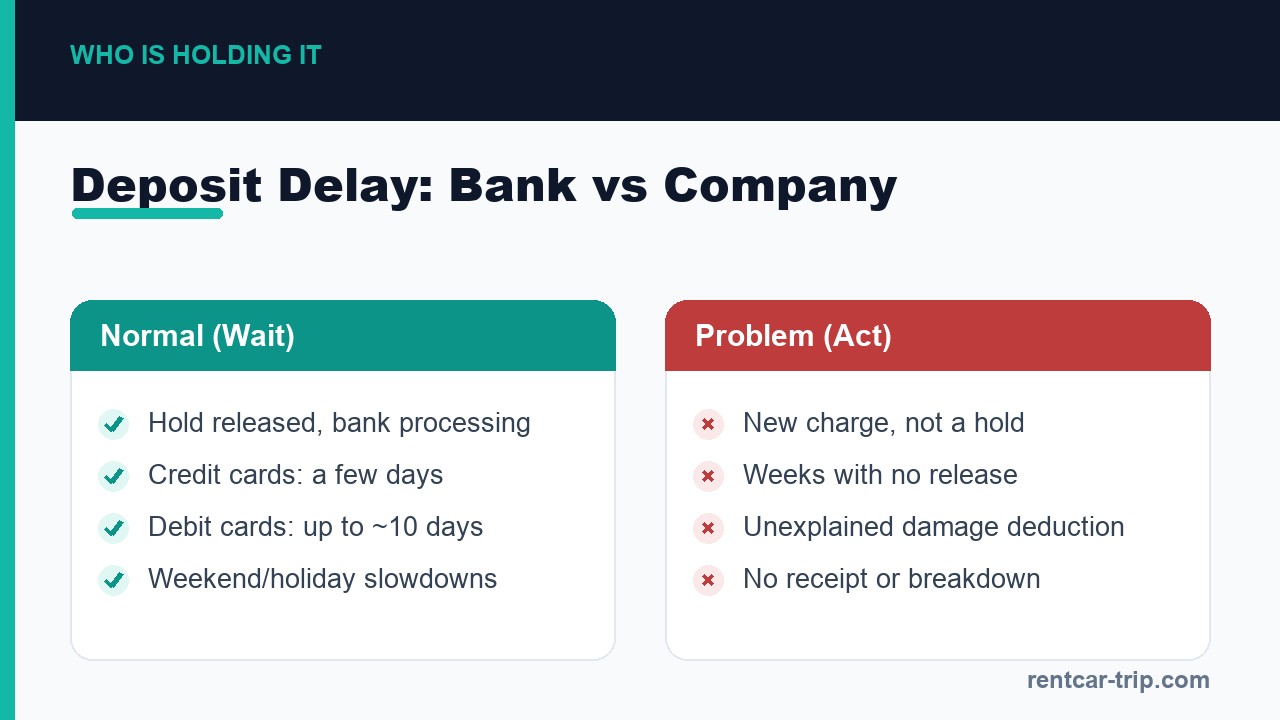
First, “refund” is often the wrong word. When you pay with a credit card, most major rental companies never actually charge the deposit. They place an authorization hold — a temporary block on part of your credit line — and release it at return. Your bank decides how quickly a released hold disappears from your account. Most banks clear a released authorization within a few business days.
Debit cards are where most complaints come from. Many companies charge the deposit to your checking account as a real transaction at pickup, then refund it after return. Enterprise says debit refunds typically take 5 to 10 business days and advises calling the renting branch if nothing arrives after 10 business days. Either way, a rental car deposit not refunded yet is usually money in transit — a released hold or a queued refund — not money the company has decided to keep.
| Payment type | How the deposit is taken | Typical timeline after return | Who controls the wait |
|---|---|---|---|
| Credit card | Authorization hold on your credit line; usually no actual charge | Released at return; commonly drops within about 3–7 business days | Company releases it; your bank removes it |
| Debit card | Often a real charge or hard hold on checking funds at pickup | Refund typically posts in about 5–10 business days; some banks take longer | Company issues the refund; your bank posts it |
| Cash, check, or money order (rare) | Full payment plus deposit collected up front | Refund usually comes by mailed check; Enterprise quotes up to 20 business days | Company processes and mails the refund |
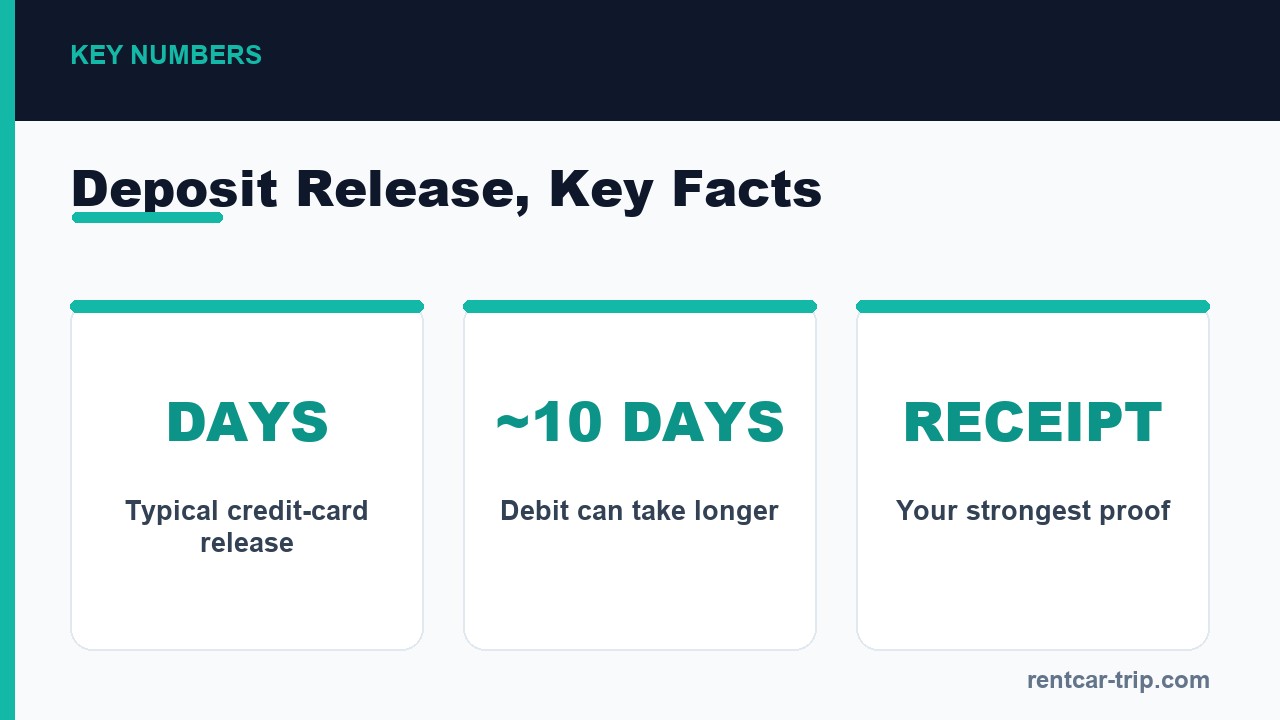
These windows count business days, so a holiday weekend can push a debit refund past two calendar weeks.
Is It the Bank or the Rental Company? How to Tell
Open your card account and check how the deposit appears — that tells you who is sitting on your money.
If the deposit shows as pending, the rental company most likely never captured the money — it either sent the release already or the authorization is aging out on your bank’s schedule. Call the rental location and ask one specific question: “Has the authorization release been transmitted, and can you give me a release confirmation number?” With that confirmation, ask your bank to remove the hold early; many issuers will lift a hold once the merchant documents the release.
If the deposit shows as a posted or completed charge, the rental company actually took the money, and only the rental company can send it back. Debit card deposits are often charged as real transactions, so they must be refunded rather than simply released. Ask the location when the refund was issued and get the date and amount in writing. Also read your final receipt: what looks like a missing refund is sometimes a legitimate deduction for fuel, tolls, late-return time, cleaning, or a damage claim.
Escalation Steps When the Deposit Still Has Not Come Back
If a deposit posts as a completed charge and the company will not refund it, you can dispute the charge with your card issuer within 60 days. Work through these steps in order, keeping notes of dates, names, and reference numbers.
Step 1: Wait out the stated window. Check your rental agreement or the company’s deposit FAQ for its quoted timeline, counting business days from the return date.
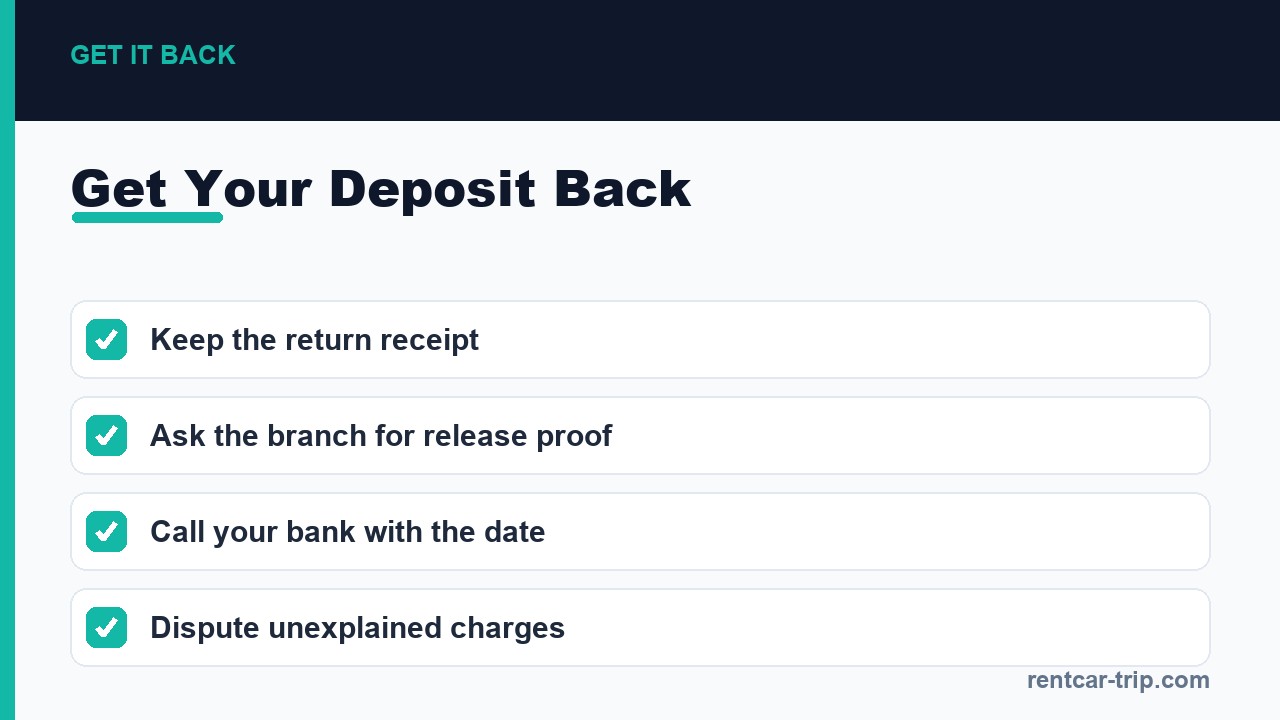
Step 2: Call the renting location. Have your rental agreement number and return receipt ready, ask whether the release or refund was processed and on what date, and get it in writing.
Step 3: Bring in your bank. For a stuck pending hold, give your bank the merchant’s release confirmation and ask for early removal. For a missing debit refund, ask whether an incoming credit is queued.
Step 4: Escalate to corporate customer service in writing. Written complaints create the paper trail a later dispute will rely on.
Step 5: File a card dispute. The Fair Credit Billing Act lets you dispute a credit card billing error in writing within 60 days of the date the first statement showing the charge was sent. Debit card disputes fall under the Electronic Fund Transfer Act, with narrower protections — notify your bank within 60 days of the statement showing the error, so do not wait.
Step 6: Report the company. File complaints with the FTC and your state attorney general to document a pattern and add pressure.
Common Mistakes To Avoid
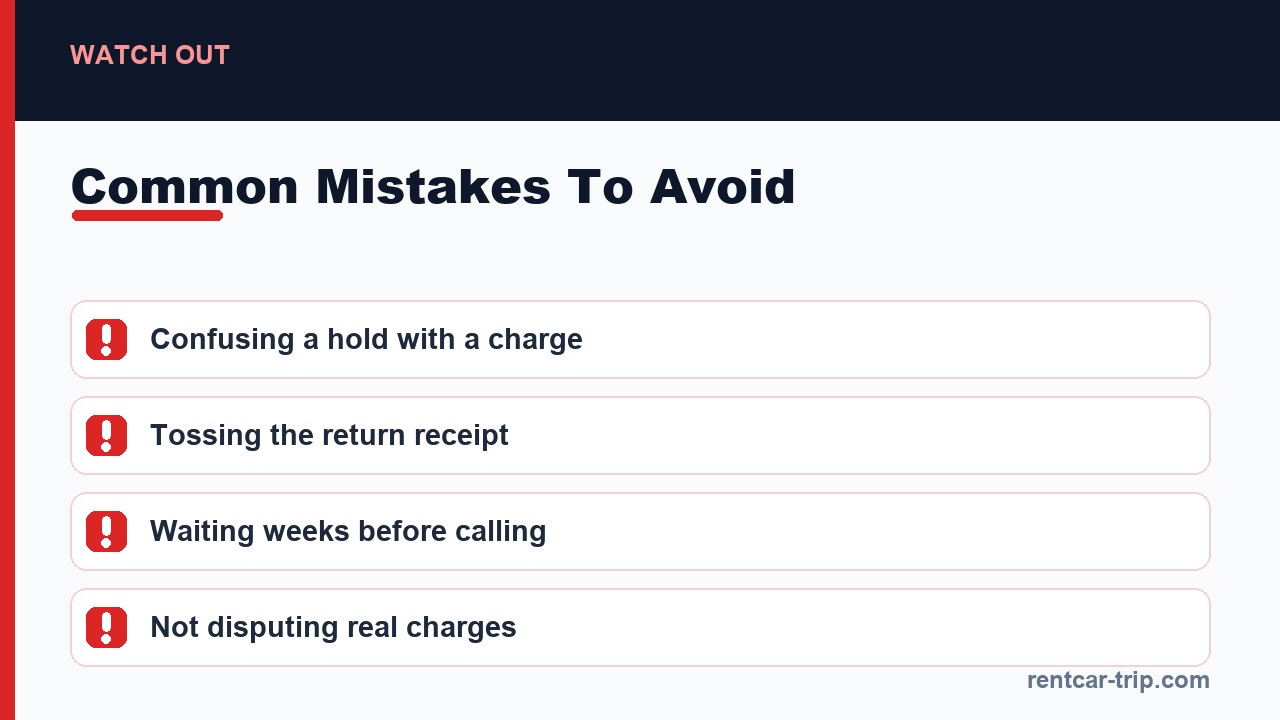
- Treating a pending authorization as a stolen deposit — a hold that was never captured cannot be “refunded,” only released or expired.
- Renting on a debit card without budgeting for the deposit to be tied up for two weeks.
- Throwing away the return receipt and final invoice, which prove your return date, condition, and amounts.
- Missing the 60-day written credit card dispute window while waiting politely for a promised refund.
- Assuming the full deposit is owed back without checking the final receipt for fuel, toll, late-return, or damage deductions.
Frequently Asked Questions
How long should I wait before worrying about my rental car deposit?
Give it about 10 business days from the return date. Credit card holds commonly drop within a week, and major companies quote 5 to 10 business days for debit refunds. Weekends and holidays pause the clock. After that window with no movement, start with a call to the renting location.
Why does a debit card deposit take longer to come back than a credit card hold?
Because it is usually real money that was charged, not a temporary hold. A credit authorization is simply released, while a debit deposit must be refunded as a new transaction that travels back through the payment network and your bank’s posting cycle before it reaches your balance.
Can I dispute a rental car deposit with my credit card company?
Yes, if the deposit was actually charged and not refunded. Under the Fair Credit Billing Act you must dispute in writing within 60 days of the date the first statement showing the error was sent. You cannot dispute a pending authorization, because no charge exists yet — that hold has to be released or expire.
The rental company says it released the hold, but my bank still shows it. Now what?
Ask the rental company for a release confirmation or reference number, then call your bank with it. Many issuers will remove an authorization early when the merchant documents the release; otherwise the hold ages off on the bank’s own schedule. At this stage the delay is on the bank’s side, not the rental company’s.
What if the company kept part of my deposit for damage or fuel?
Request an itemized final invoice showing exactly what was deducted and why, plus damage documentation such as photos and a repair estimate. Companies may apply deposits to legitimate charges, but they should prove them. If a deduction looks wrong, dispute it in writing with the company first, then with your card issuer.
Does prepaying my rental online avoid deposit refund problems?
Not entirely. Prepaying covers the rental cost, but most companies still place a separate security deposit hold at the counter, and that hold follows the same release timelines. Prepaying with a credit card and presenting that same card at pickup generally keeps the deposit as a hold rather than a charge.
Official and Primary Sources Used
- FTC Consumer Advice: Renting a Car – supports guidance on rental fees, payments, and reporting problems.
- FTC: Using Credit Cards and Disputing Charges – supports the 60-day written dispute window under the Fair Credit Billing Act.
- Enterprise Rent-A-Car: How Do Refunds Work With Different Payment Methods? – supports the credit-hold release at return, the 5-10 business day debit refund window, and mailed-check timing.
- Insurance Information Institute: Rental Car Insurance – background on coverage behind damage deductions.