Style: plain-spoken consumer guidance — practical, calm, and specific, written for a traveler staring at an unexpected damage bill.
A rental damage bill can land days or weeks after you drop off the car, sometimes for marks you are sure you never made. The good news: you have real, structured rights to push back. This guide walks you through how to dispute a rental car damage charge with evidence, a written demand, and a credit-card chargeback if the company will not budge.
Quick Answer
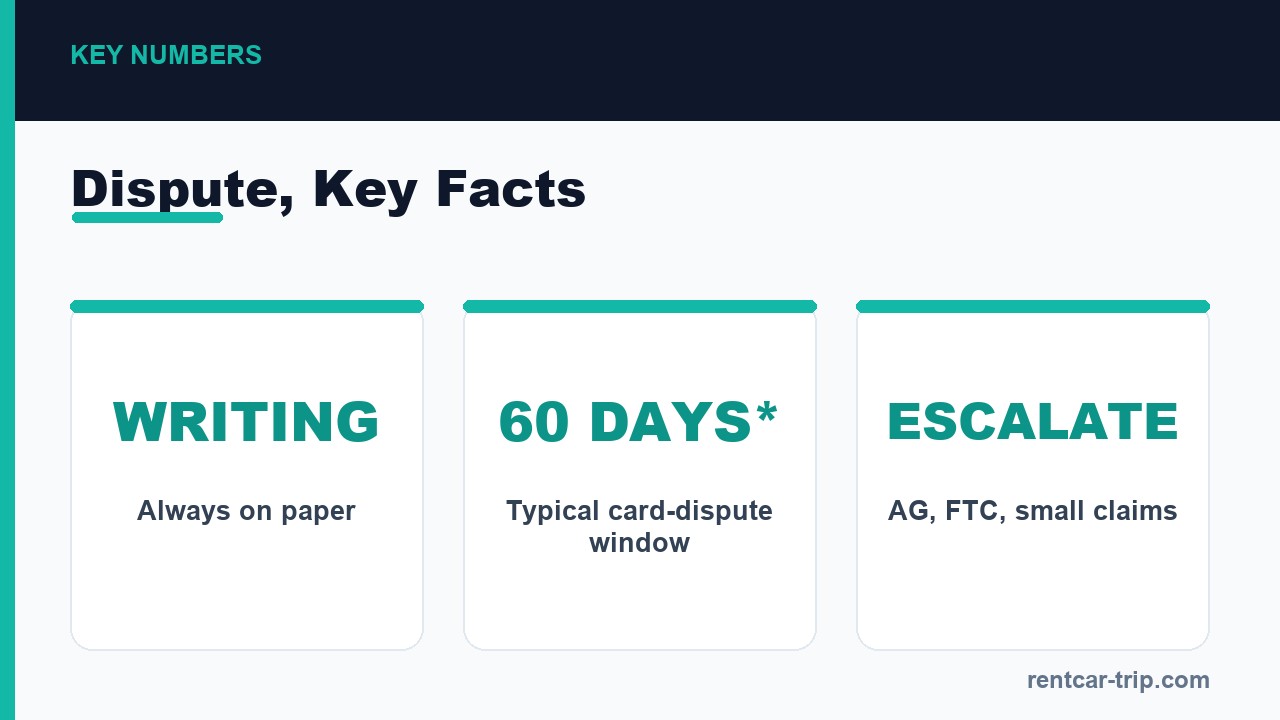
To dispute a rental car damage charge, gather your evidence, send the rental company a written dispute, and if they refuse to drop an unfair charge, dispute the charge with your credit card issuer under the Fair Credit Billing Act. Move quickly, because credit-card billing-error disputes generally must be made in writing within 60 days of the date the first statement showing the charge was sent to you.
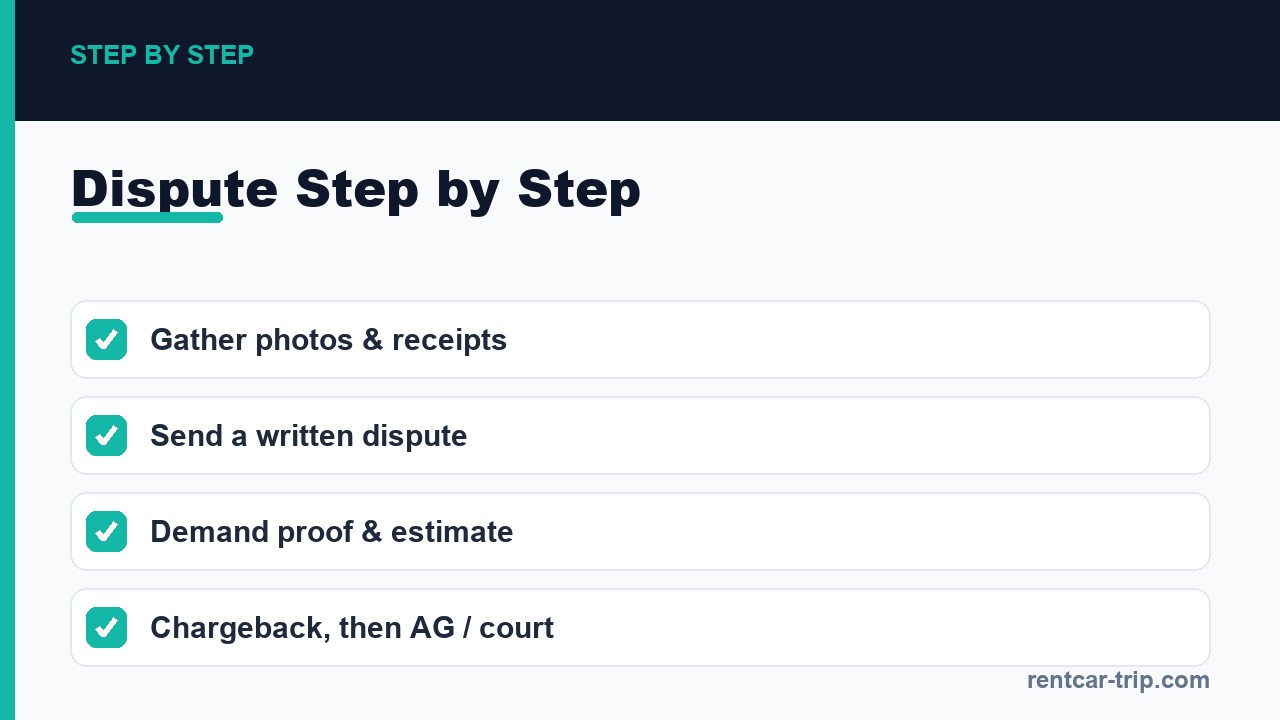
- Pull together your pickup and return photos, the signed rental agreement, and the return receipt or check-in slip.
- Ask the company in writing for the damage report, repair invoice, and proof the damage is new.
- Send a dated written dispute and keep copies of everything you send and receive.
- If the company will not resolve it, dispute the charge with your credit card issuer, generally within 60 days of the statement.
- Escalate to your state regulator or small claims court if the charge is still unfair.
Last Checked
This guide was last checked on June 29, 2026. Charges and dispute rights vary by company, state, and rental terms, so always confirm the details in your own agreement and with your card issuer.
Build Your Evidence First
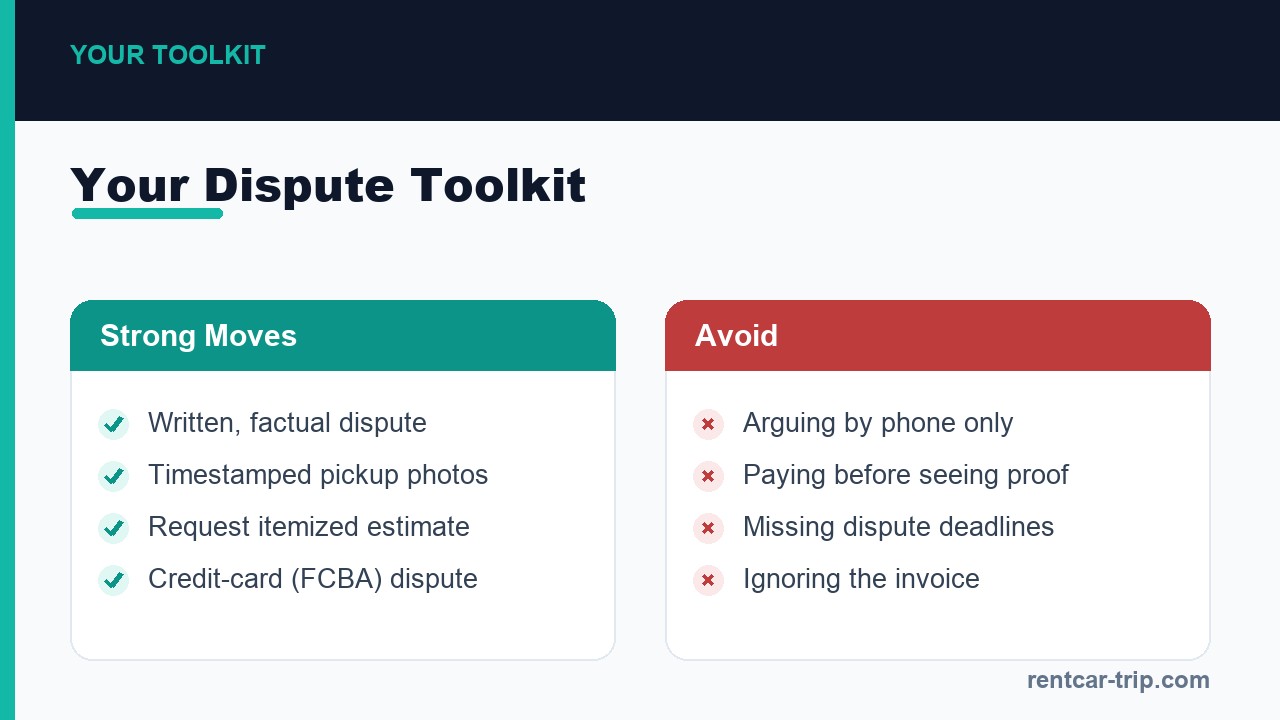
Evidence wins damage disputes. The company is the one asserting the damage is real, new, and caused by you, so make it document that claim. Before you write a single word, assemble a complete file so your dispute reads like a documented case rather than a complaint. The strongest disputes pair timestamped photos with paperwork that shows the car’s condition when you took it and when you returned it.
Request the rental company’s own paperwork in writing, including the damage incident report, the repair estimate or invoice, and any photos their inspector took. If a charge includes “loss of use,” administrative fees, or “diminished value,” ask them to itemize and justify each line. Loss-of-use and diminished-value charges are often added on top of the repair cost, and consumer guidance widely flags them as a common reason a bill balloons far beyond the actual work done, so insist on documentation rather than accepting a lump sum.
A charge that exceeds the documented repair cost is a charge worth challenging. The table below shows what each piece of evidence proves and where to find it.
| Evidence | What it proves | Where to get it |
|---|---|---|
| Pickup photos/video (timestamped) | Pre-existing damage you did not cause | Your phone’s camera roll |
| Return photos/video | Car condition when you handed it back | Your phone’s camera roll |
| Signed rental agreement and condition form | What you agreed to pay and any noted damage | Counter copy or confirmation email |
| Return receipt / check-in slip | The car was accepted without noted damage | Agent at drop-off or email |
| Repair invoice and damage report | Whether the charge matches actual repair cost | Request from the company in writing |
Send a Written Dispute Before You Pay
Always dispute in writing, because a phone call leaves no record and verbal promises rarely hold up. Send a short, factual letter or email to the company’s damage recovery or billing unit. State plainly that you are disputing the charge, reference your rental agreement and reservation number, and attach your photos and the return receipt. Keep the tone businesslike and specific rather than angry.
Ask them to either withdraw the charge or send full documentation supporting it. Give a reasonable deadline, such as 14 days, and send anything physical by certified mail with a return receipt so you can prove they received it. Keep copies of everything, including the dispute itself. The table below outlines a typical escalation path and the rough timing involved. Treat the timing as general guidance, not a legal guarantee.
| Step | What you do | Typical timing |
|---|---|---|
| 1. Direct dispute | Write to the company’s damage/billing unit with evidence | Allow about 10-14 days for a reply |
| 2. Request documentation | Demand the repair invoice and proof the damage is new | Often required within their stated window |
| 3. Card chargeback | File a written dispute with your issuer under the FCBA | Generally within 60 days of the statement |
| 4. Regulator complaint | File with your state AG or consumer protection office | Anytime; helps flag patterns |
| 5. Small claims court | Sue over an unfair charge, or defend against one | Varies by state |
Use the Chargeback, Then Escalate
If the rental company will not back down, your credit card is your strongest tool. Under the federal Fair Credit Billing Act, you can dispute billing errors on a credit card, and your written dispute generally must reach the issuer within 60 days of the date the first statement showing the charge was sent to you. The FTC recommends calling the issuer first, then following up in writing. Explain that the rental company charged you for damage you did not cause, or overcharged beyond the repair cost, and attach your evidence.
A chargeback shifts the burden onto the rental company to justify its charge to the bank, and many cannot. While the issuer investigates a qualifying dispute, you can generally withhold payment on the disputed amount and related finance charges, and the issuer may not report that amount as delinquent while it works through the claim. Be aware that these protections largely apply to credit cards. Debit card holds and prepaid deposits often carry weaker dispute rights, so verify what applies with your bank.
Keep in mind that winning a chargeback does not always erase the underlying debt. A rental company can still pursue it or add you to a “do not rent” list. If a fair resolution still escapes you, file a complaint with your state attorney general or department of insurance, report the pattern to the FTC, and consider small claims court, where rental companies frequently settle rather than send someone to a hearing. Confirm the FCBA deadlines and your card’s specific benefits before you rely on them.
Common Mistakes To Avoid
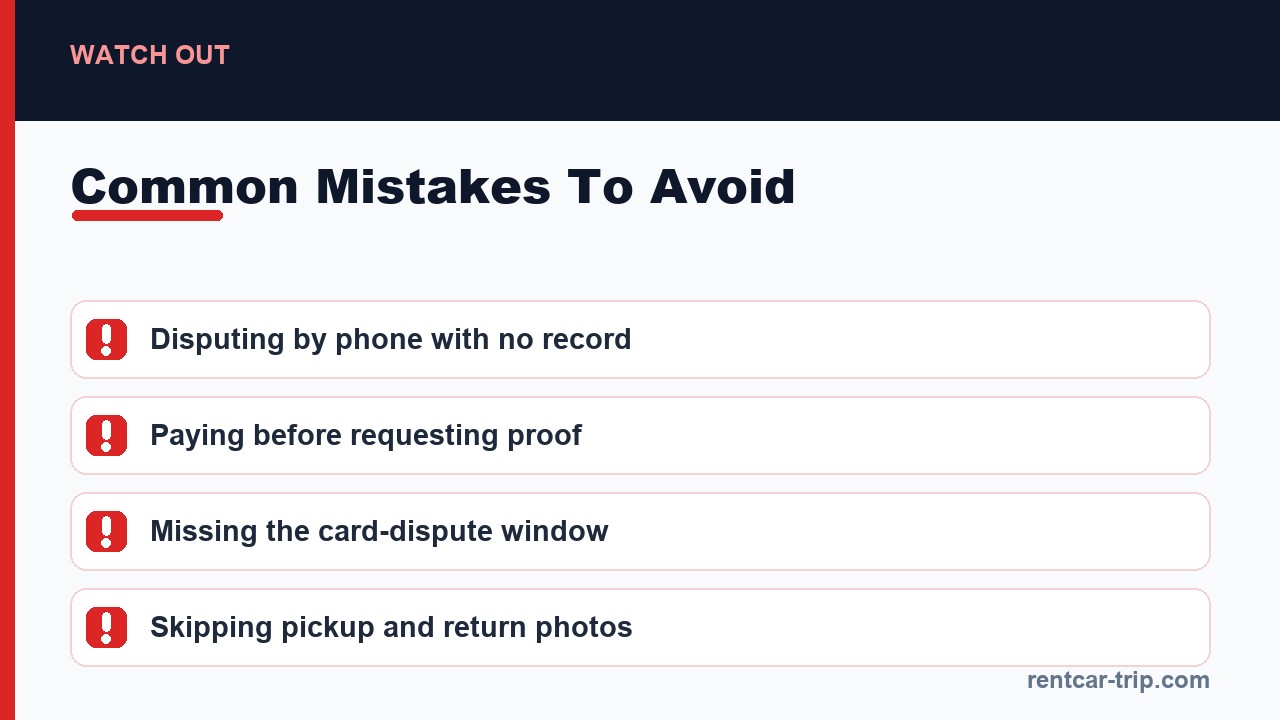
- Skipping pickup and return photos, which leaves you with no proof of the car’s actual condition.
- Disputing only by phone and never putting your objection in writing.
- Paying the charge immediately to “make it go away,” which can weaken your leverage in a dispute.
- Missing the roughly 60-day window to dispute a credit card charge under the Fair Credit Billing Act.
- Accepting vague “loss of use” or administrative fees without demanding an itemized repair invoice.
- Assuming a debit card gives you the same chargeback protections as a credit card.
Your Dispute Rights Depend on How You Paid: Credit Card vs. Debit Card
Whether you booked the rental (or paid the disputed damage charge) on a credit card or a debit card changes which federal law protects you and how strong your leverage is. A credit card charge is governed by the Fair Credit Billing Act (FCBA), which amended the Truth in Lending Act and is implemented through Regulation Z. A debit card transaction is instead governed by the Electronic Fund Transfer Act (EFTA), implemented through Regulation E (12 CFR Part 1005). The practical differences below matter most when a rental company has already pulled the money, or when the two months after your statement are ticking down.
| Feature | Credit card (FCBA / Truth in Lending Act, Reg Z) | Debit card (EFTA / Regulation E) |
|---|---|---|
| Deadline to dispute in writing | Written billing-error notice must reach the card issuer within about 60 days after the first statement showing the charge was sent to you. | You generally must notify the bank no later than 60 days after the periodic statement showing the error was sent (Regulation E allows oral notice, but written notice is safer and the bank can require written confirmation within 10 business days). |
| Whose money is at stake during the investigation | You can typically withhold payment on the disputed amount (and related finance charges) while it is investigated, so the money usually has not left your pocket. | The funds have typically already left your checking account; you wait for the bank to investigate and refund, though provisional credit may apply (see below). |
| Cap on liability for truly unauthorized charges | Capped at $50 under the Truth in Lending Act (15 U.S.C. §1643), and often $0 in practice via issuer “zero liability” policies; the cap does not escalate based on how fast you report. | Tiered under Regulation E §1005.6: up to $50 if reported within two business days of learning of the loss, up to $500 if reported after that but within 60 days of the statement, and potentially unlimited if reported later. |
| Covers goods/services “not delivered as agreed”? | Yes — the FCBA treats charges for items not accepted or not delivered as agreed as billing errors. | No — Regulation E’s definition of “error” is limited to unauthorized or incorrect transfers, not merchant delivery disputes. |
| Covers quality-of-goods/services disputes? | Yes, but through a separate FCBA right (the “claims and defenses” rule at 15 U.S.C. §1666i, not the billing-error track): you must first try to resolve it with the seller, and conditions have historically included the charge exceeding $50 and the purchase being in your home state or within 100 miles of your billing address (exceptions apply, including when the seller solicited the sale by mail/online with the issuer’s participation). | No — Regulation E’s definition of “error” (§1005.11) does not include disputes about the quality of goods or services. |
| Provider’s response timeline | Issuer must acknowledge in writing within about 30 days and resolve the dispute within two billing cycles (not more than 90 days). | Bank must investigate within 10 business days, or take up to 45 days if it provisionally credits your account within that 10-day window (longer timelines can apply to new accounts and certain point-of-sale or foreign-initiated transfers). |
The takeaway for a rental car damage charge: paying the reservation and any deposit on a credit card generally gives you stronger footing than a debit card, because you can often withhold the disputed amount rather than fight to claw back money already gone, and your liability for unauthorized amounts does not balloon with time. If you paid by debit card, report the problem to your bank quickly — the Regulation E liability tiers reward speed. As of July 2026, verify current terms with your issuer and the official sources, since network “zero liability” policies are voluntary and can change.
The Escalation Ladder When a Dispute Stalls
If your card issuer or bank does not resolve the charge, escalate in order. Each rung has a different official channel; note that federal regulators generally do not resolve individual disputes for you, but their complaint processes apply pressure and feed enforcement.
| Step | Where to go | What it does |
|---|---|---|
| 1. Card issuer or bank | The billing-dispute address on your statement (not the payment address) | Filing a written dispute here is the step that preserves your federal rights under the FCBA or Regulation E. Keep proof of mailing, such as certified mail with return receipt. |
| 2. Consumer Financial Protection Bureau | consumerfinance.gov/complaint | The CFPB forwards your complaint to the company (companies generally respond within about 15 days) and administers the federal rules under both the Truth in Lending Act/FCBA and the EFTA/Regulation E. |
| 3. State attorney general or consumer protection office | Your state’s official AG or consumer protection website | Handles unfair or deceptive business practices; some states have rental-specific consumer statutes that add leverage. |
| 4. Federal Trade Commission | ReportFraud.ftc.gov | The FTC does not resolve individual disputes but uses reports for enforcement and trend-tracking; it enforces the FCBA for almost all creditors except banks. Use this especially if the charge involves fraud or deception. |
| 5. Small claims court | Your local small claims court | For amounts within your state’s small-claims limit, a relatively low-cost way to seek a judgment if the earlier steps fail. |
As of July 2026, confirm the current complaint URLs, phone numbers, and small-claims dollar limits with the official agencies before you rely on them, as thresholds and procedures vary by state and can change.
Sources verified for this section: consumerfinance.gov, consumerfinance.gov, consumerfinance.gov, consumer.ftc.gov, consumer.ftc.gov, consumer.ftc.gov, law.cornell.edu, law.cornell.edu, consumerfinance.gov, reportfraud.ftc.gov
Frequently Asked Questions
How long do I have to dispute a rental car damage charge?
For a credit card dispute under the Fair Credit Billing Act, your written dispute generally must reach the card issuer within 60 days of the date the first statement showing the charge was sent to you. Disputing directly with the rental company has no fixed federal deadline, but act fast, since their internal windows and the available evidence both fade over time. Confirm the exact dates with your issuer.
Can I dispute a charge if I already returned the car without issues?
Yes. A clean return receipt or check-in slip showing no noted damage is strong evidence in your favor. If a charge appears later, you can dispute it directly and through your credit card. The company is the one claiming the damage is new and that you caused it, which is hard to prove against a documented, accepted return.
What if the rental company charges my card before I can object?
You can still dispute it. Many damage charges hit your card automatically through an authorization or hold. File a written dispute with the rental company and, if needed, request a chargeback from your card issuer within the roughly 60-day window. The fact that money already moved does not erase your right to contest an incorrect or unfair charge.
Does a credit card chargeback actually cancel the debt?
Not always. A successful chargeback reverses the charge on your card, but the rental company may still consider the debt owed and can pursue it separately or block future rentals. Treat the chargeback as one tool, keep your evidence, and be ready to resolve the underlying dispute in writing or, if necessary, in small claims court.
Should I file an insurance claim instead of disputing?
Sometimes both. If you actually caused the damage, filing a claim through your own auto policy, a credit card benefit, or a purchased waiver may be the cleaner path. If the charge is wrong or inflated, dispute it directly and via chargeback. When unsure, contact your insurer or card benefits line and confirm coverage and deadlines in writing before deciding.
Where can I escalate if the company ignores me?
File a complaint with your state attorney general or consumer protection office, and your state department of insurance if a waiver or coverage is involved. You can also report patterns to the FTC. For a clearly unfair charge, small claims court is a practical option, and rental companies often settle rather than send a representative to a hearing.
Official and Primary Sources Used
- FTC: Renting a Car – consumer guidance on rental cars, damage waivers, full-value liability, and card holds.
- FTC: Using Credit Cards and Disputing Charges – how to dispute credit card charges and the Fair Credit Billing Act 60-day timeline.
- Insurance Information Institute: Rental Car Insurance – overview of rental coverage, waivers, and loss-of-use fees.
- FTC: Fair Credit Billing Act – statute governing billing-error disputes on credit accounts.