RentCar Trip plain-English insurance series: no jargon, no upsell pressure, just what the coverage does and when it earns its cost.
At the rental counter, the agent will likely offer to raise your liability limits for a few extra dollars a day. That add-on is supplemental liability insurance rental car coverage, and whether you need it depends entirely on what protection you already carry. This guide explains what SLI pays, who genuinely benefits, and how it differs from the bare-minimum liability that comes with the car and from CDW.
Quick Answer
Usually no if you already carry solid personal auto liability limits, but often yes if you have low limits, no auto policy at all, or rely on a credit card that excludes liability. SLI raises the amount available to pay other people you injure or whose property you damage, typically up to around $1 million depending on the provider.
- SLI covers third-party injuries and property damage you cause, not damage to the rental car itself.
- It sits on top of the minimal state-minimum liability bundled into most rental agreements.
- Drivers with high personal auto liability limits frequently do not need it.
- Renters with no auto policy, low limits, or a liability-excluding credit card often do.
- It does not replace CDW/LDW, Personal Accident Insurance, or Personal Effects Coverage.
Last Checked
This guide was last checked on June 28, 2026. Coverage varies by policy, card, provider, country, and rental terms, so confirm your own documents.
What SLI Actually Covers (and What It Doesn’t)
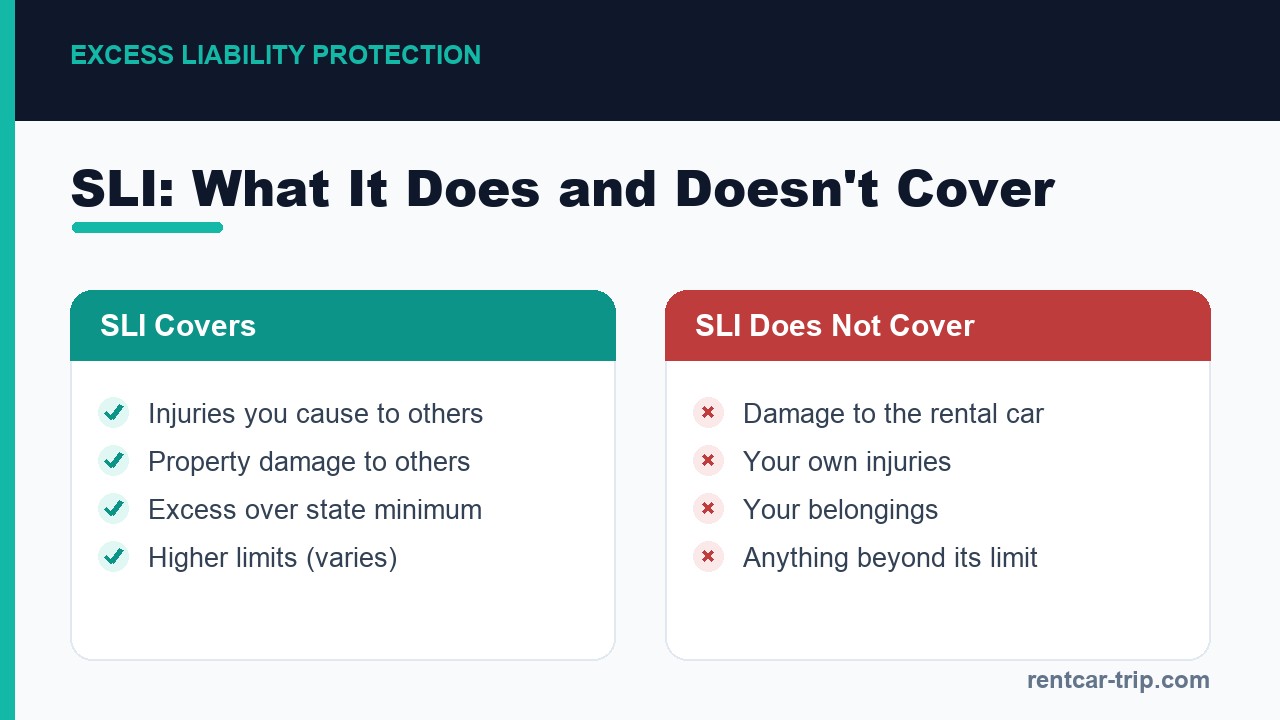
Supplemental Liability Insurance is optional excess coverage that increases your third-party liability limits while driving a rental car. Third-party liability means harm you cause to other people, such as another driver’s medical bills or repairs to someone else’s vehicle. SLI does nothing for your own car repairs, your own injuries, or your belongings. Those gaps are filled by entirely different products.
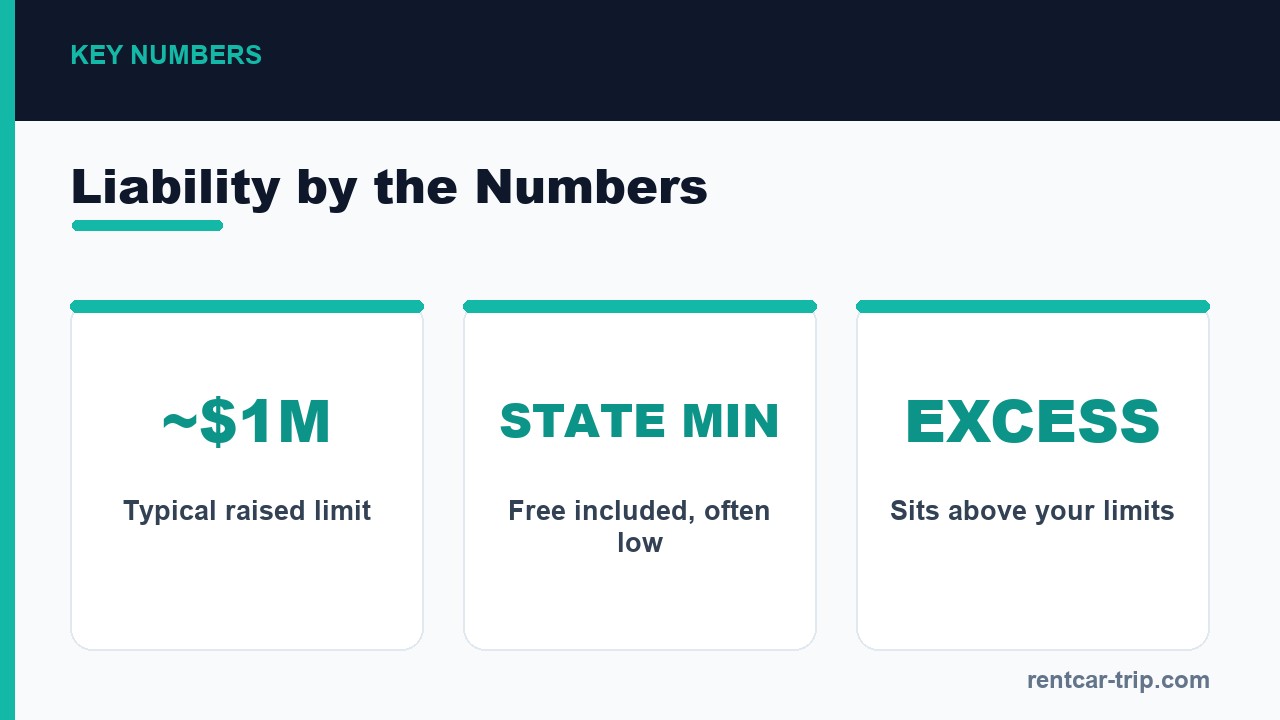
The reason SLI exists comes down to how low the included protection can be. Most rental agreements bundle only the state-minimum liability, which can be a few thousand to a few tens of thousands of dollars depending on the state. A serious crash with injuries can blow past that minimum quickly, and you are personally responsible for the difference. SLI is designed to absorb that gap.
| Coverage | Pays For | Does NOT Pay For |
|---|---|---|
| SLI (Supplemental Liability Insurance) | Injuries and property damage you cause to others, plus related legal costs, above the rental’s base limit | The rental car, your injuries, your belongings |
| Included base liability | State-minimum third-party amount only | Anything above that minimum |
| CDW / LDW (damage waiver) | Damage or theft of the rental car itself | Injuries or damage to other people |
| Personal Accident Insurance (PAI) | Medical costs for you and your passengers | Third-party claims, vehicle damage |
| Personal Effects Coverage (PEC) | Theft or damage to your belongings in the car | Liability, vehicle damage, injuries |
The key takeaway is structural: SLI and CDW solve opposite problems. CDW protects the car you rented; SLI protects everyone else on the road from your mistakes. Buying one does not give you the other.
Who Actually Needs SLI
SLI is rarely legally required, so the decision is about risk, not compliance. Whether it makes sense depends almost entirely on what liability protection you already have through your own auto policy or credit card.
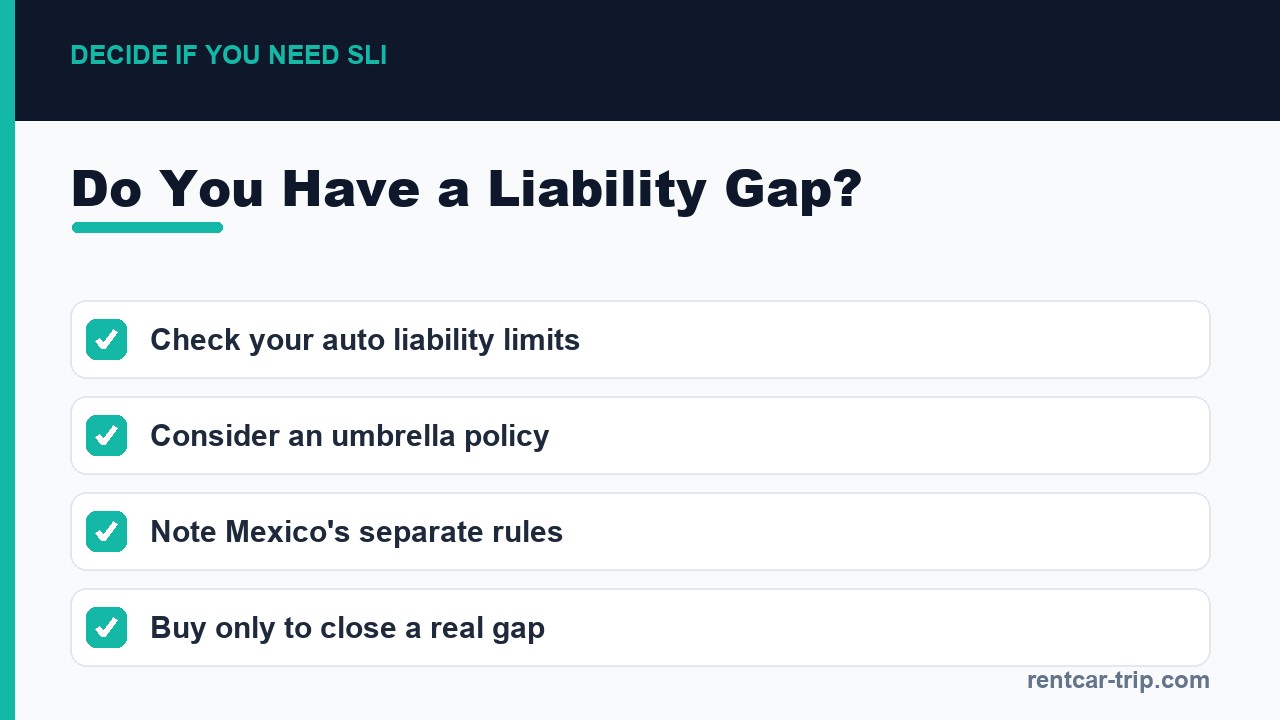
You likely do not need SLI if you carry a personal auto policy with high liability limits, because that policy generally extends to rental cars for personal use. You likely do benefit from SLI if you fall into one of these groups:
- No personal auto policy. If you do not own a car, you have no liability coverage to fall back on, and the rental’s state-minimum is all that stands between you and a lawsuit.
- Low personal auto limits. A bare-minimum personal policy may leave a wide gap on a serious claim.
- Relying only on a credit card. Most credit card rental benefits cover damage to the car (secondary CDW), not third-party liability. A card alone usually leaves your liability exposure untouched.
- Higher-risk trips. Heavy traffic, unfamiliar cities, or long drives raise the odds of an at-fault collision.
One caution worth repeating: travel insurance and credit cards almost never include third-party liability for rental cars. If you assumed those products had you covered for injuring someone else, you may be carrying a serious gap without realizing it.
How the math can turn against you is easy to picture. Imagine an at-fault collision where another driver needs surgery and lengthy rehabilitation. Medical bills, lost wages, and a totaled vehicle on the other side can climb well into six figures. If the rental included only a low state minimum and you have no personal policy behind it, the shortfall becomes a personal debt that can follow you for years. That single scenario is the entire argument for SLI, and it is why renters without their own liability coverage should treat it seriously rather than waving off the upsell on reflex.
How SLI Compares to Your Existing Coverage
Before paying the counter rate, check three sources in order. Your personal auto policy is first, because it is the most likely place you already hold liability coverage that follows you into a rental. Your credit card is second, but read it carefully, since most card benefits stop at the car and skip liability entirely. The rental company’s SLI is third, and it makes the most sense when the first two leave a clear gap.
Coverage limits vary by provider. SLI at major rental companies commonly tops out around $1 million combined single limit, though some agreements set lower ceilings. Always confirm the exact limit on your own rental agreement, because the number printed on the contract is what actually applies if you have a claim.
On the other side, double-paying is just as real a mistake. If your personal auto policy already carries a high liability limit and clearly extends to rentals, layering SLI on top usually buys you very little additional protection for the daily fee. The honest answer for most insured drivers is to read the declarations page, confirm rental coverage with the insurer, and decline the add-on if the existing limit is already strong.
Common Mistakes To Avoid
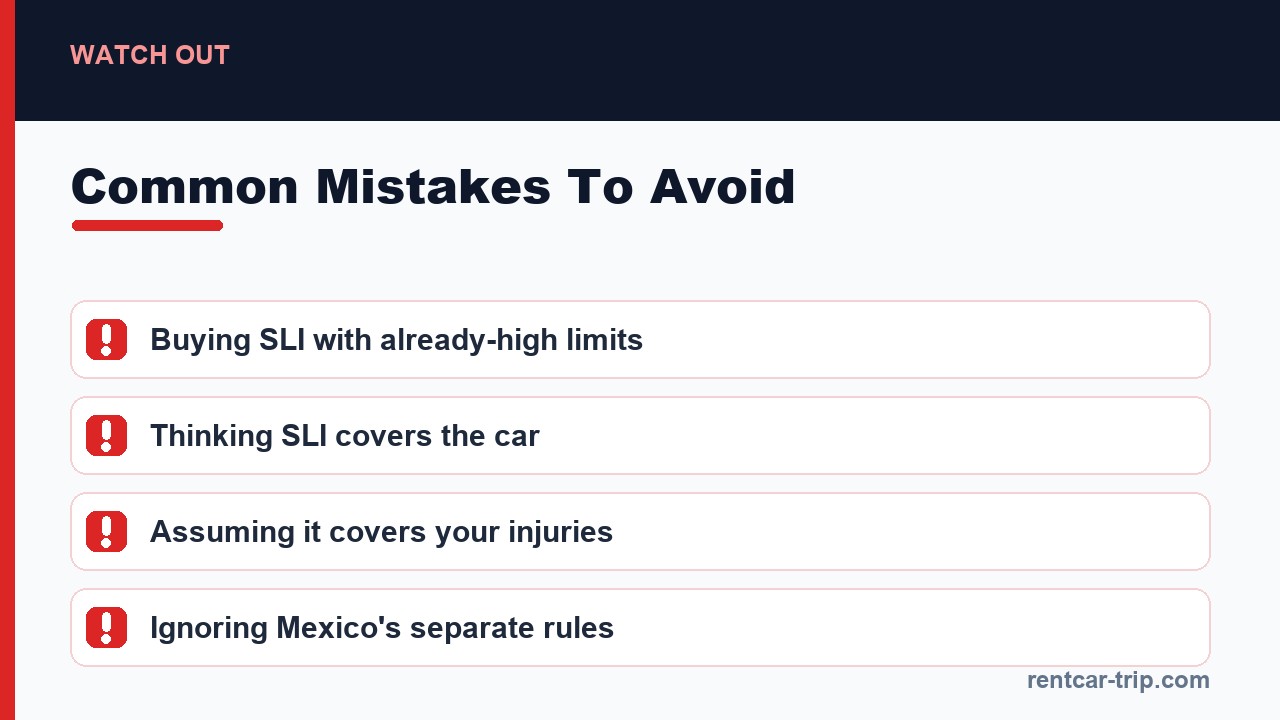
- Assuming CDW covers liability. A damage waiver protects the rental car, not the people you might injure. They are separate purchases.
- Assuming your credit card covers liability. Card rental benefits are usually damage-only and exclude third-party liability.
- Double-buying. If your personal auto policy already carries high liability limits, SLI may simply duplicate protection you have.
- Ignoring the included minimum. The base liability bundled with the rental is often a low state minimum, not real protection for a serious crash.
- Forgetting exclusions. Unauthorized drivers, off-road use, and driving over the legal alcohol limit can void coverage entirely.
- Skipping the agreement. Verify the actual SLI limit on your contract rather than trusting a verbal pitch at the counter.
How Avis, Budget, Enterprise, and Hertz Actually Structure This Coverage
Each major U.S. brand sells this add-on under its own name, and — importantly — the coverage limits are lower today than the “$1 million” figure that older guides still repeat. The table below reflects each brand’s current U.S. protection-products or rental-terms page. Avis, Budget, and Hertz all describe their optional coverage as primary: it responds to third-party claims before your own auto policy is touched. Enterprise structures its version differently — Enterprise covers you up to the applicable state minimum and Zurich American provides excess coverage above that, so it layers on top of baseline liability rather than clearly sitting primary to your personal policy.
| Brand | Product name | Max combined single limit (standard passenger cars) | How it pays / underwriter | Typical daily price |
|---|---|---|---|---|
| Avis | Additional Liability Insurance (ALI) | Up to $500,000 in all states | Primary to your own policies; underwritten by Empire Fire & Marine in CA, DE, FL, IN, IA, LA, ME, MD, MT, NH, NY, PA, PR and WA, and ACE American elsewhere | Not published as a flat rate; the added daily charge is shown on the rental agreement |
| Budget | Supplemental Liability Insurance (SLI) | Up to $500,000 in all states | Primary to your own policies; underwritten by Empire Fire & Marine in CA, DE, FL, IN, IA, LA, ME, MD, MT, NH, NY, PA, PR and WA, and ACE American elsewhere | Not published as a flat rate; added daily charge shown on the agreement |
| Enterprise | Supplemental Liability Protection (SLP) | Up to $300,000 (up to $1,000,000 on the Enterprise Truck Rental brand) | Layered, not clearly primary: Enterprise covers up to the applicable state minimum and Zurich American Insurance Company provides excess coverage above that up to the limit | Enterprise cites an average of roughly $8 to $42 per day, varying by location (higher on Enterprise Truck Rental) |
| Hertz | Liability Insurance Supplement (LIS) | Up to $300,000, plus up to $100,000 uninsured/underinsured motorist coverage | Primary; pays before your personal policy for third-party bodily injury and property damage | Not published as a flat rate; added daily charge quoted at booking |
Enterprise is the one brand that attaches a dollar figure to the coverage in its own materials, citing an average of roughly $8 to $42 per day — though the exact charge depends on your location and vehicle type, and independent guides commonly quote closer to $8 to $17 per day for standard cars. Avis, Budget, and Hertz do not post a flat daily rate; each states that the charge appears on your rental agreement, so treat any quoted number as typical and confirm it at pickup.
Why the Common “$1 Million” Rule of Thumb Is Now Outdated
Many summaries still describe rental SLI as raising you to a $1,000,000 combined single limit. For standard passenger cars from these four brands, that is no longer accurate: Avis and Budget currently cap their optional coverage at $500,000, while Enterprise and Hertz sit at $300,000 (Hertz also adds up to $100,000 of uninsured/underinsured motorist coverage, which is not offered in California). Hertz’s cut is recent — it lowered LIS from $1,000,000 to $300,000 per accident, effective January 1, 2025. The $1,000,000-and-up figure now survives mainly in narrower situations: Enterprise Truck Rental carries up to $1,000,000, and Hertz currently lists higher LIS limits — up to $2,000,000 — in California and Florida. Because the amount that ultimately applies is the one printed on your agreement, verify the specific limit and daily charge for your exact rental location and vehicle type before deciding whether the add-on is worth it on top of your existing auto policy or credit-card coverage.
As of July 2026, verify current terms. Coverage limits, underwriters, and daily charges change and vary by state, vehicle class, and location; always confirm the figures on each brand’s official protection-products page and on your own rental agreement at the time of booking.
Sources verified for this section: avis.com, budget.com, enterprise.com, hertz.com, legalclarity.org, legalclarity.org
Frequently Asked Questions
Is supplemental liability insurance the same as CDW?
No. SLI covers injuries and property damage you cause to other people, while CDW (or LDW) covers damage or theft of the rental car itself. They protect opposite parties and do not overlap. Many renters need to think about both separately, since buying one provides no protection for what the other handles.
Do I need SLI if I already have car insurance?
Often no. A personal auto policy with high liability limits generally extends to rental cars used for personal trips, which can make SLI redundant. But if your limits are low, SLI may still close a meaningful gap. Check your declarations page for your liability limits and confirm rental coverage with your insurer before deciding.
Does my credit card include SLI?
Almost never. Most credit card rental benefits cover damage to the car as secondary or primary CDW, but they typically exclude third-party liability entirely. If a card is your only rental protection, your liability exposure usually remains uncovered. Read the card’s benefits guide to confirm exactly what is and is not included.
How much liability does the rental include for free?
Usually just the state-minimum amount, which varies widely by state and can be quite low. That minimum is enough to meet the legal requirement but often far below the real cost of a serious collision with injuries. SLI raises that limit substantially, commonly toward $1 million depending on the provider and your agreement.
Is SLI required by law?
Generally no. SLI is an optional add-on, not a legal requirement. Rental companies in many states must provide the legal minimum liability for that state, but raising it with SLI is your choice. Mexico is a notable exception abroad, where mandatory third-party liability rules differ from the U.S. system entirely.
Does SLI cover my own injuries or stolen belongings?
No. SLI is strictly third-party coverage for harm you cause to others. Your own medical costs are addressed by Personal Accident Insurance, and your belongings are covered by Personal Effects Coverage. If those risks concern you, you would need to add those separate products rather than relying on SLI to handle them.
Official and Primary Sources Used
- Source – Insurance Information Institute on rental liability, why state minimums are often too low, and non-owner liability policies.
- Source – FTC consumer guidance on rental car contracts and checking existing insurance before buying add-ons.
- Source – Insurance Information Institute home for general definitions of liability coverage and damage waivers.
Related RentCar Trip Guides
- Do You Really Need Rental Car Insurance at the Counter?
- CDW vs LDW vs Liability: Rental Car Insurance Terms in Plain English
- Credit Card Rental Car Insurance: Primary vs Secondary Explained
- Rental Car Liability Insurance Not Included
- Rental Car Insurance With No Personal Auto Policy
- Mexico Rental Car Liability Insurance Checklist