RentCar Trip Guides — plain-English help for rental car damage claims.
Getting an invoice weeks after returning a clean car is stressful, especially when the dent was already there at pickup. The good news is that rental car prior damage is one of the most disputable charges you can face, because under the general civil standard the company has to prove you caused it. This guide shows you what to document and how to push back.
Quick Answer
To prove pre-existing damage was not you, produce timestamped pickup photos and a signed condition report showing the damage existed before you drove off. Then dispute the charge in writing and ask the company to provide its own proof that you caused it.
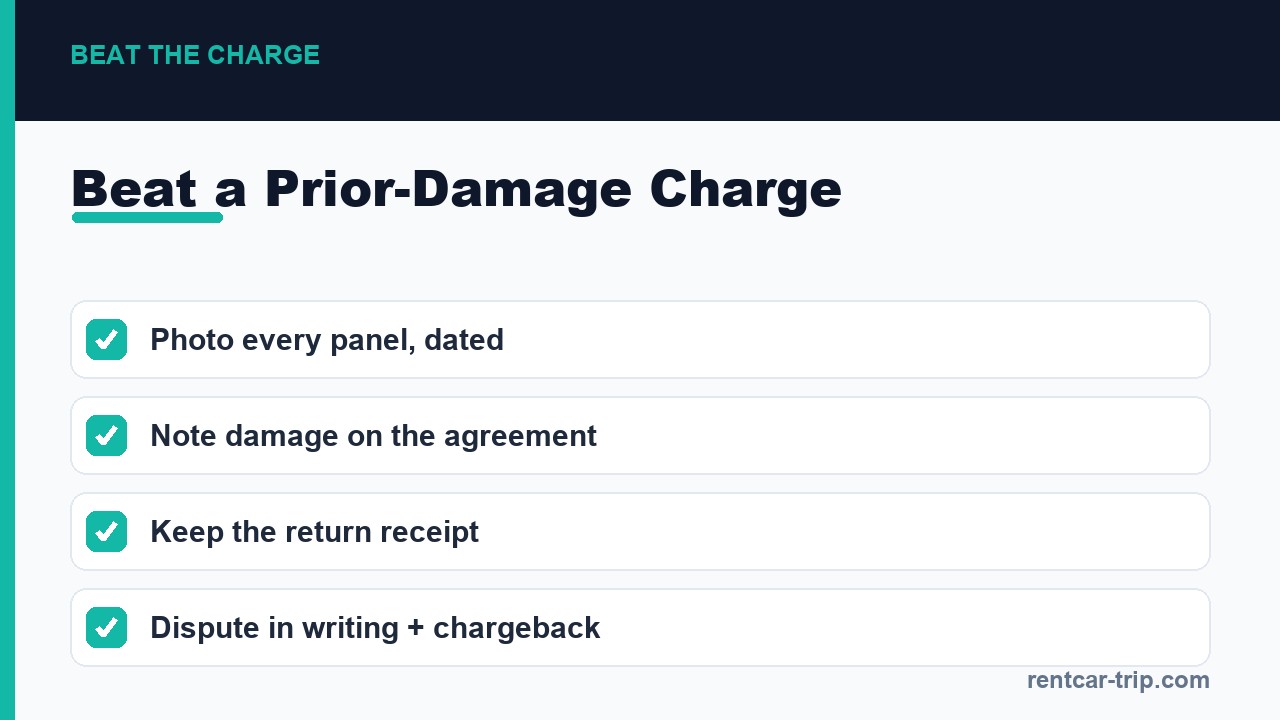
- Photograph and video every panel at pickup with the date and time visible on each shot.
- Get any damage you spot noted in writing on the rental agreement or condition form before you leave.
- Save your return receipt and any no-damage confirmation as your strongest evidence.
- Dispute billed damage in writing within the company’s stated window and demand a repair estimate.
- If the company will not back down, use a credit card dispute, your state Attorney General, or small claims court.
Last Checked
This guide was last checked on June 28, 2026. Charges and dispute rights vary by company, state, and rental terms, so confirm your own agreement.
What Counts As Proof That Damage Was Already There
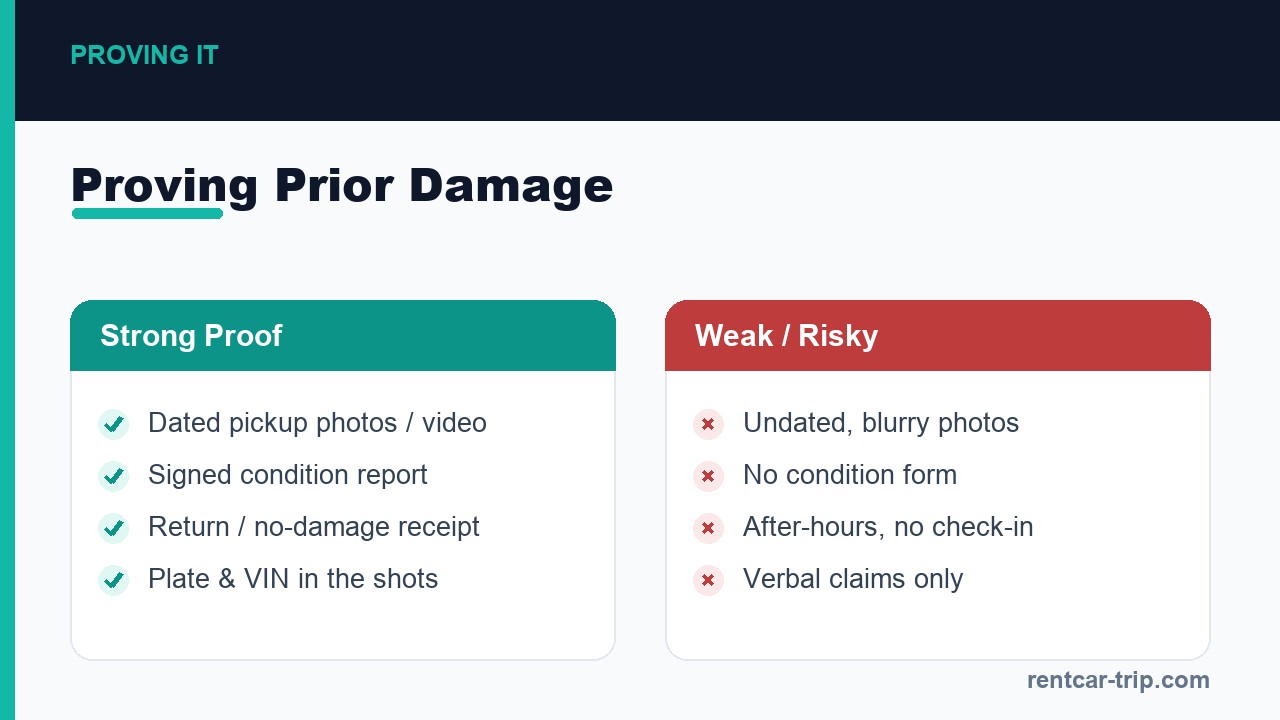
The single best defense against a prior-damage charge is evidence created at the moment you took the keys. A rental company that bills you generally has to show the damage was not present when you received the car, because in a civil dispute the party making the claim carries the burden. If your own records show the damage was already there, the claim becomes much harder to sustain. Proof must be specific, dated, and tied to that exact vehicle.
Not all documentation is equal. A blurry photo with no timestamp is weak; a clear, dated set covering every panel is strong. The table below ranks the evidence that typically carries the most weight.
| Type of proof | How strong it is | Why it matters |
|---|---|---|
| Timestamped pickup photos and video of all panels | Strongest | Shows the exact condition before you drove off, with a verifiable date and time. |
| Signed condition report noting the damage | Very strong | The company itself acknowledged the damage in writing before handoff. |
| Return receipt or no-damage check-in confirmation | Strong | Suggests an employee inspected the car at return and found nothing new. |
| Photos of the license plate and VIN in the same set | Supporting | Proves your photos are of the rental in question, not another car. |
| Written communication with the counter agent | Supporting | Creates a paper trail showing you reported pre-existing issues promptly. |
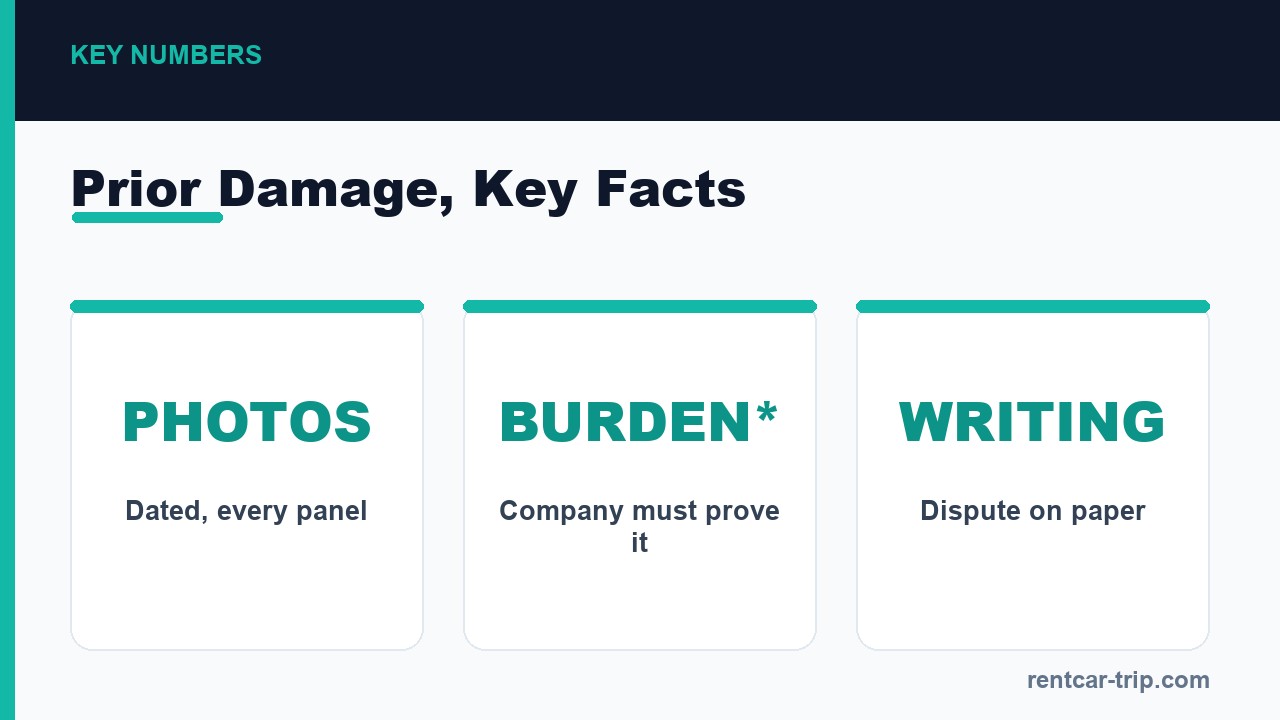
Aim to capture all four sides, the roof, the wheels, the windshield, and any existing scratches in close-up, plus a quick walk-around video. Pickup and return photos together tell a complete story of how the car looked when you got it and when you gave it back.
How To Document At Pickup So You Never Have To Argue
Most prior-damage disputes are won or lost before you leave the lot. The Federal Trade Commission advises renters to inspect the car for existing damage before driving off and to bring any damage to the rental agent. If an employee is available, have them note any damage in writing before you take the keys. Documentation beats memory every time.
Airport and unattended lots are the highest-risk situations, because the car is often inspected and then left for you with no employee present. That gap is exactly where disputed charges originate, so your own photos become the only neutral record. When possible, avoid returning the car when no employee can check it in with you.
Build a simple routine you repeat for every rental:
- Turn on the date-and-time stamp in your phone camera, or shoot a quick video that captures the date naturally.
- Walk the full perimeter and photograph each panel, then close in on any chip, scratch, or dent.
- Photograph the windshield, wheels, roof, interior, and the fuel gauge.
- If you spot damage, get it written onto the rental agreement or condition form and keep your copy.
- Repeat the same sequence at return, and request a check-in receipt confirming no new damage.
What To Do If You Are Billed For Damage You Did Not Cause
Stay calm and act in writing. A prior-damage invoice is a starting position, not a final verdict. Because the company is the party asserting you caused the damage, ask it to back that up: request a written, itemized repair estimate and dated photos of the alleged damage.
Send a short, factual dispute that references your evidence: the pickup photos showing the damage already existed, the timestamps, and your return receipt. State clearly that you received the vehicle in that condition and are not liable. If the company charged your card and refuses to show proof, you have stronger escalation paths than many renters realize.
| Step | What you do | When to use it |
|---|---|---|
| 1. Written dispute to the company | Send your photos, return receipt, and a clear statement of non-liability. | Always do this first; many claims are dropped here. |
| 2. Request proof and an estimate | Demand dated photos of the damage and an itemized repair bill. | When the company asserts a charge without backup. |
| 3. Credit card dispute | Ask your issuer to dispute the charge and submit your evidence. | When the company billed your card and will not reverse it. |
| 4. Regulator or AG complaint | File with the FTC and your state Attorney General consumer division. | When you suspect deceptive or unsupported billing. |
| 5. Small claims court | Bring your timestamped evidence before a judge. | As a last resort if a chargeback fails and amounts justify it. |
If the matter goes to a debt collector, you can request written validation of the debt, generally within 30 days of first contact, and the collector must verify it before continuing to collect. Keep copies of every email, photo, and letter in one folder.
Common Mistakes To Avoid
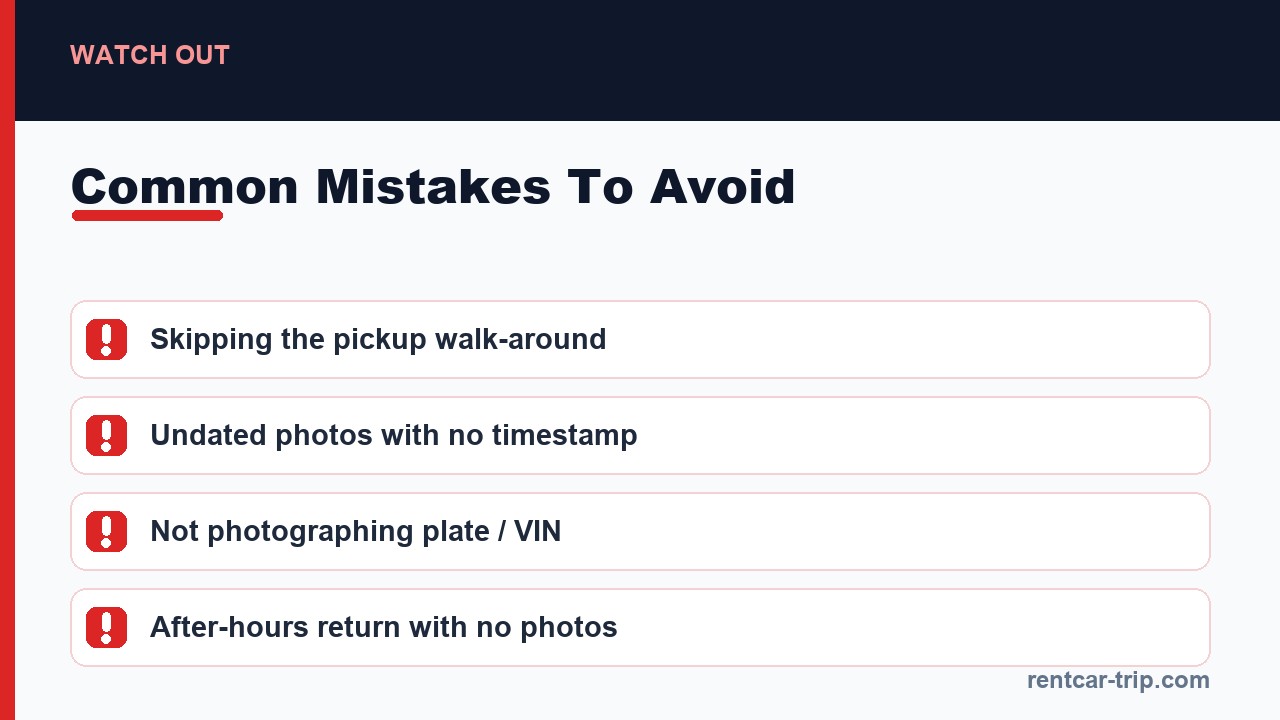
- Skipping the walk-around because you are in a hurry at the counter or a closed airport lot.
- Taking photos with no visible date or time, which makes them easy to dismiss.
- Failing to photograph the plate or VIN, so you cannot prove the shots are of that rental.
- Not getting spotted damage written onto the agreement before you drive off.
- Returning the car after hours with no employee check-in and no return photos.
- Arguing by phone only and leaving no written record of your dispute.
- Ignoring the invoice or paying immediately instead of asking the company for its proof.
Frequently Asked Questions
Who has to prove I caused the rental car damage?
Under the general civil standard, the party claiming you caused the damage carries the burden of proof. A company generally has to show the car was undamaged at pickup and damaged at return, then tie that to your rental. If your own timestamped photos show the damage already existed, that evidence directly undercuts the claim and often ends the dispute in your favor, though no single piece of evidence guarantees the outcome.
How long after returning a car can I be charged?
It varies by company and state, and bills sometimes arrive days or weeks after return. There is no single national deadline, so check your rental agreement for any stated notice window. Keep your pickup and return evidence indefinitely, because a charge can surface long after you assume the rental is closed.
Are phone photos enough to win a dispute?
Clear timestamped photos are often the deciding evidence, especially when they cover every panel and include the plate or VIN. Photos beat verbal claims because they are dated and specific. Pair pickup photos with a return receipt, and keep the originals rather than screenshots so the file details stay intact.
What if the lot was closed and no one inspected the car?
Unattended pickups and after-hours returns are the riskiest scenarios, because no employee verifies condition with you present. Your own photos become the neutral record. Shoot a dated walk-around at pickup and again at return, and when possible return during staffed hours so an employee can confirm no new damage in writing.
Can I dispute the charge with my credit card?
Often yes. If the company billed your card and refuses to reverse an unsupported charge, you may be able to dispute it under the Fair Credit Billing Act and submit your photos and return receipt. The company then has to respond to the issuer. Rules and time limits apply, so contact your card issuer and act promptly.
Should I report the company to a regulator?
Reporting can help, especially if billing looks deceptive or unsupported. You can file a complaint with the Federal Trade Commission and with your state Attorney General consumer protection division. These complaints create a record and sometimes prompt a company to drop a weak claim, though they do not guarantee a refund. Keep your evidence attached.
Official and Primary Sources Used
- FTC: Renting a Car – Advice on inspecting a rental, reporting existing damage, and charges.
- Insurance Information Institute: Rental Car Insurance – Coverage, CDW/LDW, and exclusions.
- FTC ReportFraud Portal – Where you can file a complaint about billing practices.
- Florida Attorney General: Car Rentals – Example state consumer-protection guidance.