Plain-English guidance for renters facing a damage claim — what the charge is, when it sticks, and how to push back.
If you damaged a rental and now see a line item for lost resale value, you are dealing with rental car diminished value: the drop in a car’s market worth after it has been wrecked and repaired. A rental company often can pursue this charge under your contract, but whether it sticks depends on your state, your rental terms, and any waiver or insurance you carry. This guide explains what the charge is, how it differs from repair cost, how it is estimated, and how to push back.
Quick Answer
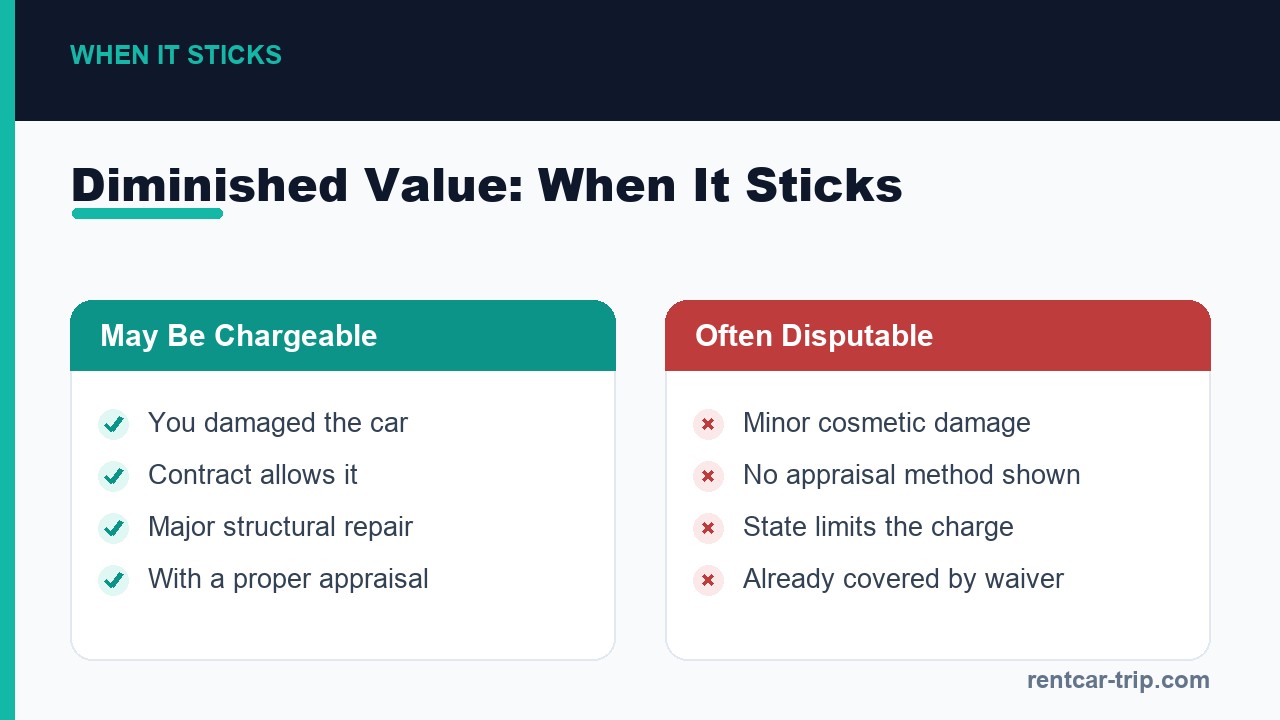
Yes, a rental company can often try to charge you diminished value when you are responsible for damage, because most rental agreements make you liable for the car’s full loss, not just repairs. Whether the charge is valid and collectible depends heavily on your state’s laws, the exact contract language, and whether you bought a waiver.
- Diminished value is the loss in resale price after repair, separate from and on top of the repair bill itself.
- A Collision Damage Waiver (CDW) or Loss Damage Waiver (LDW), if valid and not voided, typically removes your liability for this charge.
- Your personal auto policy and most credit cards usually do not pay diminished value when you are the at-fault driver.
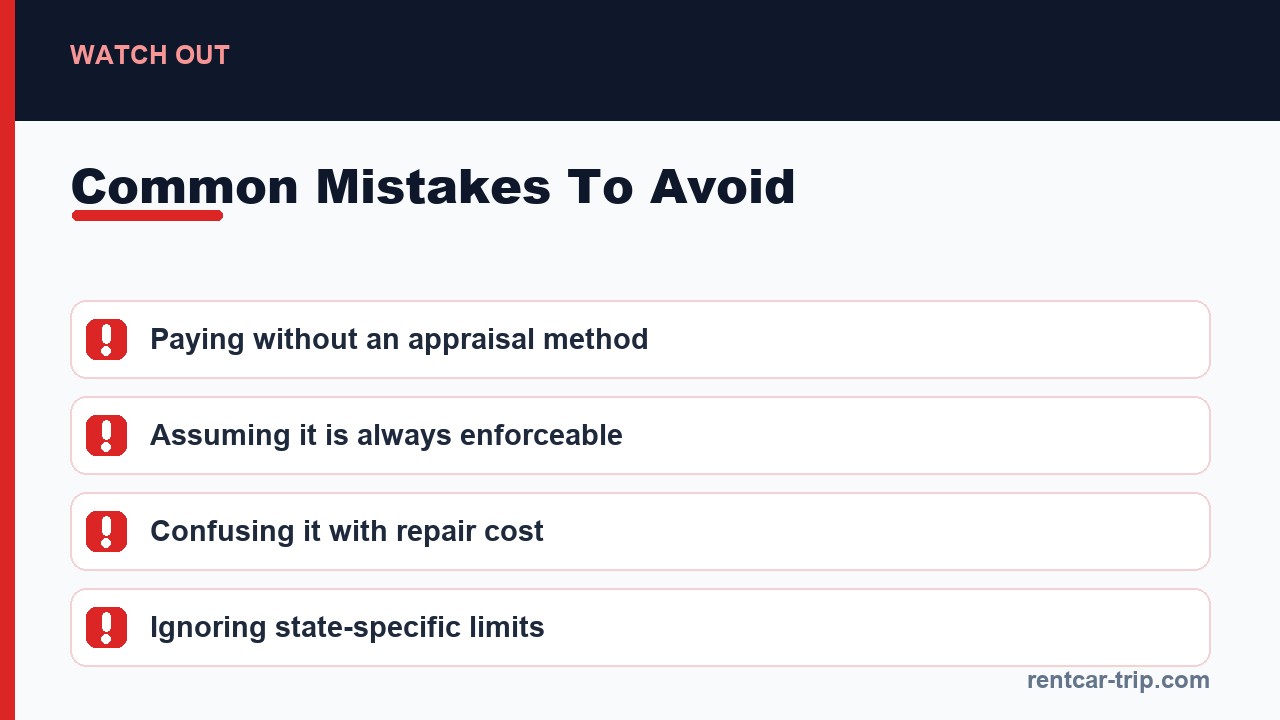
- Some states limit or bar rental companies from recovering loss of use, administrative fees, or diminished value from the renter, so check your state.
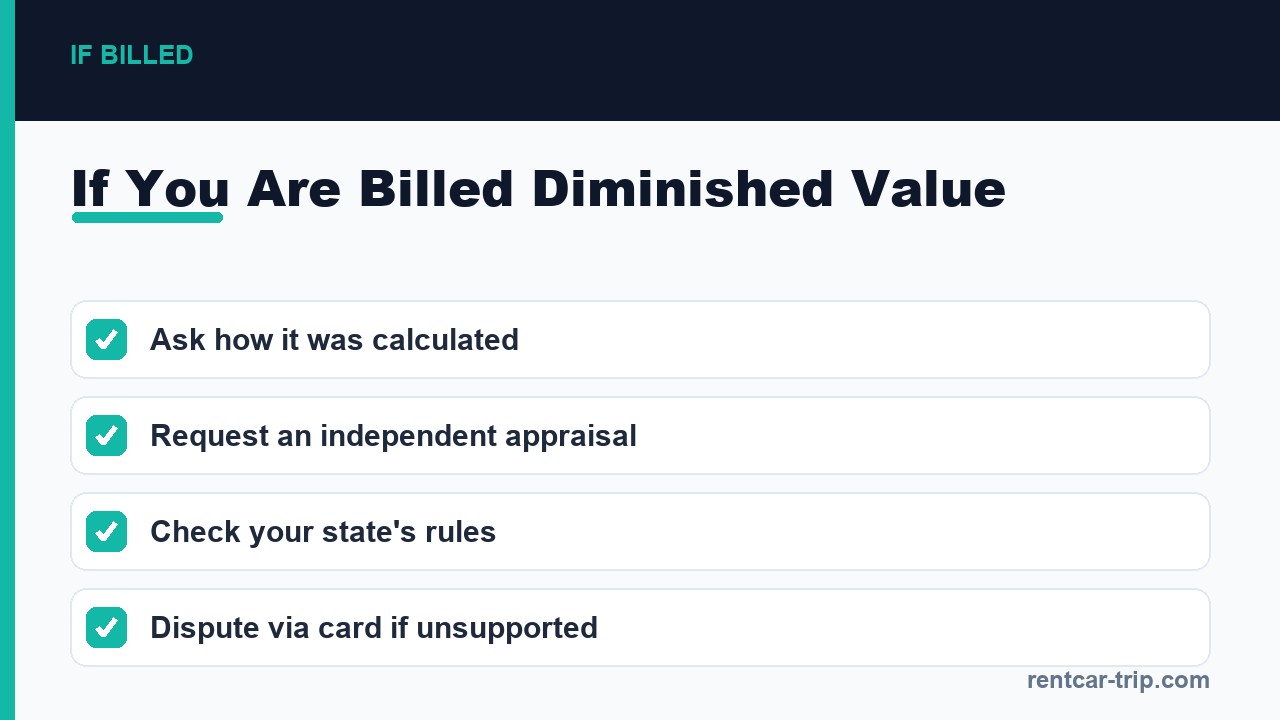
- You can dispute the amount by demanding the repair invoice, photos, a written valuation, and the contract clause that authorizes the charge.
Last Checked
This guide was last checked on June 29, 2026. Charges and dispute rights vary by company, state, and rental terms, so confirm your own agreement.
What Diminished Value Actually Means on a Rental
Diminished value is not about what it costs to fix the car. It is about what the car is worth afterward. Even a flawless repair leaves a car with an accident history, and a future buyer at auction will usually pay less for a vehicle that has been damaged and repaired than for an identical one that never was. The Insurance Information Institute describes this gap as the difference between the pre-accident value and the post-repair market value.
This matters to rental companies in a specific way: they sell their cars relatively quickly into the used market. When a repaired unit goes to auction with a damage record, the company can recover less, and it may try to bill you for that shortfall. So a diminished value charge is the rental company saying, “Even after we fixed it, this car is worth less, and you caused that.”
Keep in mind that diminished value does not apply to every car. The III notes that some older vehicles can actually be worth slightly more after repair because worn parts were replaced with new ones, so a credible claim depends on the car’s age, mileage, and condition.
Diminished Value vs. the Other Charges After Rental Damage
Diminished value is one of several add-on charges that can appear after a damage claim, and renters often confuse them. The table below breaks down how each line item works and who typically pays.
| Charge | What it covers | Typical range | Who usually pays |
|---|---|---|---|
| Repair cost | The actual physical fix to the vehicle | Varies widely by damage | You, your auto policy, or credit card CDW |
| Diminished value | Lost resale worth after a quality repair | Often a fraction of repair cost; varies | Usually you, unless a valid waiver applies |
| Loss of use | Rental income lost while the car is out of service | Often a daily rate times repair days | You, if your state and contract allow it |
| Administrative fee | The company’s cost to process the claim | Often a flat fee; varies by company | You, where permitted by state law |
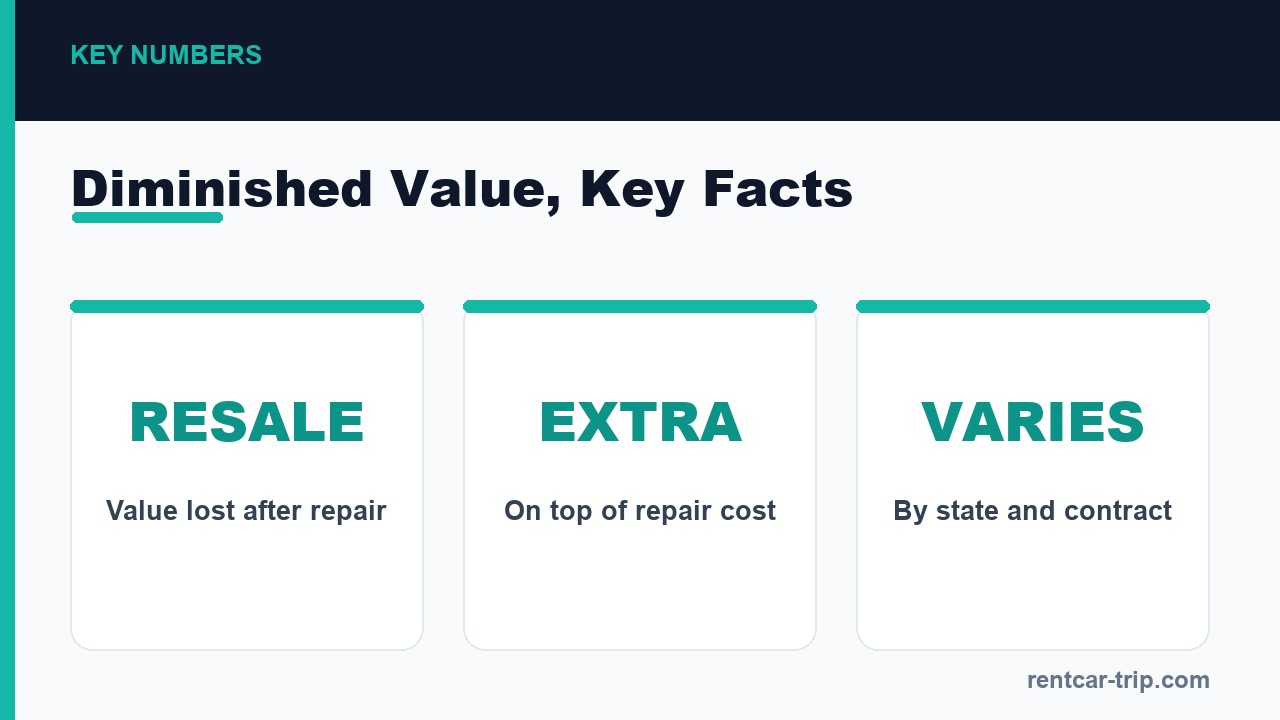
The critical takeaway is that these stack. A renter can face repair, plus diminished value, plus loss of use, plus an administrative fee, all from one fender bender. Read every line, because each one has its own rules and its own weak points for a dispute.
How the Charge Is Calculated and Who Pays
Conceptually, diminished value is the vehicle’s market value just before the damage minus its market value after repair, as a reasonable buyer would judge it. Many rental companies, however, do not calculate it that carefully. Some apply a rough internal formula or a flat percentage rather than a defensible market valuation, which is exactly where many charges fall apart under scrutiny.
Coverage depends on fault and on what you bought:
- CDW/LDW at the counter: A valid waiver typically transfers responsibility for damage, including diminished value, back to the rental company, as long as you did not void it (for example, by reckless driving, driving on unpaved roads, or letting an unauthorized driver take the wheel).
- Your own auto insurance: The III notes that in most states a standard collision policy excludes diminished value when you are the at-fault driver, so your insurer may pay the repair but not this charge.
- Credit card rental coverage: Card benefits commonly cover collision damage but often exclude diminished value, and may exclude loss of use and administrative fees. Coverage is also frequently secondary, kicking in after your own policy. Always read your card’s benefits guide.
Because insurance is state regulated, both the validity and the limits of these charges shift across state lines. According to industry subrogation guides, most states leave the question to the rental contract, so the charges are recoverable if the agreement clearly provides for them. But a number of states — California, New York, and Wisconsin among them — restrict what a rental company can recover from the renter. New York’s General Business Law, for instance, bars recovery of loss-of-use and related administrative fees from authorized drivers, and a New York Department of Financial Services opinion has addressed diminution of value and administrative fees in the rental context. Importantly, these renter protections often do not shield a third-party at-fault driver, who may still owe the full amount. When in doubt, treat the charge as negotiable until the company proves otherwise.
Common Mistakes To Avoid
- Paying the bill immediately without asking whether your state even allows the rental company to recover diminished value from a renter.
- Assuming your personal auto policy covers it; most exclude diminished value when you are the at-fault driver.
- Skipping the CDW at the counter and then discovering your card explicitly excludes diminished value and administrative fees.
- Failing to photograph the car at pickup and return, which leaves you unable to dispute the scope or cause of the damage.
- Accepting a round-number “diminished value” figure without demanding a written, market-based valuation.
- Ignoring the claim until it goes to collections, where it can hit your credit before you ever contest it.
- Voiding your waiver through off-road driving, an unlisted driver, or a contract breach, which can wipe out coverage you paid for.
The State-Law Landscape: Why Rental Diminished Value Is Contested
Whether a rental company can actually make a diminished-value charge stick depends on two separate questions: what its rental contract can lawfully impose on you (the authorized driver), and what an insurer must pay if it steps in to indemnify you. These are governed by different bodies of law, and the answer varies by state. In New York, for example, the Department of Financial Services (DFS, formerly the Insurance Department) has issued advisory opinions distinguishing the two, and the treatment of diminution of value itself is not squarely settled.
| Official source | Jurisdiction / scope | What it addresses for rental diminished value | Status |
|---|---|---|---|
| NY DFS OGC Opinion No. 03-12-14 (Dec 11, 2003) | New York — charges against an authorized driver | Recovery of rental damage from an authorized driver is governed by the General Business Law and the rental contract, not the Insurance Law. Under GBL § 396-z, loss-of-use damages and related administrative fees “shall not be recovered from authorized drivers.” The opinion does not separately resolve diminution of value. | Advisory opinion |
| NY DFS OGC Opinion No. 06-11-22 (Nov 22, 2006) | New York policy, out-of-state (Florida) rental | If an insurer chooses to indemnify its insured, it must cover the insured’s obligations — including diminution of value and administrative fees — but only if the rental company is entitled to recover those items under the law of the state where the rental occurred. | Advisory opinion |
| NY General Business Law § 396-z | New York — statutory | Limits what a rental company may charge an authorized driver for vehicle damage and blocks recovery of loss-of-use and administrative fees directly from that driver. | Statute |
| Chlopek v. Schmall, 396 N.W.2d 103 (Neb. 1986) | Nebraska — general (owner) third-party claims | Where a vehicle is repaired to substantially its pre-accident condition, the measure of damages is repair cost plus loss of use; widely read as leaving Nebraska the outlier state where post-repair diminished value is generally not separately recoverable. | Case law; exact scope debated |
The practical takeaway: a rental diminished-value charge is not automatically enforceable. It typically turns on the rental contract, the state whose law governs (often where the rental occurred, per the New York opinion above), and whether that state generally recognizes post-repair diminished value at all. Because these opinions are advisory and the case law is state-specific and contested, confirm the rule for your jurisdiction — ideally with a licensed attorney in the relevant state — before paying or disputing.
How Rental Diminished Value Is Actually Calculated: Appraisal vs. Formula
Conceptually, diminished value is a market-value measurement, not a repair bill. The defensible measure is the vehicle’s fair market value just before the damage minus its fair market value after a quality repair — a figure supported by comparable sales for the same year, make, model, mileage, and condition. In practice, though, insurers and rental fleets often substitute shortcuts, and the numbers those shortcuts produce can differ sharply from a market-based appraisal.
| Method | How the loss is derived | Typical use and limitations |
|---|---|---|
| Appraisal-based (market comparison) | Pre-accident fair market value minus post-repair fair market value, evidenced by comparable-sales data and, often, an independent (frequently USPAP-compliant) appraisal. | Generally treated as the most defensible measure of true loss and as proof of loss in a dispute; requires an actual valuation rather than a flat rule. |
| Insurer “17c” formula | Starts at a base capped at 10% of the pre-loss value, then multiplies by a damage-severity modifier (0 to 1.00) and a mileage modifier (0 to 1.00). | Originated as a class-action settlement shortcut in Georgia (State Farm Mutual Automobile Insurance Co. v. Mabry, Ga. 2001) and became widely used by insurers; criticized for understating real-world loss and is not a binding legal standard. |
| Repair-cost proxy / flat percentage | A rough internal percentage of the repair cost or of the vehicle’s value. | Easy to apply but not market-based; diminished value is conceptually distinct from repair cost, so this method can over- or under-state the true figure. |
If you are billed a diminished-value amount, ask for a written breakdown of the method used. A charge derived from a flat percentage or the 17c formula is not the same as a market-based appraisal, and an independent appraisal comparing pre-accident and post-repair market value is the standard way to test — or rebut — the number.
As of July 2026, verify current terms. Statutes, regulatory opinions, case law, and rental-contract provisions change and vary by state; the sources above are advisory or state-specific, so confirm the current rule for your jurisdiction and rental agreement (and consult a licensed attorney for an actual claim) before relying on any figure or paying a charge.
Sources verified for this section: dfs.ny.gov, dfs.ny.gov, dfs.ny.gov, en.wikipedia.org, mwl-law.com, courtlistener.com, law.justia.com
Frequently Asked Questions
Can a rental company legally charge me diminished value?
Often yes, because most rental contracts make you liable for the car’s full loss, not just repairs. However, validity depends on your state’s laws and the exact contract clause. Some states limit or bar recovery of diminished value, loss of use, and administrative fees from the renter, so confirm your state’s rules before paying anything.
Is diminished value the same as the repair cost?
No. Repair cost is what it takes to physically fix the car, while diminished value is the resale worth the car loses even after a perfect repair. They are separate charges and can appear together on the same claim, which is why a single accident can produce a bill far larger than the repair invoice alone.
Will my CDW or LDW cover diminished value?
A valid Collision Damage Waiver or Loss Damage Waiver typically removes your liability for damage, including diminished value, if you did not void it. Waivers are commonly voided by reckless driving, unauthorized drivers, or off-road use. Read the conditions carefully, because one breach can leave you owing the full charge.
Does my credit card cover rental diminished value?
Usually not. Most credit card rental benefits cover collision and theft but exclude diminished value, and sometimes loss of use and administrative fees too. Coverage varies by card network and card tier and is often secondary, so always read your card’s benefits guide before declining the counter waiver and relying on the card.
How do I dispute a diminished value charge?
Request the repair invoice, before-and-after photos, a written market-based valuation, and the specific contract clause authorizing the charge. Then check whether your state limits such recovery from renters. If the valuation is just a flat percentage with no market basis, challenge it in writing and ask the company to substantiate the figure.
What happens if I refuse to pay?
The rental company may send the claim to a collection agency, which can report the unpaid amount and damage your credit. That said, refusing while you actively dispute, with documentation and written communication, is different from ignoring the bill. Contest it promptly and in writing rather than letting it silently escalate to collections.
Official and Primary Sources Used
- Source – FTC guidance on rental car insurance, waivers, and what coverage you may already have.
- Source – Insurance Information Institute explanation of diminished value, at-fault exclusion, and state-by-state coverage.
- Source – Insurance Information Institute on rental coverage, loss of use, and credit card coverage limits.
- Source – New York Department of Financial Services opinion on rental vehicle diminution of value and administrative fees, an example of state-level regulation.