If you returned a rental with a scratch and later got a bill with a confusing extra line item, you are not alone. A rental car administrative fee is a separate charge the rental company adds for the work of processing your damage claim, on top of the actual repair cost. This guide explains why it appears, what amounts are typical, and exactly how to question or dispute it.
Quick Answer
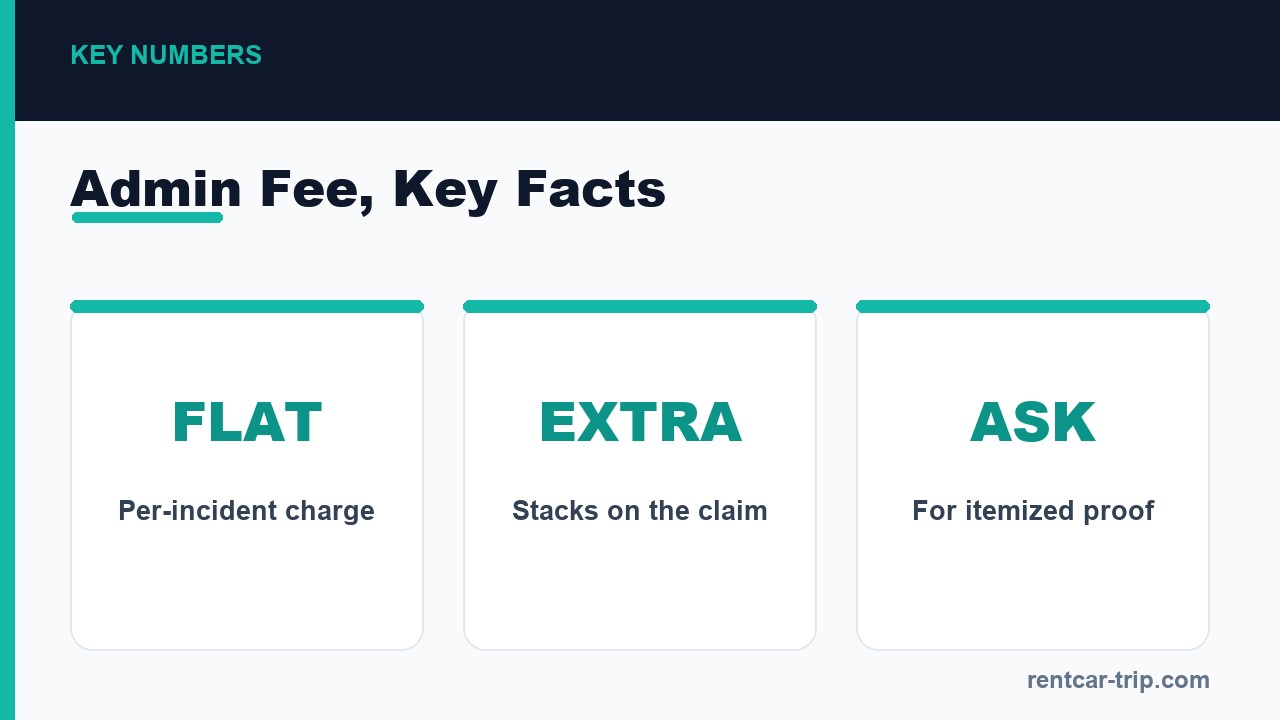
A rental car administrative fee is a flat, per-incident processing charge the rental company bills to cover the staff time and overhead of opening and managing your damage claim. It is distinct from the repair invoice and from loss-of-use charges, and it can usually be questioned or disputed if it is undocumented or barred by your state’s law.
- It is a per-claim fee, not a per-day charge, and is often a fixed amount or a percentage of the repair.
- It can appear even if a credit card or insurer pays for the actual repairs.
- Several states limit or prohibit administrative and loss-of-use fees from being charged to renters.
- The rental company must show the contract language and documentation that supports the fee.
- Your credit card or personal auto policy may reimburse it, but coverage varies by card and policy.
Last Checked
This guide was last checked on June 28, 2026. Charges and dispute rights vary by company, state, and rental terms, so confirm your own agreement.
What the Administrative Fee Actually Pays For
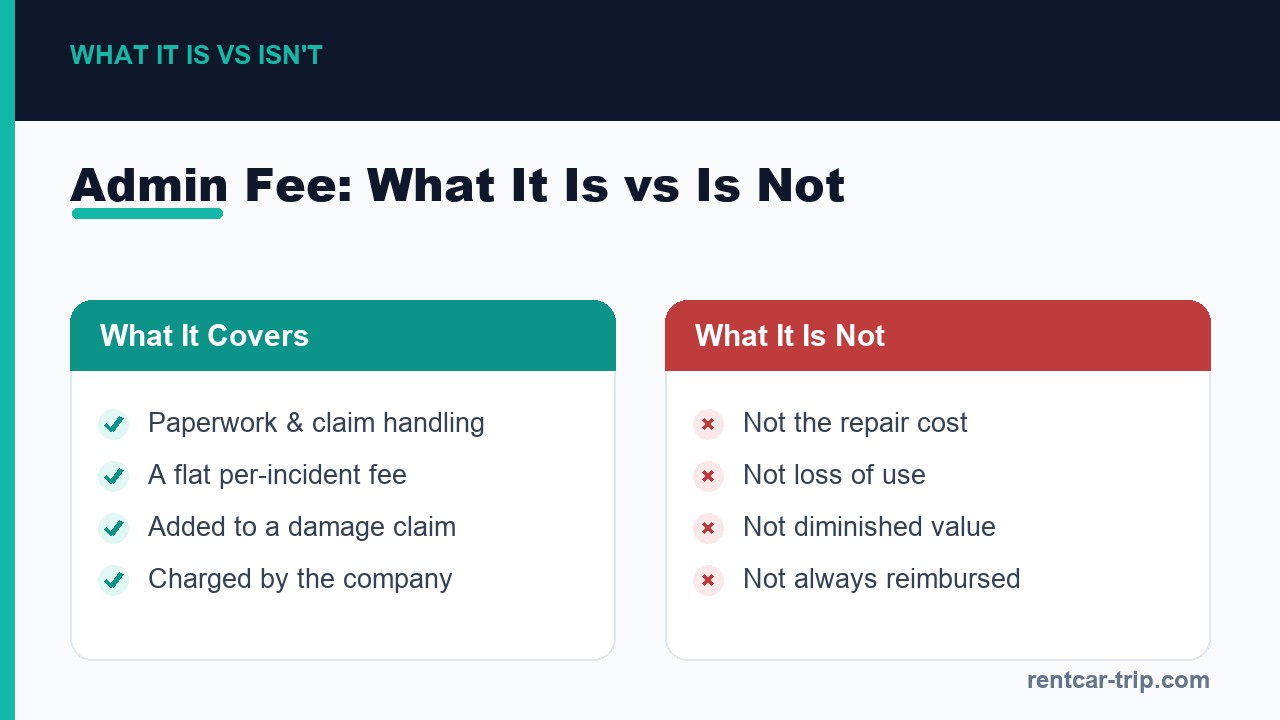
When you damage a rental car, the company does more than fix the bumper. Someone has to open a claim file, photograph the damage, request and review repair estimates, coordinate with a body shop, and pursue payment from you, your insurer, or your card. The administrative fee is meant to cover that handling work as a single, flat charge per incident.
The fee is conceptually separate from two other charges that often appear on the same claim. The repair cost is the price of the physical fix. Loss of use is the income the company says it lost while the car sat in the shop. The administrative fee covers neither of those; it covers the paperwork and coordination. Because all three can stack, a minor scuff can generate a repair invoice, a loss-of-use line, and an administrative fee at the same time.
One detail surprises many renters: the administrative fee can be billed even when you do not personally pay for the repair. If your credit card benefit or insurer covers the repair, the rental company may still pursue the administrative fee directly from you, depending on the contract wording and the coverage you bought at the counter.
Typical Amounts and How the Fee Is Calculated
There is no single national rate, and amounts vary widely by company and rental agreement. Some companies use a flat dollar figure per claim, while others scale the fee as a percentage of the repair total, sometimes with a minimum and a cap. The only reliable source for your number is your own rental agreement and the claim letter you receive.
The table below shows how the common charges differ. Treat the descriptions as general patterns, not fixed prices, and verify every figure against your paperwork.
| Charge | What it covers | How it is usually set | Can you question it? |
|---|---|---|---|
| Administrative fee | Staff time to process the claim file | Flat amount or a percentage of repairs, per incident | Yes, if undocumented or barred by state law |
| Repair cost | The physical fix to the vehicle | Itemized estimate or paid invoice | Yes, request the itemized invoice |
| Loss of use | Lost rental income during repair | Daily rate times days out of service | Yes, request the repair timeline |
| Diminished value | Drop in the car’s resale value | Appraisal or formula | Yes, request the valuation method |
Your State May Limit or Ban the Fee
Whether the company can collect an administrative fee from you depends heavily on your rental contract and on the law of the state where you rented. In many states there is no special rule, so the rental agreement governs, and a clearly written fee is generally enforceable. The right to charge it must still be spelled out in writing in the contract.
Other states restrict or prohibit these charges. New York and Wisconsin, for example, have rules that limit a rental company’s ability to recover loss-of-use and related administrative fees from authorized drivers. Several other states, including California, Illinois, Indiana, Iowa, Missouri, Nevada and Utah, have special laws governing loss-of-use recovery. The takeaway is simple: do not assume the fee is automatically valid. Check both your agreement and your state’s rules before you pay.
How to Question or Dispute the Fee
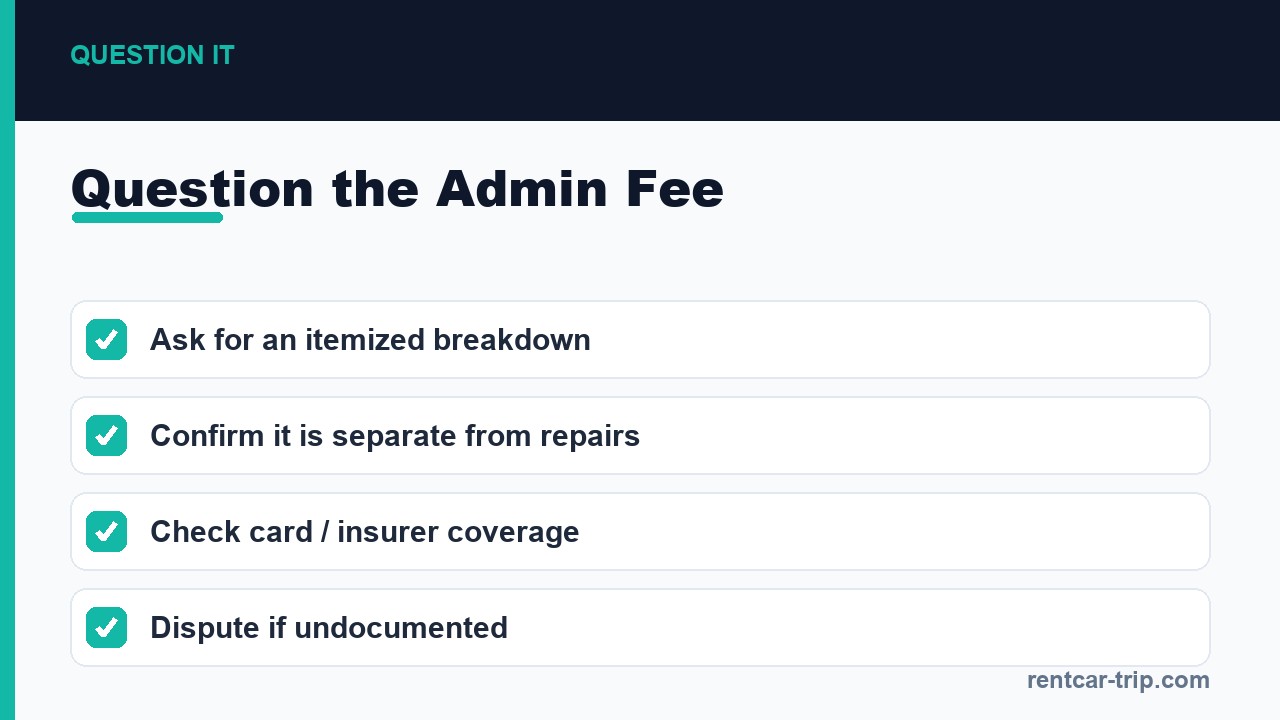
Disputing is not about arguing on principle; it is about checking whether the charge is documented and allowed. Put requests in writing and keep copies. Start by asking the company to support each line of the claim:
- Ask for the rental agreement language that authorizes an administrative fee, quoted by section.
- Request the itemized repair estimate and the final paid invoice, with dates, labor, parts, and shop details.
- Request a repair timeline showing inspection, shop intake, repair start and finish, and return-to-fleet dates.
- Ask, in writing, how the administrative fee amount was calculated and what work it represents.
- Check your credit card benefit and personal auto policy, since one of them may reimburse the fee.
The burden of proof sits with the rental company. A blurry photo and a round-number fee are not enough; the company must show that you are responsible and that the charge is supported. If it cannot substantiate the fee, or if your state bars it, say so in writing and ask for it to be removed. If the company refuses without justification, you can escalate to your state’s attorney general, your state insurance department, or the FTC, which uses complaints to spot patterns even when it does not resolve individual disputes.
Common Mistakes To Avoid
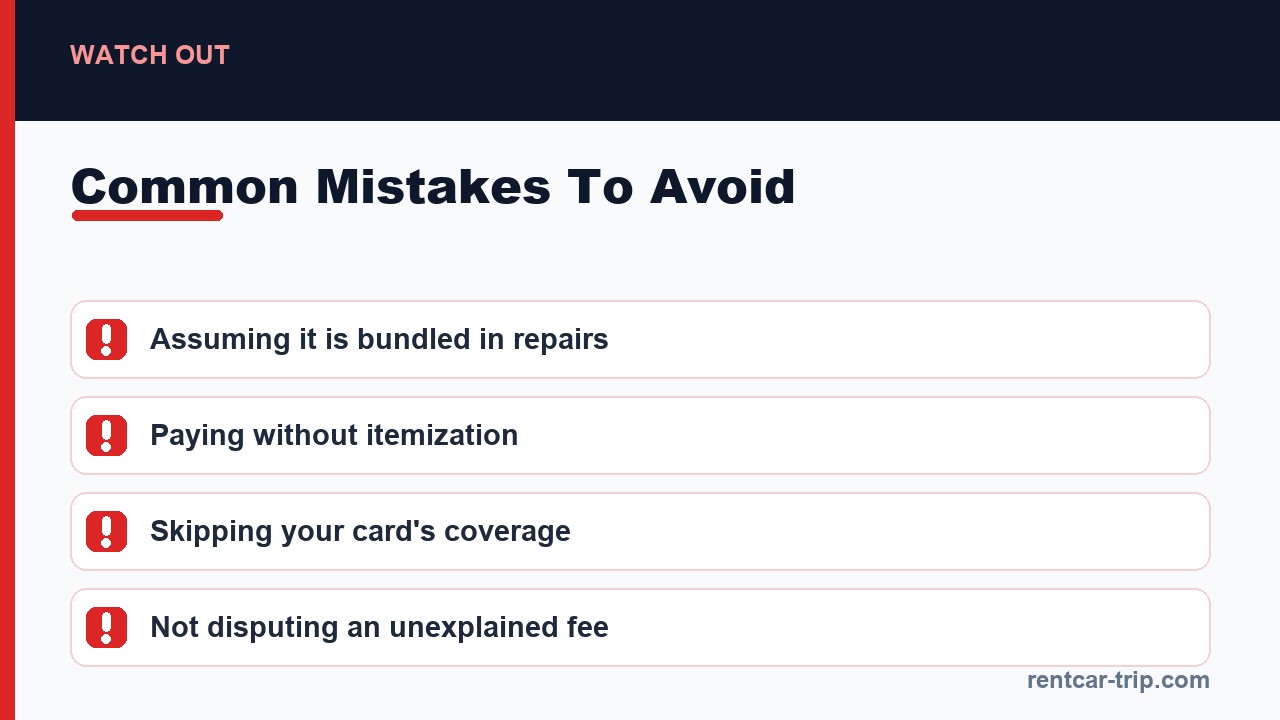
- Paying the full claim immediately without first requesting itemized documentation for each charge.
- Assuming the administrative fee is illegal everywhere, when in many states a written, disclosed fee is enforceable.
- Assuming the fee is automatically valid, when your state may limit or ban it entirely.
- Forgetting to check your credit card benefit or auto policy, which may reimburse the administrative fee.
- Disputing only over the phone and keeping no written record of what was requested or promised.
- Skipping pickup and return photos, which makes it far harder to challenge alleged damage later.
How the major rental brands itemize a damage bill after a claim
Once a damage claim is opened, the big rental groups do not send a single lump sum. They route the file to a dedicated claims unit and typically break the bill into separate line items, so the administrative (or “processing”) fee sits on its own line, apart from the physical repair cost. That fee covers the staff labor of opening, documenting and collecting the claim, which is why it can still appear even when your own insurer or a credit card benefit covers the repair itself (many credit card collision benefits explicitly exclude administrative and loss-of-use fees). As of July 2026, here is how the three main brand families describe the process on their own claims pages.
| Brand family (parent) | Who handles the damage claim | Line items you may see itemized | Official reference |
|---|---|---|---|
| Enterprise, National, Alamo (Enterprise Mobility) | Damage Recovery Unit (DRU); incident first reported to the branch or Roadside Assistance | Repair cost; administrative fee; loss of use; diminishment of value; towing, storage and other recovery costs | Enterprise “accident in a rental car” FAQ; Enterprise DRU payments help article |
| Avis, Budget (Avis Budget Group) | Third-party administrators named on your paperwork (Fleet Response, Viking Client Services) and an assigned adjuster | Repair cost; administrative fee for claim processing; loss of use; diminished value where the vehicle is sold in damaged condition (per rental agreement) | Avis Claims & Accident FAQ; Budget Rental Car Accident FAQ |
| Hertz, Dollar, Thrifty | Internal claims / First Notice of Loss; reported through the online Vehicle Incident Report (VIR) | Repair cost; administrative or processing fee; daily loss-of-use fee; diminished value in some cases | Hertz Accident & Damage support hub; Hertz Vehicle Incident Report |
Two cautions on reading this table. First, a brand’s public FAQ does not always spell out every line item; diminished value, towing and storage more often appear only in the rental agreement and on the actual claim letter, so treat the letter (not the website) as the authoritative itemization for your case. Second, whether each item is enforceable against you varies by the state where you rented — several states, including California and New York, restrict or bar recovery of loss of use and related fees from a renter — so verify the rules that apply before you pay.
How to request the itemized breakdown from each brand
Because the administrative fee is a distinct charge from the repair, you are entitled to ask each line to be justified separately. In practice, request the repair estimate and final paid invoice, the vehicle’s out-of-service dates, the daily rate used for loss of use (and, for loss of use, the fleet utilization records), and the basis for the administrative fee. Each group channels these requests through the claims unit or adjuster named on your documentation rather than the front-desk rental branch.
| Brand family | Where the claim is documented | How to request the itemized breakdown |
|---|---|---|
| Enterprise, National, Alamo | Enterprise “accident in a rental car” FAQ; the DRU claim letter you receive | Contact the Damage Recovery Unit listed on your claim and ask, in writing, for the repair estimate and a fully itemized statement of every fee |
| Avis, Budget | Avis Claims & Accident FAQ; Budget Rental Car Accident FAQ | Contact the assigned third-party administrator or adjuster named on your claim documentation and request the itemized invoice and supporting proof for each charge |
| Hertz, Dollar, Thrifty | Hertz Accident & Damage support hub; Vehicle Incident Report record | Hertz’s Vehicle Incident Report provides that, upon request of the authorized driver or their insurer, Hertz will supply a copy of its estimate of the repair cost; ask the same for loss of use and the processing fee |
As of July 2026, verify current terms directly on each brand’s claims page before acting, since fee structures, third-party administrators and contact channels change over time. The figures and formulas are set by your specific rental agreement and by the law of the state where you rented, so treat the amounts on your own claim letter as controlling rather than any general description.
Sources verified for this section: enterprise.com, ehi1425.zendesk.com, avis.com, avis.com, budget.com, hertz.com, dvir.hertz.com, images.hertz.com, alamo.com, budget.com
Frequently Asked Questions
Is a rental car administrative fee the same as loss of use?
No. They are two separate charges that often appear on the same claim. The administrative fee covers the staff time to process and manage your damage claim, billed once per incident. Loss of use covers the rental income the company says it lost while the car was out of service for repairs, usually calculated as a daily rate times the number of days the vehicle was unavailable.
Can the company charge an administrative fee if my credit card paid for the repair?
Often, yes. Many rental agreements let the company pursue the administrative fee directly from the renter even when a credit card benefit or insurer covers the actual repair cost. Whether it sticks depends on your contract wording and your state’s law. Check whether your card benefit or auto policy will also reimburse the administrative fee, since some do and some exclude it.
How much is a typical administrative fee?
There is no national standard, and amounts vary by company and agreement. Some firms charge a flat figure per claim; others apply a percentage of the repair total, sometimes with a minimum and a cap. Your rental agreement and damage-claim letter are the only reliable sources for your specific number, so read both rather than relying on a general estimate.
Can I refuse to pay the administrative fee?
You can dispute it, and in some states you may not legally owe it. Start by requesting the contract language and documentation that support the charge. If the fee is undocumented, miscalculated, or barred by your state’s law, put your objection in writing and ask for removal. If the company cannot justify it, escalate to your state attorney general, insurance department, or the FTC.
Which states limit rental car administrative or loss-of-use fees?
Several states regulate these charges, including New York, Wisconsin, California, Illinois, Indiana, Iowa, Missouri, Nevada and Utah. Rules differ by state, and some restrict loss of use while treating administrative fees separately. Because laws change and details vary, confirm the current rule with your state’s attorney general or insurance department before you pay or dispute a charge.
What documents should I request when I dispute a fee?
Request four things in writing: the rental agreement section that authorizes the administrative fee, the itemized repair estimate, the final paid repair invoice, and a repair timeline with dates. Together these show whether the charges are documented and consistent. If the company cannot produce them, that weakness strengthens your dispute and supports asking for the fee to be removed.
Official and Primary Sources Used
- Source – FTC consumer guidance on rental car waivers, existing coverage, and damage charges.
- Source – Insurance Information Institute explanation of loss of use and administrative fees under an LDW.
- Source – New York Department of Financial Services, a state authority on insurer and rental fee recovery rules.
- Source – FTC reporting portal for escalating deceptive or undocumented rental charges.